A few weeks ago, no one was talking about YouTube’s ad network. Some ad buyers didn’t even know that the product, called Google Video Partners (GVP), existed.
But it’s squarely on their radar now, thanks to a recent report published by independent research firm Adalytics. It found that the majority of ad spend against TrueView placements on GVP inventory appears in low-quality, auto-play, sound-off environments. (TrueView is YouTube’s proprietary cost-per-view ad unit.)
According to Integral Ad Science, however, GVP’s existence was never a secret.
The IAS reporting dashboard includes information about the number of impressions served against GVP inventory. IAS has offered viewability and invalid traffic measurement for GVP since 2016, although there wasn’t a tool for measuring brand safety and suitability.

Safety and suitability
Which put IAS in an awkward spot, since many advertisers do feel hoodwinked by YouTube.
“I was a bit surprised that advertisers were surprised,” said Craig Ziegler, SVP of product management at IAS. “Advertisers were aware enough of GVP to demand more transparency from us, which is something we’ve been working on.”
Ziegler is referring to a new capability that IAS added to its media quality offering on Friday to measure brand safety and suitability for off-YouTube sites and apps through GVP. (DoubleVerify, Google’s other brand safety partner, doesn’t yet have an analogous tool.)
“This is a progression of our joint road map,” Ziegler said. “Since the beginning of our partnership with Google, we’ve continuously evolved our measurement capabilities and expanded the types of inventory and placements we measure.”
The offering, which was in beta for the past few months, analyzes any video ads, including TrueView, that extend to the GVP network.
Google signals to IAS whether an ad is served on a GVP app or site, he said. Campaign delivery data is then shared with IAS through Ads Data Hub (ADH), Google’s cloud-based ad server data repository.
From there, IAS uses natural language processing to assess the content for brand safety and suitability based on the framework created by the Global Alliance for Responsible Media (GARM), which sets standard definitions for high-, medium- and low-risk content.
IAS, however, does not suggest that Google remove publishers from GVP. If advertisers don’t like what they see, Ziegler said they can take action to exclude specific sites or apps from their campaigns.
“This is about transparency,” Ziegler said. “Marketers make the decision themselves whether something is OK for their brand.”
Work in progress
But there are still open questions about the value of GVP and how it’s measured.
According to IAS, only 3.4% of TrueView impressions run on GVP inventory, while 7% of overall video placements include GVP inventory. DoubleVerify says GVP represents 3% of its monitored impressions.
The Adalytics report, meanwhile, found somewhere between 50% and 90% of TrueView skippable in-stream budgets were being served on GVP rather than YouTube O&O.
It’s difficult to reconcile these numbers.
“All I can comment on is the data we put out there,” Ziegler said. “That’s the data we see.”
The MRC question
But what about ads that could be seen but not heard?
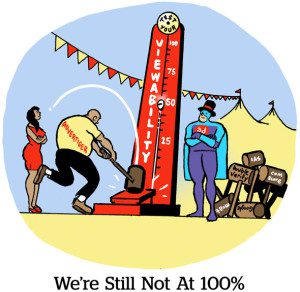
One of the main issues Adalytics uncovered is that many TrueView ads served via GVP were muted, outstream ad formats. Although IAS rates GVP for viewability, it doesn’t yet measure for audibility. It’s on the road map.
“We’re expanding into other types of measurements,” Ziegler said, “audibility being one of them.”
It’s important to note, however, that none of these offerings are accredited by the Media Rating Council, and there is still fuzziness about what it means to offer independent third-party measurement in this context.
Although Google has MRC accreditation for first-party data collection and transmission with third parties through ADH, the review doesn’t extend to inventory off YouTube. No third-party measurement provider has MRC accreditation for GVP.
The MRC is aware that third-party vendors have started receiving GVP data from Google. Its expectation, said Ron Pinelli, SVP of digital research and standards, is that any GVP data shared through ADH “is segregated and disclaimed as unaccredited.”
“We are working to confirm this,” Pinelli said. “We do not consider this third-party direct independent measurement and note it on our site as third-party reporting and in our accreditation letters as independent third-party calculation and reporting.”
An IAS spokesperson is not planning to pursue MRC accreditation for GVP measurement at this time, but the company is “evaluating our options.”