
What’s On The Agenda For Michael Komasinski, Criteo’s New Chief?
Michael Komasinski, Criteo’s newly-minted CEO, shares his vision for the company – and swears that Criteo doesn’t regret its huge investment in testing the Chrome Privacy Sandbox.

Michael Komasinski, Criteo’s newly-minted CEO, shares his vision for the company – and swears that Criteo doesn’t regret its huge investment in testing the Chrome Privacy Sandbox.

As AI agents begin to mediate everything from search to purchase, marketers are being forced to confront the reality that they must treat machines as customers.
YouTube is winning the CTV race by not just focusing on TV; ads threaten the gen AI user experience; and sports still brings brands incremental reach.

Amazon is integrating into Prebid. What does this mean for publishers? Plus, are Amazon and Google diverging in their product focus?

Ad spending across RMNs and CMNs is still hindered by incomplete data access and connectivity. Here’s how to bridge that gap.
Sports sponsorships can play well for small brands; Perplexity was first to AI search ads, but advertisers waited for Google; and GroupM officially rebrands to WPP Media.
Magnite’s SpringServe deal illustrates why SSPs need a video ad server; Google grapples with AI search’s impact on publisher traffic; and Anthropic’s AI assistant is a law enforcement snitch.

Although furniture brand James & James was hitting its own aggressive revenue targets while primarily spending on search and social ads – the facts told a different story.

Former Goodway Group CEO Jay Friedman shares hot takes on everything from curation (“absurd”) to brand safety (“botched”).

OMD’s Emily Proctor outlined the criteria the ad agency uses to evaluate alt IDs. She also shared which five IDs OMD uses most often and why.
TV dealmaking has shifted to “always-on” models; “activation” is a classic bit of ad jargon; ChatGPT is sending more traffic to publisher.

Microsoft’s AI assistant, Copilot, is a product of trial and error. Past mistakes paved the way for today’s iteration which has led to performance improvements and increased customer trust.

PubMatic’s new AI curation features are helping it forge closer relationships with ad agencies like GroupM that are ramping up their use of AI.
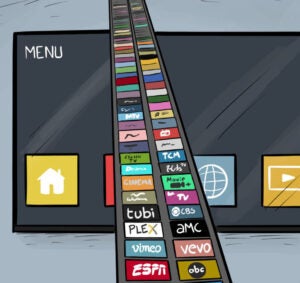
Amazon Prime Video rolls out new audience and contextual targeting; streamers wring more revenue from subscription-weary consumers; and AI is an app, so it must obey Google and Apple.
Google and Amazon compete for people’s time and wallets, and for advertisers’ budgets. And on Wednesday, they both kicked off their marketing industry conferences and announced a round of big ad tech news.

We’re seeing the worst possible outcomes with the CPM-based buying approach. And Google’s recent decision to hang on to cookies indefinitely risks perpetuating the worst parts of the digital ad business.

Perplexity is thirsty for revenue streams; Marketecture’s media biz grows; and Duolingo goes dark on social after its AI pivot.

The era of fragmented, adversarial ad tech is winding down. A new paradigm is emerging defined by AI-first, end-to-end platforms and collaboration among buyers and sellers.

Google’s DV360 adding attention as optimization signal could finally help wean buyers and platforms off bidding on ad inventory based on viewability.

AirBNB considers introducing ads (just not right now); antitrust enforcement is about more than shrinking Big Tech; and broadcasters want to get the ball rolling on sports again.
Now that all the dust and confetti has settled after the upfronts, negotiations between marketers, agencies, networks and streamers are only just getting started.

Amid the glitz of TV upfront presentations, advertising executives take the stage to talk about things like new audience targeting capabilities or to ballyhoo new ad measurement partnerships. How, though, are we supposed to focus on brand lift statistics when we can all hear Lady Gaga belting a vocal warmup offstage?

Equativ is now blocking made-for-advertising content from all exchange activity, marking a larger trend of pushing to eliminate MFA sites.

Political advertisers, by necessity, have built precise, privacy-conscious targeting strategies that work without relying exclusively on third-party data like cookies.

The CFPB backtracks on plans to bar data brokers from selling financial data; Jamie Lee Curtis takes on Mark Zuckerberg over fake AI ads; and Gas Station TV drives traffic to Applebee’s.

On Wednesday, Microsoft announced that it will shut down Microsoft Invest by March next year, to be replaced by a chatbot-style ad-buying product powered by Copilot.

Marketing On Autopilot Companies that build AI-powered marketing software have been framing the technology as a friendly helper. Nothing to fear here, just an eager “copilot” ready to serve. The AI “copilot” that first comes to mind for most people is Microsoft’s generative AI chatbot of the same name. GitHub, meanwhile, which is owned by […]

The Trade Desk released OpenSincera on Tuesday, a free API integration that posts ad impression data on publishers and tech vendors.
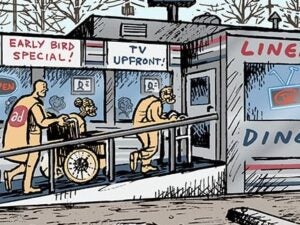
Ever since 2020, TV upfront rates have declined; inconsistent metrics mean inaccurate results; plus, Roblox is touting its strong hold on its viewers’ (er, gamers’) attention.

Contextually relevant pause ads were just one of three new formats that Amazon unveiled in advance of its upfronts presentation on Monday.

People Inc. is offsetting a 50% decline in Google search traffic through off-platform growth and its highest digital revenue gains in five quarters.
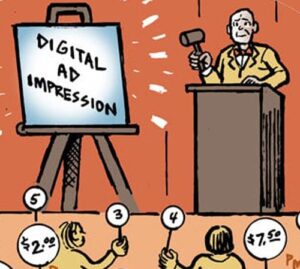
The MRC’s auction transparency standards aren’t intended to force every programmatic platform to use the same auction playbook – but platforms do have to adopt some controversial OpenRTB specs to get certified.

SSPs have mostly either applauded or downplayed the recent crackdown on CTV resellers, but smaller publishers see it as another revenue squeeze.


The IAB unveiled its Project Eidos on Monday, a new program uniting its numerous measurement initiatives under one banner.

To those who knew him, John “JG” Gentry wasn’t just a CEO. He was a colleague who showed up with genuine care and curiosity.

The group that turned header bidding software into an open standard is bringing the same approach to publisher-side AI agents.