 Speculation about Alibaba’s upcoming IPO pegs Yahoo’s share at about $10 billion, giving Yahoo CEO Marissa Mayer substantial firepower to acquire more companies and develop Yahoo’s businesses. But Mayer has an extremely thin margin of error to turn the Sunnyvale, CA company’s fortunes around.
Despite its expected windfall, Yahoo is struggling. Its revenue for 2013 was $4.7 billion, down 6% from the previous year. Display advertising, excluding traffic acquisition costs, was $491 million, down 6% compared to $520 million for Q4 of 2012. And the company has yet to increase its mobile revenue, which Mayer has said is “still not material.”
So who is helping Mayer with Yahoo’s turnaround?
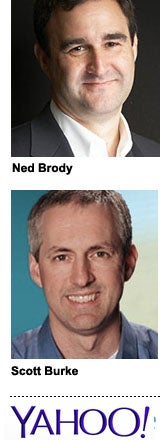
After COO Henrique De Castro was fired early this year after failing to boost the company’s ad business, the task of convincing brands and agencies to spend on Yahoo’s properties fell to a larger degree on head of the Americas Ned Brody and SVP of advertising Scott Burke, among other executives.
Prior to Yahoo, Brody was rising up the ranks at AOL. He managed AOL’s paid services group before being promoted to COO of media, advertising and commerce. Brody eventually became CEO of AOL Networks (formerly Advertising.com Group and now AOL Platforms) where he oversaw AOL’s owned and operated advertising, global network business, sales and advertising and publishing products.

Brody declined to comment for this article, but according to former colleagues, he is known for being “analytic” and “strategic. ”
“I remember Ned being passionate about AOL’s premium formats and making sure we were capitalizing on the innovation we had brought to market,” said Janet Balis, CRO at Betaworks Studio who worked with Brody as head of sales strategy, marketing and partnerships at AOL. “He’s good at analyzing a situation by the numbers and crafting a product vision … he’s almost militaristic in terms of his focus, which is really effective.”
Rene Rechtman, international president at Maker Studios and former SVP of the international division of AOL’s Networks business, agreed. “Back in the day, Tim Armstrong was all about content,” Rechtman said. “Ned championed advertising, especially programmatic advertising, and got it on AOL’s agenda.”
Brody joined Yahoo in September 2013 and his experience steering AOL toward solutions like the demand-side platform AdLearn Open Platfrom and AOL Marketplace (a supply-side platform) should help Yahoo get its programmatic offerings up to speed.
In December last year, Yahoo reorganized its ad tech system. It folded its real-time bidding platform Right Media into the Yahoo Ad Exchange and expanded the services of its data management software Genome with Yahoo Audience Ads.
It also introduced Yahoo Ad Manager and Ad Manager Plus, which are self-serve campaign tools designed to support the idea of “programmatic direct.” All of its advertising offerings, including sponsorships and native ads, such as marketing under its Tumblr unit, are now housed within the umbrella suite, Yahoo Advertising.
Given that Brody had only recently joined Yahoo at the time, other senior executives like Burke played a larger role in influencing the company’s decisions to restructure its ad tech stack.
Burke, who has been at Yahoo for 8 years primarily in engineering roles, had been thinking about self-service programmatic tools for several years, according to Joel Jones. Jones is a sales planning and operations director at Facebook and was a former VP of ad marketplaces for the Americas at Yahoo, who worked closely with Burke.
“When I heard that Yahoo announced Yahoo Ads Manager Plus, I had this flashback to three years ago when Scott was making the case that we need to provide self-service access to premium inventory, that this is a priority for the company,” Jones said. “And it’s obvious that he’s continued to push those themes and set the direction for Yahoo’s ad platform.”
In addition to positioning itself to capture more programmatic ad dollars, Yahoo must also flesh out its offerings in other spaces, such as mobile advertising.
Yahoo has more than 400 million monthly mobile users, placing it behind Facebook’s 1 billion monthly mobile users, but ahead of Twitter, which has about 241 monthly mobile users.
Yahoo has taken steps to better monetize its mobile users by acquiring AdMovate (a mobile-ad targeter and data-management software provider), Bread (URL shortener and mobile creative company) and Distill (an HR software company whose founder and staff helped build mobile performance-based ad platform TapJoy).
In addition, the company launched Yahoo Gemini, a platform that lets advertisers buy mobile search ads and native ads, like “Stream Ads,” through one marketplace.
Given that brand advertisers have been slow to adopt Yahoo’s native ads—its Stream Ads consist mainly of direct-response ads—aligning native ads with mobile search ads and making it easier to buy them could make both units more desirable.
The impact of Yahoo’s recent changes to its ad offerings remains to be seen, though.
And in terms of telling Yahoo’s story, Burke and Brody have both been described as more analytical thinkers when the company needs more people to build connections with advertisers.
Brody has pushed back against this characterization, telling Ad Age, “There’s been a lot in the press where people looked and sort of said, ‘He doesn’t have 25 years of carrying a bag and selling in the marketplace … I have a background in market research and strategy consulting, in operating as an entrepreneur.”
While Mayer is likely to continue acquiring more companies to bolster the company’s offerings, she and her team must also work on streamlining its ad products and developing stronger advertising relationships.
“Yahoo has two challenges,” said Rechtman. “One is defining the platform—what is Yahoo today? The second is giving advertisers a clear proposition for why they should be on their platform.”