


It would be nice if we never had to hear the word “uncertainty” ever again … but too bad, because Q2 happened, and it wasn’t pretty for ad tech.
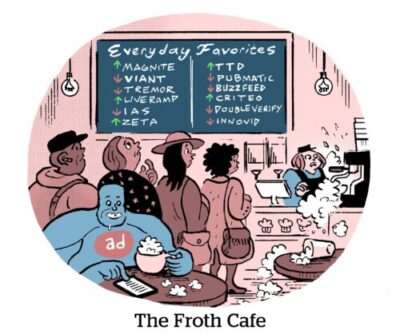
The public ad tech and mar tech stocks tracked by LUMA Partners, which released its Q2 market report last week, fell more than 30% across the board year-to-date as of the end of the second quarter.
Zoom in on ad tech, and roughly one-third of public companies in that cohort were down by 50% or more since the start of the year.
To be fair, ad tech is still up overall relative to pre-pandemic levels, and ad tech stocks were flying a little too close to the sun last year and into Q1. For example, when Magnite bought SpotX in February 2021 in a deal valued at more than $1 billion, Magnite’s stock jumped by more than the value of the deal.

Starting late last year, though, the market began to correct itself, and valuations have mostly come back down to Earth – meaning the Q2 slump is more about external macroeconomic factors.
Of which there are many. Take your pick: a looming recession, supply-chain snafus, the ongoing war in Ukraine, increased interest rates to fight rising inflation.
“You’ve got all of this uncertainty brewing, and that creates a lot of challenges and puts a ton of pressure on valuations and on dealmaking,” said Conor McKenna, a director at LUMA Partners.
Recession ahead (or are we already in one … ???)
And uncertainty is the enemy of M&A, as clearly demonstrated during the second quarter, which was dry as a bone from an ad tech perspective.
There were only a handful of notable ad tech deals in Q2, including OpenWeb’s acquisition of French ad network Adyoulike for $100 million in April and Dreamscape’s acquisition of ad spend tracker Standard Media Index in June. (Dreamscape, a subsidiary of PE firm GTCR, also made a strategic investment in SQAD, a campaign forecasting and analytics company, in April.)
But Q3 should liven up, and there’s already evidence of that happening with Unity’s acquisition of ironSource on Wednesday for $4.4 billion.
 Sellers likely held back during Q2 because they didn’t want to get lowballed as a result of negative market conditions.
“We’re starting to see conversations pick back up now that we’re two quarters into this correction,” McKenna said. “Deals can get done in a low market and deals can get done in a high market; you just need to be comfortable in terms of where we are and then start to assess on those terms.”
Still, there’s always uncertainty (sorry) about what an economic downturn will do to ad budgets. Brands often pull back on advertising and marketing when the going gets tough, because they’re considered discretionary.
But that probably won’t be the case with performance advertising, which marketers seek as a refuge of efficiency during uncertain (sorry) times.
During the 2008 recession, which, granted, was a long time ago – the passage of nearly 15 years might as well be the equivalent of digital dog years considering how much the ecosystem has changed since then – Google “held up well because people needed to spend efficiently,” McKenna said.
“It’s possible that overall spending decreases, but that the shift towards digital and digital’s slice of the pie increases,” he said. “That will be very interesting to see.”
Better days ahead
And although Q2 wasn’t a great quarter for ad tech, there were a few other bright spots.
M&A activity in the digital content sector, for instance, ticked up 15% thanks to gaming and entertainment.
Tech buyout fund acquired a 25% stake in mobile game studio Playtika. German ad software holding company MGI bought game developer AxesInMotion. Social video company ATTN: was acquired by Candle Media. Team Coco, Conan O’Brien’s podcast network, was bought by SiriusXM. Oh, and Elon Musk said he’d buy Twitter or something, maybe.
Closer to home on the ad tech front, however, is Netflix’s plan, first announced in April, to launch ad-supported tiers. (Congrats to Microsoft’s Xandr, by the way.)
Until recently, Netflix looked down its nose at ads, but when subs started to slip, suddenly AVOD didn’t sound like such a bad idea anymore.
And now that Netflix and Disney Plus are both launching ads, that will bring a lot of premium inventory into the connected TV market, which has been relatively supply-constrained.
“This is opening up a ton more inventory in places where people spend a lot of their time,” McKenna said. “It’s hard to imagine that CTV doesn’t have big growth from an advertising perspective as a result.”











