


Pigs have flown and minds are blown. Netflix is considering ads.
“Think of us as quite open to offering even lower prices with advertising as a consumer choice,” Netflix CEO Reed Hastings said during the company’s Q1 earnings call on Tuesday.
Wait, what?
Netflix has long looked down its nose at advertising as a form of monetization. Why change its stance now?
Because Netflix reported a Q1 subscriber net loss for the first time in a decade, and “ads are an excellent way to monetize users,” said John Hamilton, CEO and founder of CTV performance ad platform TVDataNow.
“Netflix has been leaving consumers on the table by not including an ad-supported tier,” he said. “This has been inevitable for years.”

Inevitable, perhaps, but there was no urgency until now. Netflix’s favorite pastime, beyond spending billions of dollars on original content, has been to scoff at new competition it didn’t really consider competition. Netflix considered itself above services like Disney-owned Hulu and Fox-owned Tubi because it stood firm in remaining ad-free.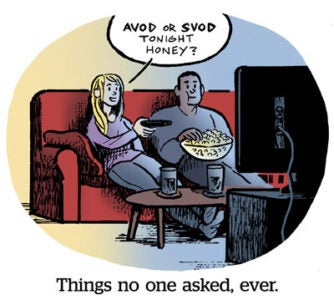
But this quarter’s subscriber drop was a wake-up call.
Sorry, SVOD
Subscriptions have always been Netflix’s main revenue source, but the fact is “advertising-driven video consumption is growing much faster than subscription-based [counterparts],” PubMatic CEO Rajeev Goel told AdExchanger.
If Netflix had a time machine, it might make sense to go back and buy an AVOD service like many of the broadcasters did a couple of years ago. Tubi, for example, which Fox acquired in 2020 right at the start of the pandemic, would have made a great acquisition target for Netflix, Hamilton said.
It was fortuitous timing for Fox. The amount of time that consumers spent online increased dramatically during the pandemic, as did financial sensitivity. Although subscription services like Netflix did make bank in 2020, other subscription-only services like Disney Plus and HBO Max saw the writing on the wall and began to embrace AVOD.
For its part, Netflix has tried just about everything to avoid having to pull the emergency lever on ad revenue.
Since September, Netflix has bought three game development studios, including Boss Fight Entertainment in March, to give consumers a wider array of content and make its subscription offering stickier.
In Netflix’s view, the best user experience is ad-free content.
In addition to its game studio buying spree, Netflix also instituted new policies last month against password sharing in a crackdown on the 100 million people who use logins from their friends or family rather than buying their own. (Sorry, moochers, a global password-sharing crackdown is coming.)
But Netflix has finally run out of options, Hamilton said.
“Our views are a little different because our numbers are a little different,” Hastings said on Tuesday.
“Little” is somewhat of an understatement. Netflix missed its Q1 customer acquisition goal of 2.5 million subscribers – and posted a net subscriber loss of roughly 200,000.
To be fair, Netflix lost 700,000 subscribers when it pulled out of Russia following the invasion of Ukraine, but that loss is only one piece of the puzzle. Having attracted so many subs during the pandemic – what Netflix refers to as “the COVID pull forward” – demand is slowing down.
Although Hastings insists Netflix continues to believe in the “simplicity of subscription” over the “complexity of advertising,” he acknowledges that consumers deserve choice.
And when can we expect this more wallet-friendly tier supported by ads?
According to Hastings, it’ll be a slow roll, with ads phasing in over the next couple of years.
But the bigger question is, what will ads look like on Netflix and how will they be implemented?
Hastings’s reference to the “complexity of advertising” could offer a hint.
What next?
Netflix has already been working directly with brands on product integration and sponsorship deals for years, often sidestepping agencies.
It’s likely that Netflix won’t deviate from that approach.
“We can be a straight publisher and have other people do all the fancy ad-matching and integrate all the data about people,” Hastings said during the investor call.
But even if Netflix starts out basic, it’s going to need some form of new ad infrastructure and the right teams to operate it.
Supporting direct insertion orders or ramping up sponsorship deals is a completely different animal than content production and distribution, Hamilton said.
First, Netflix has to hire a sales team of experts and account managers familiar with the “ins and outs” of selling ads, PubMatic’s Goel said. Then, if it wants to sell programmatically, Netflix will need infrastructure to make its inventory available to count impressions and measure the efficiency of ad targeting. Not to mention needing to figure out pricing, the optimal ad load and frequency capping.
“This is not a simple plug-and-play,” Goel said.
Don’t be surprised if Netflix ends up acquiring an ad tech platform or strikes a close partnership with with an SSP and DSP that can facilitate programmatic auction-based buying, Goel said. (PubMatic has its sights set. Godspeed.)
Netflix is also going to have to answer all of these questions for each country in which it plans to offer AVOD, Goel added, because it has to consider each region’s unique economic situation, customer base and data privacy expectations.
But no matter how Netflix does the deed, it knows it needs ads, and that’s a big change.
“It might be six months before we see an ad on Netflix,” Hamilton said, “but within two years, it’ll become an ad tech company.”






