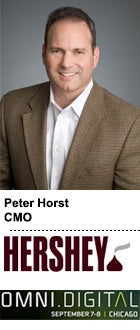
 Peter Horst will speak at AdExchanger’s Omni.Digital conference in Chicago on September 8.
After decades of focus on TV and print advertising, Hershey’s is “in the early stages of a long, judicious process of building out a data operation and translating our brands to a digital mindset,” according to CMO Peter Horst.
AdExchanger spoke with Horst about the confectioner’s transition to ecommerce and omnichannel marketing.
AdExchanger: What’s been your experience undergoing the shift to a multichannel marketing approach?
PETER HORST: The company was on the later side getting heavily into multichannel. It had been using a very effective TV model, but consumer eyeballs were moving in droves to new screens. The investments in digital ramped up pretty quickly – from double digits to around 30% practically overnight – but we had advantages too from not having moved first. It’s a benefit to have the perspective of others and be able to avoid potholes they’ve stumbled across.

What are some of the advantages to having been an “adopter” and not a “first mover”?
Well, we avoided top-down, overly ambitious declarations of how much money to move from broadcast to digital, which I think has pushed some past where they’d like to be and forced them to retrench.
Another learning from others is not moving too aggressively to invest in technology early on. Sometimes there are capabilities you’d like to have in-house or tech that seems like a good fit, but the pace of change means that down the road you may have an expensive bunch of hardware that isn’t serving you.
We only half-jokingly say we’re a chocolate company in central Pennsylvania. We’re not going to become an ad tech powerhouse overnight and build a programmatic engine. Something can be critical and also require gradual steps. Being judicious about what’s right to buy or build ourselves and what we should leverage partners for is important.
How is ecommerce changing your marketing strategy?
Our ecommerce business is growing substantially, but is still a small part of our overall business. There are some things that are just structurally difficult for us there: If you order a chocolate bar in July, it doesn’t matter how fast delivery is; it probably won’t be a nice package to unwrap. Ecommerce at the moment is not tremendously oriented to impulse categories, but we want to be leaders in that category since it’s where the world is going. So we’re deep into a working relationship with Amazon.
For us it’s not about brand-to-channel, but brand-to-segment or marketing objective. Hershey and Reese’s, both iconic, historic brands with billion-dollar-plus scope, have a ton of digital activation, but tone, feel and targeting are very different than a Jolly Rancher. [Editor’s note: For example, Jolly Rancher will turn out quick, youthful animated clips to put spend behind, while Hershey’s invests huge bucks in a video as part of its sponsorships of the Olympics and US gold medal gymnast Simone Biles.]
You talked about consumer eyeballs disappearing from broadcast and print. Does digital make up for that lost reach?
It comes down to the nature of the business and the scale we need to achieve. Some digital channels have become very effective ways to get broad reach, and others are more naturally about narrow targeting. We need to be smart about the targeting versus the reach we practically need in order to move a business. We can get brilliantly creative about red-haired, left-handed people in Ohio who maybe love our product, but that won’t move the business.
Some others went hard into laser targeting before realizing there aren’t enough people in that beam to drive the bottom line or justify the premium they were paying for the targeting. [Editor’s note: Relatedly, the CPG giant P&G announced earlier this week it will scale back targeted Facebook ad spending due to similar concerns.]