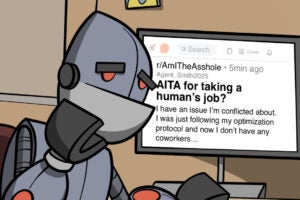
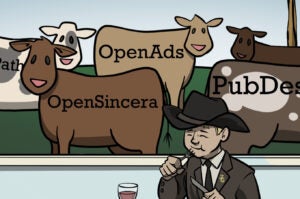
When one hears “agent” these days, one automatically thinks “AI” – but that’s not what this story is about. This is a story about how agencies are losing what makes them agents – as in, putting the interests of their clients first.
Ad agency holding companies are among the most adaptable businesses out there. In recent years, holdcos like Publicis, WPP and Omnicom-IPG have stretched our notions of what an agency business even is exactly.
For example, holdcos have acquired consultancy practices, which are a natural add-on for managed service-minded businesses. They’ve also added subscription software, marketplace data sales, ad tech CPM fees and other revenue lines. These new business models can strain the relationships between big agencies and their clients.
But nowhere is that strain more pronounced than with principal-based buying, which is now a fast-growing, multibillion-dollar revenue stream for holdcos.

Rebates: Same as it ever was
It’s been almost 10 years since the Association of National Advertisers and auditing firm K2 Intelligence published a bombshell report on agency rebate practices. The report documented agencies collecting cash kickbacks from big media sellers based on spend volume – but those refunds didn’t make it back to clients.
Although the report felt explosive at the time, the same thing could be published today and be equally true. If anything, the practices described by the ANA in 2016 have become almost acceptable. Direct rebates remain prohibited in the US, as they were a decade ago, but are commonplace elsewhere, including Europe.
Agencies have simply gotten craftier, recreating rebate economics through principal-based trading and other forms of ad credit allocation that skirt the rules.
Why now?
But if media rebate practices aren’t new, why is this boiling over again in 2026?
A few notable things happened.
First, a former WPP agency leader named Richard Foster filed a wrongful termination lawsuit alleging he was let go last year after raising objections to the holdco’s media rebate practices. WPP’s counter-filing made public a 2024 memo penned by Foster revealing GroupM’s principal media revenue had hit more than $1 billion.
Second, as agencies expand into software, ad tech and data sales, they are trespassing on the turf of vendors and partners as hybrid client-competitors.
The Trade Desk, for instance, has always taken great care to position itself as an ally of agencies – but it seems to draw the line at principal media.
Just this week, after news broke of a rift between Publicis and TTD over a campaign auditing request, TTD CEO Green responded in a LinkedIn post calling out agencies “who wave the flag of transparency publicly, but run from it in practice as they arbitrage in the inefficiencies of programmatic.” He specifically cited principal-based media as the arbitrage in question.
And during TTD’s full-year 2025 earnings call last month, Green told investors that he doesn’t think agencies are “doing as good of a job representing their clients as they could.” He was referring to principal-based buying after being asked about recent news that WPP and Dentsu had pulled back from OpenPath, TTD’s direct-to-publisher integration.
“I’m not surprised that some people would like to turn [OpenPath] off if they find ways to get paid in unique ways,” Green said.
“Unique ways” like those cited in Foster v. WPP, which affords a rare view into how the holdco thinks about the practice of principal-based media and the true scale of that revenue line.
In WPP’s aforementioned counter-filing, the 2024 memo authored by Foster, the former exec wrote that, in 2023, GroupM exceeded $1 billion in global net sales for “non-product related income,” which is WPP’s innocuous-sounding name for principal-based media. (At other times, the practice was also internally referred to euphemistically as “proprietary media trading” and “purchase risk media deals.”)
According to the memo, non-product-related income was forecasted to grow 15% in 2024, even while WPP’s net revenue was on a slight decline.
But is principal media actually bad?
Drama aside, it’s fair to wonder whether principal media trading is an actual problem.
The ANA, for example, isn’t categorically opposed.
“Our perspective is that marketers need to take a proactive stance in educating themselves on the benefits and challenges of principal media as well as the internal governance requirements,” ANA group EVP Bill Duggan told AdExchanger in an email.
Without clear contractual permissions and guardrails in place for things like spending caps and audit rights, he added, principal media is “buyer beware.”
In other words, agency holdcos have many different business models nowadays, and this is just one more way to get paid. Brands need to go in with their eyes open.
But one could also argue that principal media trading is a different kind of beast altogether, because it fundamentally misaligns incentives for agencies as true agents for their customers.
And all of the holdcos understand full well that principal trading isn’t a practice to be particularly proud of.
Last month, a Barclays Bank analyst asked Publicis CEO Arthur Sadoun why the holdco’s principal media revenue remains in the low single digits. “It is not a strategic priority for us,” Sadoun responded. “We are not the biggest player by far.”
Publicis’ principal media revenue is undisclosed, and we only know what WPP makes thanks to a disclosure in a lawsuit.
For Omnicom, “it’s a product we’ve had for a long time, a product that continues to grow, and I can see very clearly that it’s going to continue to grow into the future,” CEO John Wren said during the company’s Q2 2025 call in July.
“Everybody else that you speak to in the industry doesn’t tell you the truth,” he added. “It is what it is … it is a product.”
In 2025, Omnicom earned $4.1 billion in “third-party service costs” revenue. During Publicis’s full-year 2025 earnings call, its CFO said principal media accounted for slightly more than half of its third-party service costs. Assuming Omnicom has a roughly equivalent mix between principal media and experiential costs (renting a venue and throwing an event on behalf of a client, say, might fall under third-party service costs), then Omnicom’s principal media revenue from 2025 would be north of $2 billion.
What’s next?
But despite the increased scrutiny and wariness of brand marketers, don’t expect the principal-trading trend to slow down.
GroupM CEO Brian Lesser told WPP investors last month that marketers, especially those “trying to navigate” addressable TV ads, social media and retail media, are under pressure to prove performance. Principal media trading offers a cheaper route to that inventory, Lesser said, “and they are asking us for more, frankly.”
On the other hand, WPP’s legal disclosures reveal that none of its top 20 biggest clients participate in principal media – despite the fact that many of WPP’s largest brand accounts are themselves the purveyors of principal media deals on the supply side, including Paramount, Comcast, Uber, Amazon, Google and Sony.
These brands stand to gain the most from principal media, which rewards pure volume. They’re also very knowledgeable about the practice, which is perhaps one reason they avoid it when they have their buy-side hat on.
Regardless of any taboo, however, the practice won’t disappear. It’ll just morph.
After all, principal-media trades produce some of the highest-margin revenue for agencies right now.
Although holdco leaders will continue trying to keep themselves out of the principal media spotlight, their incentives are to pursue that revenue as hard as they can behind closed doors. When bankers have asked about principal media buying on recent holdco earnings calls, it hasn’t been out of concern. Investors want to see more principal media revenue.
So how might trends like rebates and principal media buying evolve?
Foster himself proposed alternatives, like by spending on ad commitments or investing upfront in brand-backed content production for streaming media platforms, citing the likes of A+E, TikTok and Roku. Those investments would yield ad credits or exclusive first-look ad opportunities that could be repackaged by GroupM.
In other words, the mechanics may change, but the incentives don’t. Principal media is just the latest expression of a familiar instinct inside of the holding companies. If there’s a new way to get paid, they’ll find it – and they’ll scale it.