The AdExchanger Daily Newsletter will be on hiatus for Juneteenth tomorrow, so we’ll see you back here first thing on Monday.
AdExchanger will be on the ground in Cannes (on the beach, rather, or La Croisette to the initiated), and we’ll have all the news and gossip from the south of France.
Check out the missives from editors Sarah Sluis, Allison Schiff and Lynne d Johnson in our separate Cannes briefing. First one hits your inbox Sunday morning.
Enjoy your holidays and weekends!
Hopin’ AI
Where will OpenAI put its ads? One of the AI platform’s challenges in building its ads business is having enough space, and the right space, in which to place ads.
Meanwhile, rivals like Google, Meta and Amazon have already found endless media and formats in which to shove new ads. We’re not even talking about serving ads around the web via an audience network or DSP-type extension, which the biggie platforms all do. OpenAI doesn’t have its own endless supply of new supply.
That’s not to say the endless supply of rival platforms is all user-friendly. Google has attracted more critical feedback lately on its practice of serving ads within image search results, as Search Engine Roundtable reports.
Google is also pushing more ads into the maps app, including as pop-ups during navigation; there are clickable shoppable ads in Gmail; and new sticky banner ads on YouTube posts for when people skip an ad.
“The old Google would never do this,” writes SER editor Barry Schwartz, a statement he acknowledges feels like a broken record.
The same is true for Meta. If Facebook lags, it pumps ads into Threads, WhatsApp, messages, etc. When those formats are played out, there will be ads in Ray-Ban sunglasses and VR sets.
The Big Three serve as a powerful reminder that, although they have data that tantalizes advertisers and billions of known users, ad platforms still need new blank canvases all the time.
New OpenAI feels like old Google. Tons of possibility in advertising, but where do the ads go?
The ’Tube
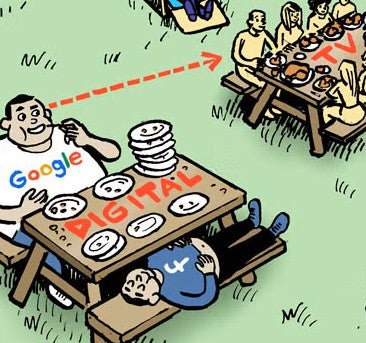
We’re all well aware by now that YouTube pitches itself to advertisers as a form of TV viewership.
But, according to YouTube, its TV status is a byproduct of viewership trends, rather than YouTube purposely trying to eat legacy broadcasters’ lunch.
YouTube is “device-agnostic,” said Tara Walpert Levy, YouTube’s VP, Americas, during the StreamTV Show in Colorado on Wednesday. It just so happens that consumers are watching more user-generated content via the big screen on the wall.
During her fireside chat with Alison Brower, executive editor of The Ankler, Walpert Levy said her kids watch YouTube Shorts on smart TVs. “It’s not intuitive,” she said, referring to the fact that short-form vertical video can feel awkward on a wide screen. “But it happens.”
What TV advertisers want from YouTube, though, isn’t necessarily the high overall production quality of television shows and commercials. It’s transparency into where their ads run.
YouTube’s recent efforts to let buyers serve ads in shows of their choice is a sign that YouTube “is definitely TV,” Brower said.
Taken For A Ride
An investigation by Consumer Reports found that Uber and Lyft regularly offer “supposed discounts on what appeared to be inflated original prices.”
The study found that 11% of all discounts advertised on both rideshare apps were apparently based on inflated prices. CR examined pricing information from 174 volunteer Uber and Lyft users who tested 40 routes across the US between March and April.
CR also alleges that Uber and Lyft engage in surveillance or personalized pricing, which means they offer different prices for the same service based on the available personal data.
For example, two Uber riders requesting the exact same ride between two Florida towns at the same time saw wide discrepancies: charges of $94.96 and $65.95. Across the study, the median difference between prices for the same ride was about 50%.
Uber and Lyft deny they engage in surveillance pricing or that they offer discounts based on inflated prices. They claim the price discrepancies are due to market fluctuations.
Either way, surveillance pricing and bogus discounts are drawing the attention of regulators. Connecticut and Maryland became the first states to ban surveillance pricing this year, and New York requires the practice to be clearly disclosed. Meanwhile, a Senate bill introduced in December aims to ban surveillance pricing at the federal level.
But Wait! There’s More!
OpenAI moves to automate ad creative. [Digiday]
CMOs are getting more responsibilities – but not more power. [Business Insider]
The UK’s social media ban for under-16s will reduce ad spend in the country by more than $1 billion per year. [The Guardian]
ICE appears to be purchasing tax identification numbers from a data broker, potentially skirting a court order that bans ICE from buying ID data. [404 Media]
Meta’s new AI search mode feature, which draws public data from its apps, would be useful if it wasn’t wrong so often. [The Verge]
Sinclair invests in IRCODE, a “Shazam for Images” AI vision startup, and will test interactive TV ads in two markets. [Variety]
You’re Hired!
Sponsorship intelligence platform SponsorUnited appoints Tim Braz as its first chief commercial officer. [release]
Nichole Schupback is elevated to global head of DSP at OpenX. [LinkedIn]
Swivel names Joe Melaragno as EVP of platform and Jonas Olsen as VP of international sales. [release]
Here’s today’s AdExchanger.com news round-up… Want it by email? Sign up here.