
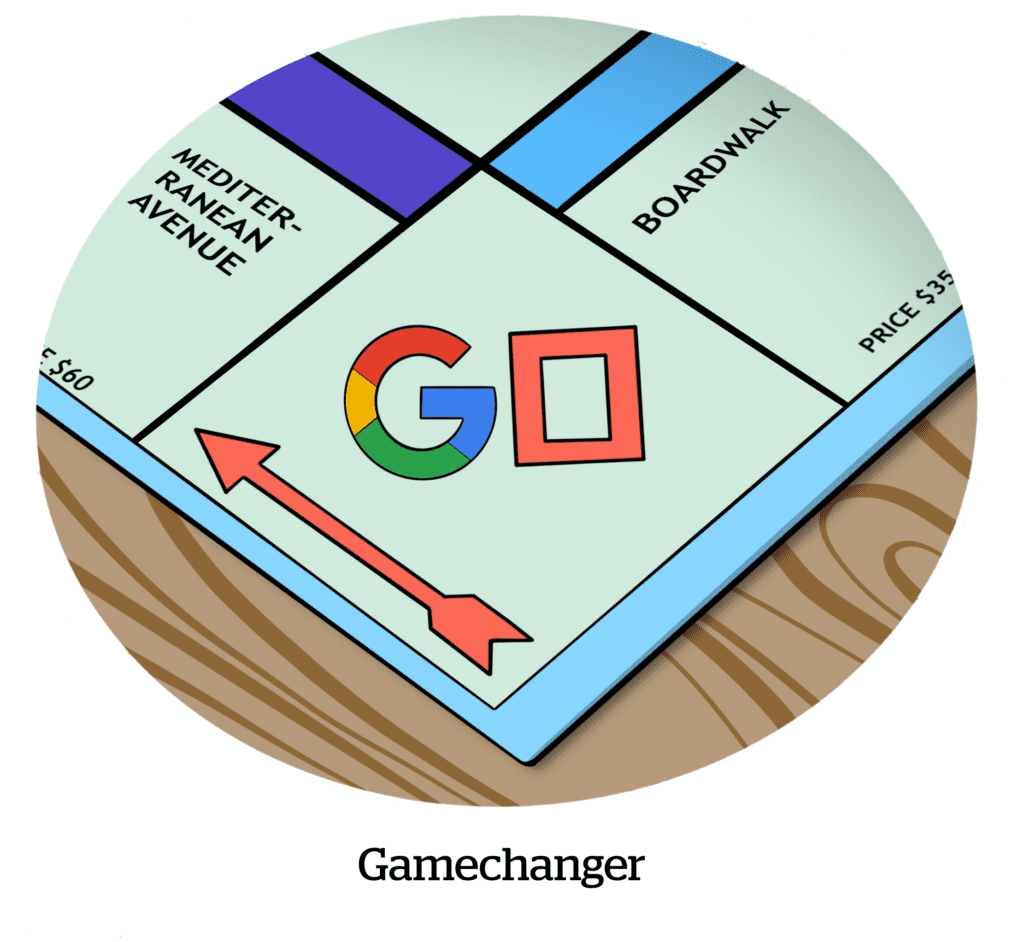
Rank Robbery
Penske Media, publisher of Rolling Stone, Billboard, Variety and The Hollywood Reporter, is suing Google over the unlicensed use of its content in AI-generated search answers, which Google calls AI Overviews (AIOs).
Lots of publishers are suing Google and other generative AI search operators, but Penske’s filing demonstrates why Google’s search monopoly conviction is so important – and why Google continues to appeal, despite having received only a minor slap on the wrist.

Penske argues that Google’s AI search is bound up with its illegal monopoly, since publishers must allow AI scraping if they also want Google Search to crawl their sites. In other words: Hand over data for AIOs or risk losing rankings.
But Google’s PR and leadership has maintained a bizarre counter-narrative that AIOs generate equal revenue to and more traffic than traditional search. The company has long asserted – using these exact words – that AIOs “send traffic to a greater diversity of sites.” In fact, that line was just repeated by a Google spokesperson to TechCrunch, which covered the Penske suit.
Penske is asking for a jury trial, and if that happens, maybe we can get a Googler on the stand to explain under oath what they mean by “a greater diversity of sites.” Because that hasn’t been the experience of most publishers.
Agentic Accountability
AI agents are technically capable of data analysis, creative strategy and ad optimization – and, increasingly, they’re being given authority to make more independent choices and take actions, Digiday reports.
But many media execs are nervous because, well, you can’t hold a robot accountable.
Developers are, for example, creating protocols for AI agents to access websites and use APIs. But once we reach the point where agents are taking instructions from other agents, it gets really challenging – if not impossible – to trace the source data and ensure accountability, says Marc Maleh, CTO at digital agency Huge.
Best practices are being written almost simultaneously as AI products hit the market. Without the proper guardrails, a company’s agentic AI services could theoretically run amok if given authority over site content and ad creative and access to a bank account.
“It’s not just a tech or a data problem,” Maleh says. “It’s also a brand problem.”
But problem or not, it’s happening.
We’re reaching the point where every advertiser, publisher and agency will have “some kind of agentic representation” that will be able to make decisions and act on their behalf, says David Berkowitz, founder of AI Marketers Guild.
And so it won’t pay to be laissez-faire. Just letting this all happen and seeing where it goes isn’t the right play, Berkowitz says.
The Beginning Of A Beautiful Framework?
Remember how TikTok was almost banned in the US at the beginning of this year? (Yeah, us neither.)
Technically, TikTok has another arbitrary deadline coming up. Parent company ByteDance must either divest TikTok’s US operations by tomorrow or face another potential shutdown.
But, as CNBC reports, Treasury Secretary Scott Bessent says the US and China reached a “framework” deal during trade talks in Spain over the weekend.
Donald Trump and Xi Jinping will reportedly discuss official terms on Friday. In the meantime, the deadline may be pushed again to accommodate for a deal signing, according to US Trade Representative Jamieson Greer.
Not that advertisers are really all that worried about another possible TikTok ban. Many are content to ride “until the wheels fall off,” as AdExchanger reported during the false alarm that was the January ban.
TikTok itself has also been operating like its business as usual, announcing new partnerships and integrating new mandatory AI tools over the course of the summer.
And why not? The deadline’s already been moved several times since Trump took office, so what’s one more rumored trade negotiation deal going to hurt?
But Wait! There’s More!
President Trump suggests that American companies do away with quarterly earnings reports in favor of a semiannual cadence. [CNBC]
TBPN, a daily tech podcast that’s only 11 months old, hired its first president and hopes to grow ad revenue from $5 million this year to $15 million next year. [WSJ]
Women are slightly more likely to use ChatGPT than men, according to OpenAI. [Business Insider]
A data broker owned by several major airlines is selling passenger travel records to the US government for warrantless searching. [404 Media]
You’re Hired!
Kantar appoints former Daily Mail boss Paul Zwillenberg as chief executive. [Reuters]
In-store audio platform QSIC brings on Sean Cheyney as EVP of global business development. [release]







