Too Much Of A Good Thing
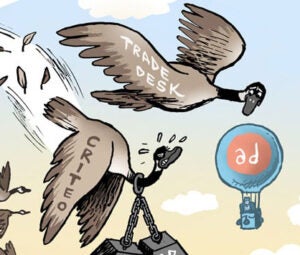
AI doesn’t want publisher content as it exists. It wants “information stripped to its raw material” that it can mix with other content to produce something new, writes Brian Morrissey at The Rebooting.
AI treating publisher content as raw material instead of expertise is the “fundamental misalignment” that leads to the commoditization of publishers, according to Morrissey. That, and an overabundance of publisher supply.
But the publisher supply chain is already being strained by AI’s incentives, argued Jon Roberts, chief innovation officer at People Inc., during a session at The Rebooting’s TRB Audience Summit last week.
To develop strong AI, “you need chips, you need power, and you need the information to run through them,” Roberts said. “Two of these supply chains are well funded,” he added, while “one of them is not funded at all.”
The difference comes down to scarcity. Or, as Morrissey puts it, “Chips and power have supply constraints. Enchilada recipes do not.”
Publishers have a nuclear option, though. If Google-driven revenue gets too small, it makes it easier to block Google’s combination search indexer/AI scraper entirely. At least, that’s what USA Today CEO Mike Reed tells Morrissey his publication is considering.
But, if one publisher blocks an AI model, the AI can find similar content elsewhere. So unless publishers cut Google off en masse, its AI will keep treating them as interchangeable.
Credit Where Due
The “K-shaped economy” theory posits that products and services have polarized around the cheapest products and the most expensive products only available to those with deep pockets.
For the credit card industry, that’s meant growth in luxury and travel cards, as well as cards with little to no annual fees. Between those two categories, though, is a burgeoning class of what The Wall Street Journal dubs “near-premium cards,” or what a consumer finance analyst calls “the upper-middle-class option.”
But these not-quite-luxe card memberships could also be dubbed “retail media-subsidized cards.”
For instance, when Amex hiked the rates on its Platinum card, it lowered rates for its Gold card and bundled in deals on brands like Dunkin’ Donuts and Five Guys.
Airlines are also integrating these “near-premium cards” with their own loyalty and retail media programs. These arrangements are revenue generators for the banks since the cost of acquiring new credit accounts shifts to the airlines. Southwest and Chase, American and Citi, and Delta and Amex are just some examples of these deals.
One question is whether associating their cards with everyday brands means brands like Amex lose some veneer of exclusivity. The more pertinent question, though, is whether they can afford to forgo the incremental help from retail media markets.
Super-Size It
Speaking of the growing power of the credit card industry’s retail media partners, McDonald’s sees an opportunity to stand up its own billion-dollar ad business. So it’s launching the McDonald’s Media Network.
In an investor presentation last week, McDonald’s CMO Morgan Flatley called advertising “an opportunity to generate revenue for the system with little in the way of additional cost, no operational complexity and no disruption to our customer experience.”
The media network spans the burger chain’s physical footprint, including in-restaurant kiosks, drive-through stations, the McDonald’s app and menu boards. Which is pretty huge, although it doesn’t include online campaign extensions (for now at least).
And as further evidence of the growing connection between burger chains and finance, Adweek points out that McD’s fits into a retail media category that “includes financial and travel companies like JPMorgan Chase, Citi, Uber and PayPal.”
Which is also why the first advertisers to use the McMedia Network (patent pending) will probably be other companies that have massive first-party data and media hubs of their own, like credit card companies, ride-share apps and maybe Planet Fitness. Holistic partner brands like Coca-Cola will also likely get involved.
But another category of early advertisers will be media companies like Netflix and Disney, which are similarly built around their shared views of scaled, logged-in subscribers.
Isn’t it nice to see all these verticals united by their advertising ambitions?
But Wait! There’s More!
Is China actually copying AI technology from the US, or are companies like Anthropic and OpenAI making a big stink out of nothing? [NYT]
AI improved efficiency and speed. But marketers bemoan its “good enough” (and often not good enough) creative and optimization standards. [Digiday]
Microsoft is exiting the personal AI chatbot market, focusing instead just on corporate use of its Copilot AI. [Bloomberg]
Letterboxd, the movie review and community site, is up for sale with bidders interested at $300 million. And The New York Times is one of the potential buyers. [NYT]
Here’s today’s AdExchanger.com news round-up… Want it by email? Sign up here.