
If publishers had to explain their relationship with AI, a 2012-style Facebook status would probably do the trick: It’s complicated.
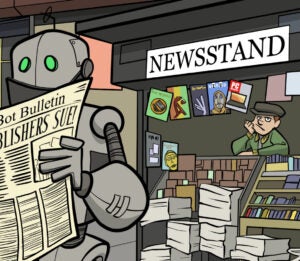
Publishers want their content to be surfaced by AI search interfaces. But offering AI scrapers free and unlimited access to content is a slippery slope that can lead to well-fed LLMs and starving pubs. Plus, there’s always the question of whether AI chatbots accurately surface publisher content.
AI’s “blended answers” are only as accurate as the sources they’re pulled from, and often less so, said Jonathan Roberts, chief innovation officer at People Inc. Too often, he added, the technology is “prone to hallucination, which is a wonderful rebranding of the words ‘making things up.’”
To control how content from its wide-ranging publisher portfolio gets used – and cited – in AI responses, People Inc. has taken a harder stance than most pubs. It’s blocking all scrapers by default and only giving access to approved AI partners that have content licensing deals in place.
Roberts spoke to AdExchanger about finding the balance between blocking and monetizing AI. He also discussed the grassroots backlash to the AI revolution and the implications for publishers.
AdExchanger: How is AI search changing what people trust on the internet?
JONATHAN ROBERTS: Brands have always been a shorthand for trusted sources.
I will cook something from Allrecipes, because I know it’s been tested to death, and I can see all the comments about people who tried it in different ways. I will not necessarily trust a recipe from a site I’ve never heard of.
At the moment, trusting [brands] is harder than ever, so we see an explosion of trust in influencers – these one-to-one deeply trusting relationships we have with people.
Our brands on social do incredibly well, not because people trust the brands, but because people trust the editors who are the faces of our brands.
We’re back to a world where you don’t have to trust InStyle, you trust Lauren Valenti, [the beauty director] from InStyle. You don’t have to trust Travel + Leisure, you can trust Jacqui Gifford, the editor-in-chief of Travel + Leisure, who’s in the location, at the hotel, behind the scenes.
Publishers want to be cited by AI, but they also don’t want to be cited inaccurately or have their content scraped without compensation. How do you strike that balance?
This is a new version of an old problem.
We have a massive audience coming directly to our sites. We have a huge email distribution list. We send many millions of magazines into people’s homes every month and year. We are one of the most cited sources in Google’s AI mode. We have exploding readership and viewership across YouTube, Instagram and TikTok. So meeting people where they are is the thing that matters.
Now, the flip side is there needs to be some economic value.
Us showing up makes the platform better, but it doesn’t make economic sense for us unless there’s some way to actually build on that.
Instagram is a platform. TikTok is a platform. The open web is a platform. Somebody else’s chatbot is an app, not a platform. We can build on platforms, but we’re not just going to enrich somebody else’s app for no benefit. Chatbots believe they should have access to everything but provide no value to the people who make them good. That just doesn’t make sense.
How do you make sure you’re getting appropriate value from being cited by AI?
We’ve been striking deals. We had the first OpenAI deal of any major US web publisher. They can get access to all of our content through that partnership, and we innovate with them on new products and releases. We were also the first lifestyle publisher to partner with Meta AI.
And in spring of this year, we switched from a block list of individual bad AI actors to blocking everybody and having a short allow list.
There’s a huge appetite for our content, and people are going to extraordinary lengths to steal it. If it’s worth that much to you, let’s just partner and do this the right way. But if you won’t partner, we will work extremely hard to block you.
In your session at Programmatic AI in May, you mentioned something a lot of people in advertising and media seem afraid to talk about: the grassroots backlash against AI. How does that backlash factor into your AI strategy?
We’re going through an industrial revolution. That’s scary. There’s a huge amount of financial anxiety throughout the country and the world.
You’ve got the CEOs of AI companies saying, “We think 50% of all jobs will be gone within a year or two,” and Microsoft saying all white-collar jobs will be automatable within 18 months.
Saying, “We’ve built this new thing, it’s going to take away all your jobs” is not a great way to get people on your side.
And at the same time, everyone who’s actually using it is saying it’s not good yet, it’s not reliable yet.
You obviously have backlash against data centers in people’s communities.
There’s broad-based concern where everyone’s being told what the downsides are, but trust us when it comes to the upside.
It’s very easy to see a world of accelerating inequality off the back of AI. It’s harder to see a world of universal growth and opportunities.
But, now, you can build stuff in a weekend that, before, you would’ve had to hire a team of engineers to help you build in six months. There have been more companies founded in the last 12 months in the US than any time in the last five years.
So there is an entrepreneurship boom and there’s growth. We just haven’t seen it hit yet.
It’s on all of us, along with our outside partners, to actually show the benefits.
This interview has been edited and condensed.
For more articles featuring Jonathan Roberts, click here.