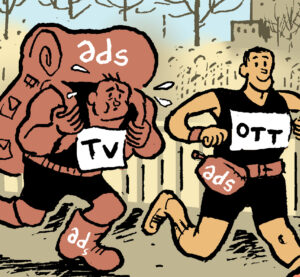
Holdcos Better Hold On Tight
Expect more ad agency holdco consolidation in the next year, Michael Kassan tells Adweek. We could even see deals potentially on par with Omnicom’s takeover of IPG, which still faces antitrust scrutiny that might derail the deal.
Of course, Kassan is a deal matchmaker through his advisory, 3C Ventures, so take his opinion with a grain of salt. But he highlights some favorites for potential mergers.

Publicis has had a good run on the stock market, but WPP, dentsu, Omnicom, IPG and S4 Capital, Martin Sorrell’s holdco venture, have not.
“I don’t think they can continue without some consolidation,” Kassan says.
Many of the bellwether indie agencies have conglomerated, too. Aside from newcomer tech and commerce agencies like Flywheel Digital, there’s the generations-old Mars United, which sold to Publicis in late 2024.
“It’s going to be harder for [indie agencies] to compete,” Rob Rivenburgh, former CEO of Mars United and now leader of the Publicis global commerce business, told AdExchanger at the time of the deal.
Kassan, unsurprisingly, thinks M&A is the solution. “It’s going to get tough,” he says. “There’s more to come there.”
Chattin’ Like Chatbots
According to researchers at the Max Planck Institute for Human Development, people are actually shifting their vocabulary to use words favored by ChatGPT.
In a review of over 280,000 academic YouTube videos, the words “meticulous,” “realm,” “adept” and “delve” were used 51% more frequently in the 18 months after ChatGPT was released compared to three years prior.
Of course, the presence of the word “delve” isn’t enough to prove that someone is using AI in their writing (speaking of which – neither are em dashes!). But as The Verge points out, suspicion of AI usage can cause people to be less trusting of one another in collaborative environments, regardless of whether or not AI was used.
Another rationale is that people inundated with certain words will reuse them whether they want to or not. Ask anybody who’s slipped into corporate jargon outside of work, or started saying something as a joke (like, let’s say, random example, hypothetically, pronouncing regular as “reg-lee-ur”) and now can’t stop doing it.
It Was Fund While It Lasted
One of the many weirdnesses of political advertising is how matching funds work.
Take the New York City mayoral primary, which culminates Tuesday and will end in a huge windfall (or avalanche, depending on your perspective) of advertising.
On Friday, many candidates saw hundreds of thousands of dollars in payouts from the city’s public matching funds program – which essentially doubles small-dollar donations from city residents as a way to boost smaller campaigns. But there’s a minimum to qualify.
Long-shot mayoral candidate Michael Blake qualified in the nick of time and picked up a much-needed $2 million. That gave him four days to spend it. Another fringe candidate, Adrienne Adams, picked up $2 million earlier this month, having also just qualified. But it was the eighth payment of the cycle for better-known candidates.
These large, late-in-the-race cash infusions go directly into get-out-the-vote efforts. Naturally, that means more TV and video ads. What else is there to spend it on? At this point, there’s no need for new fundraising or voter registration drives.
Also in the past month: Andrew Cuomo’s mayoral campaign was docked more than $1 million in matching funds by the city’s Campaign Finance Board due to concerns that the campaign illegally coordinated with an outside super PAC.
Sounds like grist for more attack ads.
But Wait! There’s More
Creators are turning to agentic AI to manage their fan engagement. [Digiday]
Microsoft’s parental controls are randomly blocking the Google Chrome browser. [The Verge]
Almost half of creative industry professionals self-identify as neurodivergent. [Marketing Dive]
At Cannes Lions, everyone is trying to sell your attention. [Axios]