
Old News
Everybody wants the news, but they don’t want it from the news, if that makes sense.
Audiences want updates, stories and insights, but they increasingly find them in places that look less like traditional journalism and more like entertainment or branded content.

Take TBPN, for example. Sitting somewhere between news and content marketing, the “Technology Business Program Network” is a live video show and podcast covering business through a tech lens. TBPN recently inked an exclusive partnership with (and apparent investment from) the New York Stock Exchange, Fast Company reports.
Streaming business news outlets like TBPN, Cheddar and even CNBC show how blurred the line between journalism and promotion has become. But if those platforms illustrate the gray area, Diaper Diplomacy shows what happens when news crosses fully into entertainment.
The social account delivers political news in a form people find palatable, as per The Wall Street Journal. Which is to say, it uses generative AI to depict politicians and other world leaders as babies lip-syncing the actual words from real news footage.
It’s not that there isn’t advertiser and audience demand for news reports; it’s just that traditional journalism struggles to capture it.
“We’re doomed,” one Diaper Diplomacy fan joked to the Journal. “So we might as well make babies with it if we’re going to be doomed.”
Blue Crush
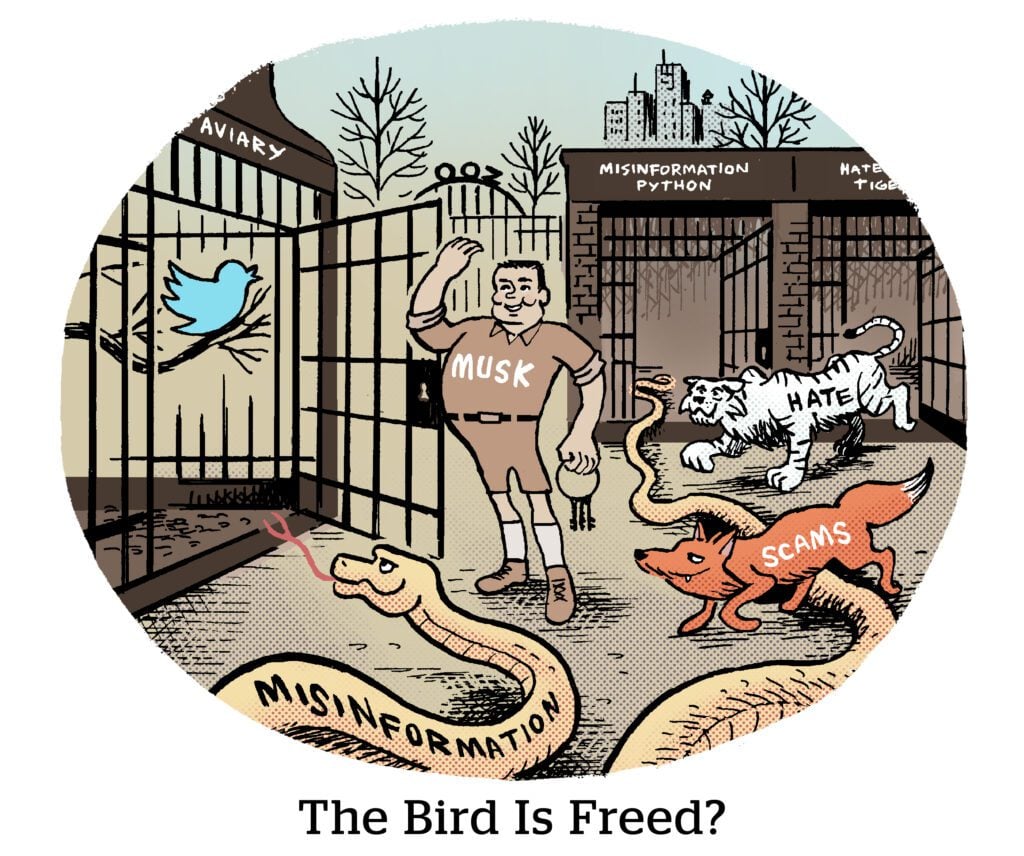
X has been fined 120 million euros (just over $140 million) by the European Commission for breaching the EU’s new Digital Services Act, which aims to reign in Big Tech, including by protecting consumers against fake ads and scams.
One of X’s violations is the “deceptive” design of its blue checkmark badges, The Guardian reports.
Back when the app was still Twitter, blue checkmarks were used to authenticate the identity of public figures or major brands (and, occasionally, the odd mid-career journalist who managed to pull the right strings).
However, in November 2022, new owner Elon Musk made that same checkmark available to anyone willing to pay $8 a month. This triggered a swell of scam ads and messages as fraudsters took advantage of Twitter users who still associated the checkmark with platform-vetted legitimacy. Many brands had to pull their ad budgets entirely.
Not long after the original checkmarks were culled in 2023, the European Commission opened formal proceedings to determine whether X’s new checkmark system (which was also made mandatory for advertisers) violates the Digital Services Act’s transparency requirements.
Along with the verdict that yes, indeed, they do, the commission found X liable for not publishing a list of its advertisers available and for failing to make data available to researchers.
Back In The News
Meta is getting back into the practice of paying news publishers – this time for training its AI chatbots to respond to queries about current events.
The social media giant struck commercial AI licensing deals with several major news orgs, Axios reports. The list includes CNN, USA Today, People Inc., Le Monde, The Daily Caller, the Washington Examiner and Fox News.
It’s another chapter in Meta’s tumultuous relationship with news publishers. Meta’s platform once revolved around the sharing of news content and featured a dedicated News Tab. But Meta began distancing itself from news amid pressure from regulators around the globe to share more revenue with publishers.
Some might also recall Meta’s notorious “pivot to video.”
Plus, questions about which news sources to keep, deplatform or promote became a headache for Meta on both the right and left. Meanwhile, many users soured on Facebook and Instagram over the prominence of news and politics in their feeds.
As a result, Meta ended its news partner payment program in 2022 and then killed its News Tab in 2024, shutting down an important traffic and revenue source for publishers. Instead, Meta prioritized viral video content and, more recently, AI slop.
But Wait! There’s More
Teads plans to lay off 10% of its workforce following its acquisition by Outbrain. [Business Insider]
Reddit’s human moderators are overwhelmed with AI-generated posts. [Wired]
No individual publisher can singlehandedly fix traffic woes. But maybe teamwork really does make the dream work. [AdMonsters]
A federal judge ruled that OpenAI must produce 20 million anonymized ChatGPT chat logs as evidence in the copyright infringement lawsuit brought against it by The New York Times and other publishers. [Reuters]
Speaking of generative AI lawsuits, The New York Times is also suing AI startup Perplexity for copyright infringement. [NYT]






