
Here’s today’s AdExchanger.com news round-up… Want it by email? Sign up here.
Black And Blue
Twitter has removed blue checkmarks from legacy verified accounts as promised, as in accounts that don’t subscribe to the new $8-per-month Twitter Blue program. The rollout has, of course, been a botched job.
Some celeb accounts, including Lebron James, Stephen King and William Shatner, were covertly paid for by Elon Musk himself, The Verge reports. The actual account holders, who loudly and proudly don’t pay for Twitter Blue, wondered why they still carried the checkmark after the mass removal and why a second-factor authentication email was mysteriously added to their accounts.
“You’re welcome namaste,” Musk responded to Stephen King.
Musk’s tactic could itself constitute false ad endorsement, since he’s giving the impression that these celebrities pay for and support the program. The $8 fee is worth it for Musk – but that’s the point. He’s getting something out of this, too.

And here’s another announcement: Accounts must subscribe to Blue to purchase ads on Twitter. This is a bizarre move, because most advertisers, even small ones, already pay thousands of dollars per year to buy ads on the platform.
SKAN In The Game
Five years after its initial release, Google Ads has said it will support Apple SKAdNetwork (SKAN). Better late than never!
Google published a SKAN best practices guide to help resolve discrepancies between SKAN’s attribution reports and Google’s modeled conversions. Google also offers tips for integrating SKAN’s app install and in-app conversion measurement with the Google Ads dashboard.
Google Analytics 4 will soon support SKAN postback reports as well.
Apple first introduced SKAN (very quietly) in 2018 as an alternative for third-party attribution of mobile app install and in-app ad campaigns.
Until 2021, brands could still access first-party device IDs and install data for attribution. But then Apple rolled out its AppTrackingTransparency framework that year, and SKAN became the only alternative.
Up to this point, Google had rarely publicly addressed SKAN. But the latest version, SKAN4, added attribution reporting for web-to-app search inventory, the introduction of which may have prodded Google to finally jump on the bandwagon.
It’s the latest sign that Apple has fundamentally reshaped the mobile advertising landscape, and even Google must follow Apple’s lead sometimes.
Pub Crawl
Some publishing execs, from digital media upstarts to century-old newspapers and magazines, believe that the failure of online news is due to the fact that the industry went all in on a free and open internet.
Others maintain that news companies didn’t perceive entities like Craigslist, Google and Facebook as threats – at least not in time to change the course of revenue streams.
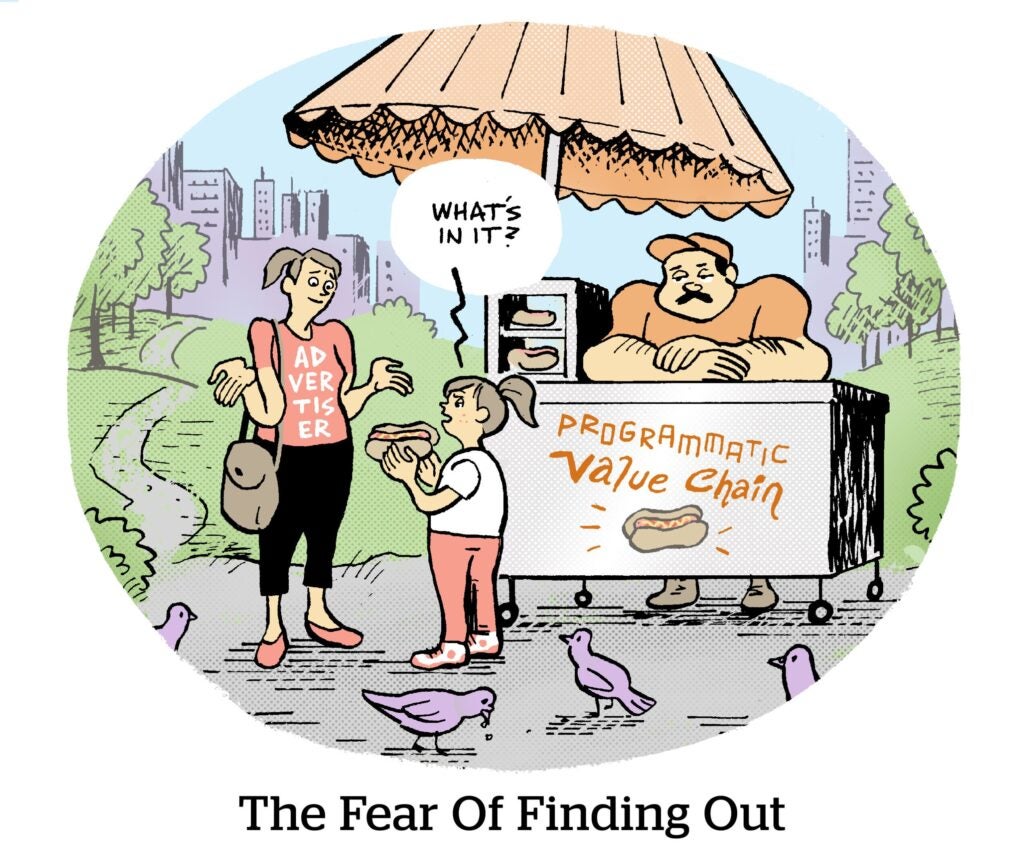
“I think it’s because executives have failed to identify the true ‘original sin,’ the one that still burdens the sector to this day: the embrace of open programmatic advertising,” writes Simon Owens in his media industry Substack newsletter.
For one, there’s the online ad fraud plague that, aside from diverting money from legit publishers to scammy crud, also lowers the ROI of all digital media.
And despite all the shiny objects calling for their slice of marketing budgets – mobile, CTV, retail, the metaverse(!) – programmatic vendors remain steadfastly tied to display ads. Let’s face it, IAB standard banners were already outdated years ago. Not to mention that all the biggies (Google, Meta and Amazon) have primarily moved on to self-service native advertising.
In short, programmatic failed the open web, and they’re going down together.
But Wait, There’s More!
Meta is entering the generative AI business. Will it make a difference? [The Drum]
Google’s rumored AI-infused search overhaul has the attention of marketers. [Digiday]
Roku will share linear TV viewership data on diverse-owned media networks with IPG-owned agency UM in an attempt to attract more advertisers. [Ad Age]
J.C. Penney’s head of ecommerce pivots to chief customer officer. [Retail Dive]
Can parents take Facebook or TikTok to court if their kids are addicted to those apps? [Bloomberg]
You’re Hired!
Outbrain promotes Yonatan Maman to CTO and appoints Zemanta’s founder, Andraz Tori, to be its first-ever chief product officer. [release]







