Yield To Merge
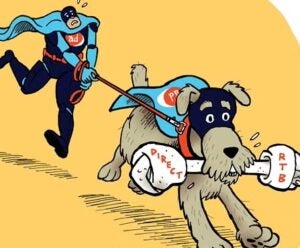
Publicis and the newly merged Omnicom-IPG giant both report Q4 earnings today – and investors will be listening closely.
They’ll want to hear indicators of how the holiday season went, of course, but they’ll also be looking for clues about how these two 400-pound gorillas intend to compete in an increasingly concentrated ad market.
So let the M&A rumormongering begin.

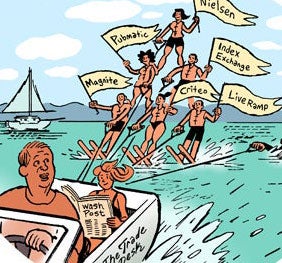
For instance, according to multiple secondhand accounts cited by Digiday, a near-deal between Publicis and LiveRamp fell through prior to CES in Las Vegas last month.
LiveRamp is a fascinating potential M&A target, because it’s central to how third-party data-matching and vendor integrations connect across the ecosystem.
“There’s no real scalable alternative” for LiveRamp, one source tells Digiday. But, also, LiveRamp derives great value from being the consummate open-to-everyone middleman vendor.
Would that work as part of Publicis? Hard to say. But at least LiveRamp’s $1.6 billion market cap is digestible – unlike The Trade Desk, which has also been the subject of deal speculation.
That said, TTD’s shares are down from roughly $118 a year ago to less than $30 by close on Monday.
Eek!
At a nearly $15 billion market cap, TTD is still quite big, but the once‑untouchable indie DSP is starting to look a little more attainable.
Growth Experience
No creature on Earth is as jumpy as a private equity growth investor.
PE funds bet on companies to grow at relatively high double-digit rates for many years, or on undervalued stocks with the potential to multiply in value.
Advertising is often in the mix here. Companies like AppLovin, Uber, PayPal and Roblox are riding the tailwinds of growth investors who expect their emerging media and data businesses to spark a boom.
But PE investors are fickle. Video game developers, for instance, have taken a hit since last Friday, when Google unveiled an AI prototype for building custom game-like worlds, Bloomberg reports.
The reaction looks overblown. Google’s Project Genie, as it’s being called, is still in its marketing debut phase, a work-in-progress on display in controlled settings rather than a product being used in the wild.
But, ironically, the developers that investors are punishing may prove to be the biggest beneficiaries. If AI tools like Project Genie mature as promised, companies like Roblox and Unity – each of which saw their shares plunge by about a third after Google’s announcement – could end up riding the same AI wave that just sent their stocks tumbling.
Water, Water Everywhere …
When debating the value of AI, advertisers and tech companies usually consider the same few elements: how the tech affects costs, the user experience and consumer perceptions.
What’s often overlooked by corporations, though, is the environmental and financial impact. But for many consumers, those issues are front of mind.
For instance, Howell Township in Michigan has always been “friendly to businesses,” The Wall Street Journal reports. That is, until developers began talks to convert 1,000 acres of the township’s farmland into an AI data center for Meta.
Ultimately, the county planning commission voted not to move forward with the site.
One easy win for tech companies to try and curry public favor is to pay for the energy used by their data centers, for example, rather than saddle local residents with the bill.
Meta is spending millions on advocacy ads to promote data centers, citing job growth. It’s a tough one, though, because those jobs are in, like, San Francisco, not Whateversville, Michigan (no offense).
If big platforms want their AI data centers, they’ll need to appeal to humans.
It’s a striking irony of the online advertising world that the biggest ad platforms often struggle to manage their own reputations.
But Wait! There’s More!
Inside Moltbook, a new website that’s billing itself as social media for AI agents. [The Guardian]
Longtime rumors about a foldable iPhone are finally starting to feel real, with Apple reportedly moving closer to launching one. And it might not stop there: Apple is also looking at a clamshell-style foldable – basically a modern flip phone – as a possible follow‑up. [Bloomberg]
What’s next for TikTok advertisers after the algorithm changes under its new ownership? [Ad Age]
OpenAI confirms $200,000 minimum commitments for ChatGPT ads. [Adweek]
A coalition of nonprofits is urging the US government to stop using Grok in federal agencies and to open a formal investigation into the chatbot’s myriad safety failures, including its handling of harmful content. [TechCrunch]
Global internet users are increasingly turning away from US-owned technology, including Google, WhatsApp and TikTok. [Rest of World]
You’re Hired!
IAB appoints several new industry leaders to its board of directors, including NBCUniversal President Alison Levin as chair and Amazon Ads VP Alan Moss as vice chair. [release]
Meanwhile, the IAB Tech Lab names Shenan Reed, global chief media officer of General Motors, to its own board of directors. [release]
Walmart and Target both announce new CEOs: John Furner and Michael Fiddelke, respectively. [Retail Dive]