Here’s today’s AdExchanger.com news round-up… Want it by email? Sign up here.
Ironed Out
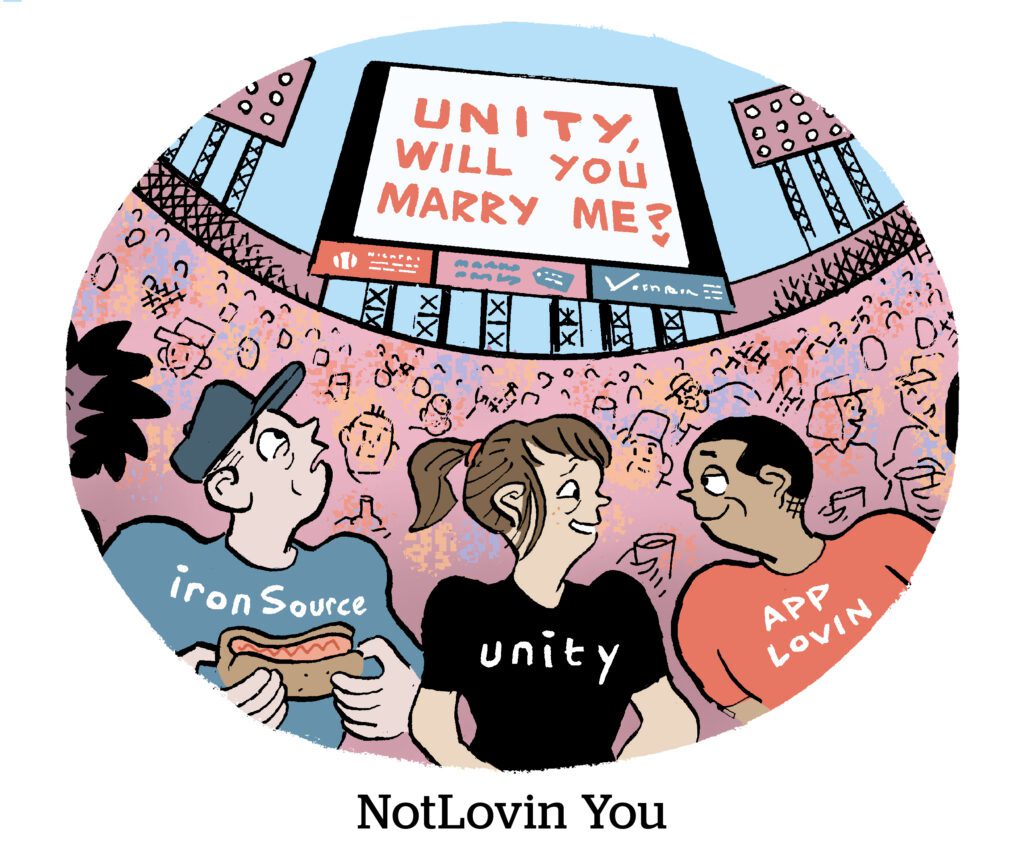
Unity will sell Supersonic, the casual-gaming studio it picked up through ironSource, and shut down the ironSource ad network as of April 30, mobilegamer.biz reports based on an investor filing.
So endeth a bizarre relationship between Unity and ironSource that began when the two announced their planned merger in 2022 – followed shortly thereafter by AppLovin’s unsolicited proposal to buy Unity, but only if Unity reneged on its deal with ironSource.
AppLovin wasn’t successful and IronSource became a part of Unity for around $4.4 billion dollars. And now, Unity has all but washed its hands of that ambitious union.
The divestment of Supersonic mirrors a trend that’s played out for AppLovin, which divested its own apps business last year to focus on ad tech and software.
The fact is, Wall Street has very little appetite for game production studios at the moment. (Investors have soured on SaaS, too, but that’s a different story.)
The chill is spreading beyond ad tech. Microsoft might exit Xbox and just last week Epic Games announced massive layoffs in response to a downturn in engagement with “Fortnite.”
But all is not lost? As Epic Games Co-Founder and CEO Tim Sweeney put it in a memo: “Market conditions today are the most extreme we’ve seen since those early days, with massive upheaval in the industry accompanied by massive opportunity for the companies that come out as winners on the other side.”
Prepare For Takeoff
OpenAI’s ads pilot is onto the next leg of its journey.
On Wednesday, OpenAI announced the expansion of its pilot program, which was initially scheduled to end in March, calling the results thus far “encouraging.”
In the coming weeks, ads will roll out to users in Canada, Australia and New Zealand.
However, the feedback from advertisers in the current pilot hasn’t all been glowing. Some advertisers have seen click-through rates as low as .91%, Adweek reports. Compare that to Google’s average of over 6%.
Plus, OpenAI is now asking advertisers for insertion order commitments to lock in spend, and the $200,000 minimum commitment reported in January is still in place.
Ads seem to be served in ChatGPT based on “the nature of the query” and a set of keywords provided by the advertiser, according to Sam Huston, SVP of media at DEPT. But, Huston tells Adweek, OpenAI hasn’t been “entirely clear” about the details.
From the consumer side, the rollout appears to be going well, though, with OpenAI reporting “no impact on consumer trust metrics” and a “low dismissal rates of ads.”
Not that there have been all that many ads to see so far.
Contact Sports
Since 1961, the NFL has enjoyed an antitrust exemption that allows it to negotiate leaguewide TV deals. That’s why the teams themselves don’t negotiate local carriage rights.
That special carveout comes with a precondition: The NFL must provide fair, equivalent access to games. For decades, that standard was met by putting games on major broadcast networks like ABC, CBS and FOX, which anyone with a set of bunny-ear antennas could watch.
But could that antitrust shield be at risk?
“That’s a very live, very ripe question” right now, FCC Chair Brendan Carr tells Semafor.
There is “a point at which you sort of tip the scale,” Carr says, and the NFL may be at or near that point considering it has “put too many games behind a paywall.”
From the league’s perspective, viewers and even the TV networks themselves are shifting to streaming services. But from the vantage point of most American viewers, that shift means having to sign up for multiple paid subscriptions just to keep watching games.
That trend has the FCC rethinking the rules.
Carr even floated flipping the script entirely, and potentially giving broadcasters an antitrust exemption to coordinate negotiations with the league.
“If the NFL teams were able to collectively negotiate,” Carr muses, “should the broadcasters, perhaps, be able to collectively negotiate as well?”
But Wait! There’s More!
E.l.f. Beauty says AI answer engines are already changing how people shop. [Adweek]
Wikipedia announces a new policy to ban all LLM-generated content from its site. [404 Media]
Be careful about pitching clients with AI agents. Turns out they’re pretty easy to jailbreak. [Semafor]
Not even FBI Director Kash Patel is safe from online hackers. [Reuters]
Why are Netflix’s subscription prices increasing again? [Variety]
One Fortune editor used AI to crank out 600 stories since July. The outlet claims AI-assisted content accounted for 20% of its traffic over that period. [WSJ]
You’re Hired!
Autonomous privacy compliance company Mine hires Ron De Jesus as chief trust officer and head of privacy strategy. [announcement]