Can You Hear Me Now?
What do you think of when you hear the term “programmatic audio?” Podcasts or streaming music probably pop to mind.
But don’t forget about in-store audio, you know, the radio-ish channels playing in the background at the supermarket.
Discount retailer Dollar General has outfitted 6,000 of its 21,000 locations with in-store audio ad measurement tools from Qsic, and is adding 6,000 more this quarter, Adweek reports.
Qsic’s platform uses Dollar General’s point-of-sale data to link ads to an uptick in sales – which is really just proof they played. Whether they actually drove those sales, or just ran in the background at the right time, is another question entirely.
Attribution aside, stores can also automatically adjust (read: increase) the volume to rise above foot traffic sounds and other in-store noises throughout the day.
But what about customers who are already listening to their own audio?
Last year, a YouGov poll found that 17% of US adults are “usually” or “always” wearing headphones in public spaces. Among 18-to-29-year-olds, that number jumps to 37%.
Headphones mean fewer shoppers hear in-store ads, so fewer sales should get credited to them. But perhaps that’s an inconvenient reality retailers would rather ignore.
Drip, Drip Goes The Leaky Wallet
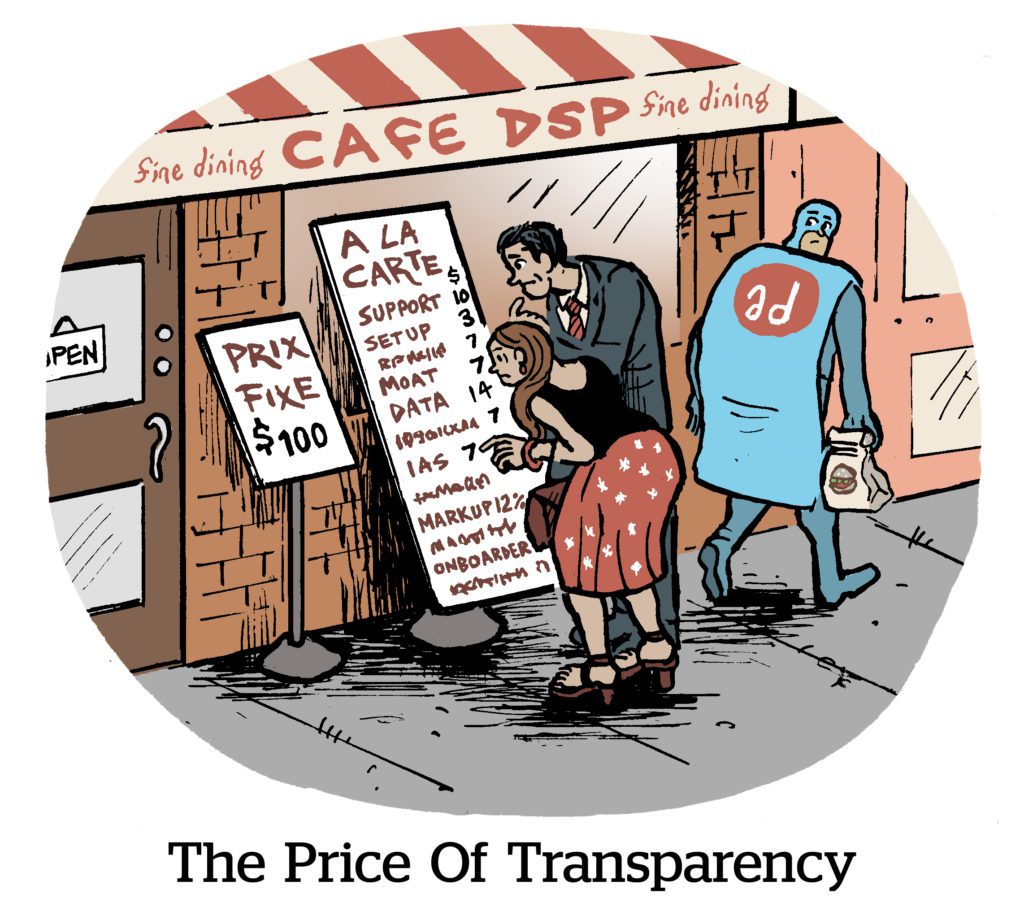
A 3% credit card fee. A quiet 5% surcharge. An unexpected new monthly charge to reconcile.
You might think we’re talking about the frustrations of a DSP customer, but no. Normal Americans are just as fed up with the trend of ticky-tacky, non-transparent price increases, The Wall Street Journal reports.
Enter the practice known as drip pricing, which is considered false advertising in markets such as Canada and Europe.
American businesses often display or advertise prices that don’t match the true price a customer has to pay. Online ticket sellers and home rental platforms have pushed the practice so far that in late 2024 a rare bipartisan FTC ruling banned drip pricing – but only within those two categories.
Drip pricing thrives on abstruse shipping and return policy nuances, last-minute fees, promotional prices that are contingent upon signing up for a program and other marketing bait-and-switches.
Now, expect fuel surcharges to join the drip pricing parade. Over the past few weeks, airlines and package delivery companies have started hiking fees, blaming higher fuel costs.
For an American abroad in Europe, the digital experience can be annoying. (“Ugh so many pop-ups!”) A benefit, though, one traveler tells the Journal: “The price was just the price… It’s exhausting to have to be so aware all the time.”
What’s The Goal?
Advertising during the World Cup is quite expensive.
FIFA says roughly 1.5 billion people watched the 2022 men’s final in Qatar – and with this year’s tournament being hosted in major North American markets (the US, Mexico and Canada), demand has spiked.
Fox is pitching direct linear and streaming packages starting at $5 million each, as in $10 million total, Digiday reports. For US team games, the minimum is $10 million to $15 million.
To appear in the finals, advertisers must commit to spend $25 million across the tournament.
Although not everyone thinks advertising during the World Cup is worth the cost, especially when ratings are “nowhere near what an NFL playoff unit is,” one media buyer tells Digiday. While FIFA’s global audience is greater, the NFL over-indexes to more lucrative audiences and markets.
But for big-name brands, investing in “sophisticated” curation deals and “multi-faceted packages” can pay off, says Rachel Costanzo, senior director of media investment at Tinuiti.
Yet there’s also the strange CPM dynamic with YouTube to consider. YouTube is a preferred FIFA media partner this year, and some advertisers on the platform will likely snag World Cup ad placements for just $10 to $15 CPMs – a fraction of what a direct deal would cost.
But Wait! There’s More!
According to eMarketer, Meta will surpass Google in net ad revenue this year. It should be noted, though, that eMarketer is excluding Google’s advertising rev-share outlays and its traffic acquisition costs. [WSJ]
Creator scandals have turned morality clauses into a go-to exit strategy for brands. [Digiday]
Roblox adds youth accounts as the push for social media bans intensifies. [Bloomberg]
Digital archive tool The Wayback Machine may be on its way out as publishers block its bot from crawling their sites. [Wired]
Booking.com confirms that hackers accessed personal customer data. [TechCrunch]
You’re Hired!
Nielsen names Roberto Ruiz as its new head of measurement science. [release]