

 Why did Google “democratize” dynamic allocation within its ad server on Wednesday to include external demand?
Google addressed its rapid response to the rise of header bidding for broader exchange and publisher partners Thursday – and other developments – at AdExchanger’s PROGRAMMATIC.IO in San Francisco.
“I find it interesting that this is the fastest time-to-market product Google has ever done,” said Chip Schenck, a panelist and VP of programmatic sales and strategy for Meredith Corp.
“[Even with] the approach Google’s taken, there will always be other partners involved. Yes, Google reduces friction by reducing latency on page, but publishers need full control over how you slot in demand … and how you strategically prioritize partners.”
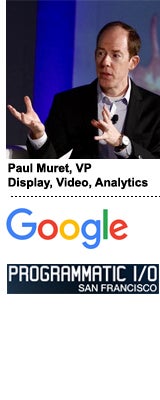
In an interview with John Ebbert, AdExchanger’s publisher, Paul Muret, who replaced longtime Google vet Neal Mohan as VP of display and video ads last year, addressed the header-bidding move as well as other proverbial “elephants” in the room.
“It’s very important that we can make the open web very healthy and sustainable with a vibrant publisher community,” Muret said. “We’re really looking at this from a user experience standpoint first, but also to help publishers monetize appropriately.”
Muret, who co-founded Urchin Software, the early-day Google Analytics, also detailed Google’s deeper moves into a comprehensive analytics and marketing suite and cross-device interests.
Here were some of the highlights:
Google on entering the header-bidding race: “How do we make sure the user experience across the board is quality? One of the top frustrations for consumers is mobile load times, which is [why] AMP [Accelerated Mobile Pages] is really important.

Native is super important. We made a lot of announcements last year around our support for in-app native on exchanges. And finally, the monetization part, which includes [outside] exchange bids within dynamic allocation. … The result is you avoid all these different [server] calls [between] systems, where, for sure you’re creating additional latency. By moving this server side, you can fan out these server calls, [and improve] user experience and yield for publishers.”
On what Google thinks of being called a walled garden: “I think we have a pretty good track record and DoubleClick has been extremely open with data. We have good partnerships with all the exchanges, with DMPs [and through] our analytics APIs. We realize you’re likely to use multiple tools, [so we’re] interoperable. You can use DBM [DoubleClick Bid Manager] without buying our media. There are going to be times when we have to take user privacy into consideration, [so there are restrictions you see] around Google’s proprietary data. Our default operating mode is to be as open as we can and Accelerated Mobile Pages is an example where we’re making this fully open-source and available to all partners and clients. It takes extra work, but we thought it was worth it.”
On the launch of the Analytics 360 Suite: “With my background coming from measurement, there’s this opportunity to bring all this data to bear in a new programmatic world – both in terms of audience buying, but also to answer questions around fractional attribution so that segments in Audience Center [Google’s DMP] are also visible in Google Analytics and biddable in DBM. It’s important for this stuff to be flowing. Our center of reporting inside of DoubleClick is around media and advertising initiatives, while Analytics is around the properties, sites and apps you own. Those things need to come closer together.”
On whether or not it’s a marketing cloud: “All our tools have been a hosted model. One thing we’re excited about is making sure ad tech and analytics platforms interoperate very easily with Google cloud services. Ensuring [that] you can take data in and out of ad tech systems into an environment where you can run additional processing and add dimensionality is really powerful. How does ad tech and analytics start to connect within a true cloud-computing environment?”
On cross-device targeting based on a Google login: “I’m going to give you a fairly canned answer here, but it’s certainly something very high on our list. I’m hopeful we can do something in the future.”
Edited for clarity and length.









