
Here’s today’s AdExchanger.com news round-up… Want it by email? Sign up here.
In The Slow Lane
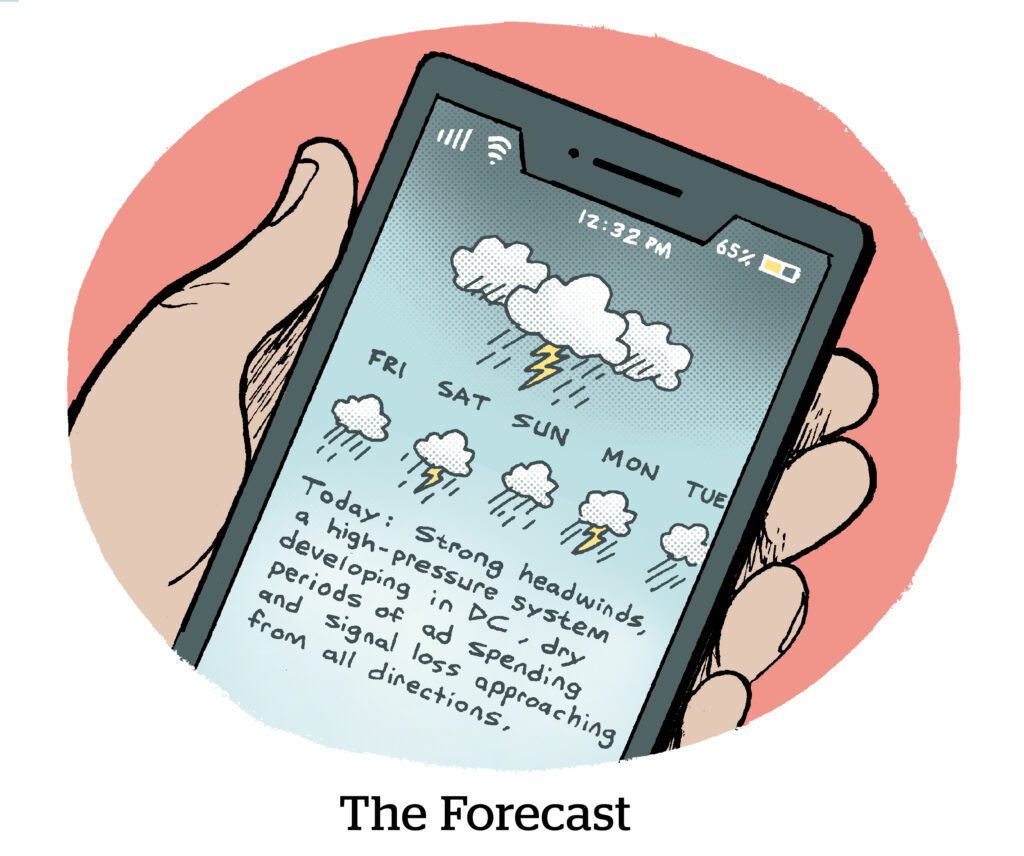
Dentsu is the latest company to revise its global ad spend forecast downward since its previous report in December. Why? The shaky economy, Adweek reports.
Digital dollars, which currently make up close to 60% of all ad spend, will decelerate to single-digit growth.
Although ad spend will grow worldwide by 3.3% to reach $727.9 billion in 2023 – and continue to grow by 4.7% in 2024 and 3.8% in 2025 – that growth is deceptive.

“Media price inflation is the true driver of this increase and hides the more lackluster reality: 2023 will be a flat year for ad spend,” Peter Huijboom, Dentsu’s CEO of international media, said in the report.
There are a few bright spots, though. Retail media, CTV, programmatic buying and search remain on the rise, with Dentsu predicting strong performance. Out-of-home, cinema and audio will see YOY growth as well.
Linear TV and print are not so lucky, which is not surprising. Both are expected to keep slumping.
One factor Dentsu’s forecast didn’t take into account, however, is the influence of generative AI on the ad industry and, by extension, on ad spend. Huijboom stated that future forecasts will track the impact of AI technology.
Show Me The Money
YouTubers are profiting more than other online creators.
Roughly half of YouTuber content creators make $500 per month for their videos, according to a survey of more than 1,000 creators by influencer marketing platform Aspire. Only 40% of Instagram creators and 36% of TikTok creators make that much, Ad Age reports.
Creators on YouTube also snag higher-paying brand sponsorships. Six-percent of YouTubers make $10,000 per month from brand deals, compared with 3% of Instagram influencers and 2% of TikTokers.
The reason? Higher engagement. Engagement rates on YouTube are 50%, compared with only 17% for TikTok.
YouTubers profit more than creators on other social platforms because they have the engagement numbers to justify charging brands higher rates.
Yet advertisers are drawn to TikTok and Instagram because they’re newer. This year, more brands have plans to increase their investments in Instagram (87%) than on YouTube (45%).
Wisdom (?) Of The Crowd
Twitter is outsourcing AI image detection to its users. What could go wrong?
On Wednesday, Twitter launched a pilot of Community Notes for images within tweets. Community Notes is a feature that Twitter says helps people collaborate to identify misleading tweets and then append contextual (and hopefully clarifying) information.
As generative AI technology gets better, it’s becoming more difficult to tell what’s real and what isn’t.
Crowdsourcing is Twitter’s response to an increase in deceitful AI-generated content on its platform, Gizmodo reports.
Sometimes this content is relatively benign and humorous. Remember the Balenciaga Pope? But then there are more sinister fake viral images, like the one posted last week of a supposed bomb attack on the Pentagon, which is far less amusing.
Until recently, detecting and flagging fabricated content would have been the responsibility of Twitter’s trust and safety team, 15% of which CEO Elon Musk recently laid off. He also slashed Twitter’s ethical AI team, which went from 17 people to just one member.
When Gizmodo reached out to Twitter for more detailed information about the new Community Notes pilot, it received a poop emoji in response.
But Wait, There’s More!
Twitter is turning to mobile ad marketplace Inmobi to sell some ads programmatically. [Digiday]
More on how Google is expanding into data clean rooms via PAIR. [Ad Age]
Why ad platforms will be the chief beneficiaries of generative AI for creative production. [Mobile Dev Memo]
You’re Hired!
Digital customer experience company Hero Digital nabs Chris Kostakis as CTO. [release]







