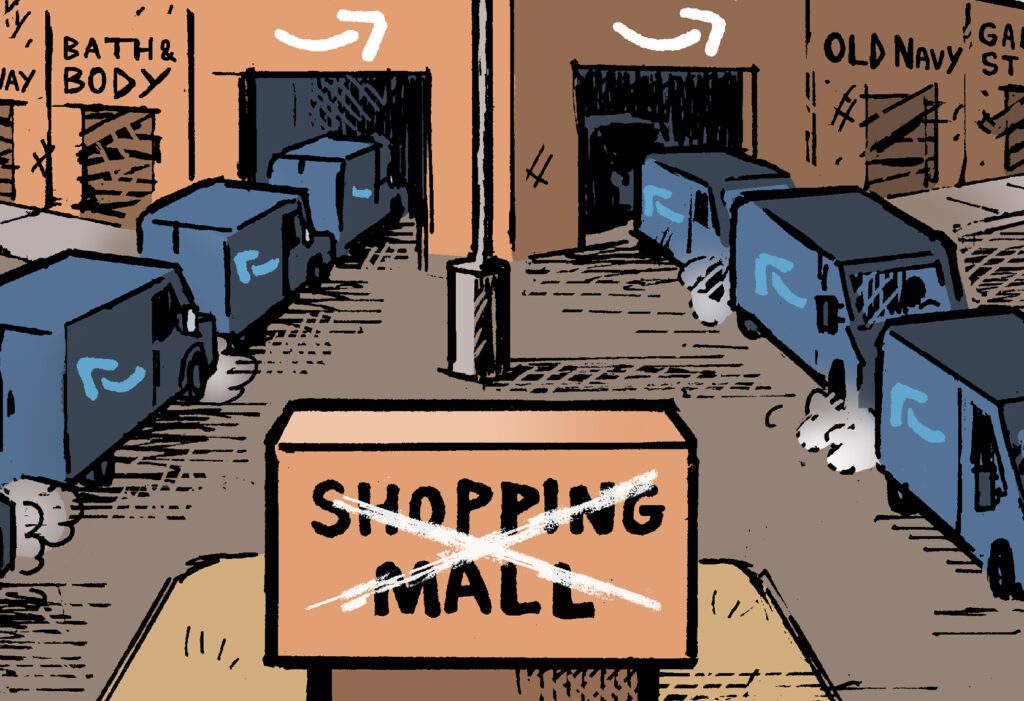
Drop Till You Shop
TikTok Shop, the platform’s payment processing and ecommerce service, underperformed in 2024 and underwent numerous layoffs and reorgs last year.
That being said, TikTok might be doubling down once again on Shop, argues Eric Seufert at Mobile Dev Memo.
TikTok Shop’s challenges are not unique. Google and Meta have tried and failed to establish themselves as full-funnel ecommerce players. But “full funnel” doesn’t just refer to marketing. There’s also the real-world supply chain of warehousing, fulfillment, returns and customer service.

Meta bet big with its own Shops and Checkout products, but has majorly backtracked, Seufert notes.
Google tried, too, with products like Express for voice-activated devices, and Google Shopping Actions, which became the marketplace “Buy on Google.” Those are all defunct now.
Google and Meta have no appetite for customer service and fulfillment logistics. For one macro-marker about what it takes to be truly “full funnel”: Google employs 180,000+ people, Meta almost 80,000. Amazon has 1.5 million employees.
TikTok, meanwhile, now requires all Shop sellers to use its fulfillment and logistics service or specific third-party partners. No more independent shipping.
“If TikTok wants to become a nexus of ecommerce discovery, it needs to prevent that discovery from being regrettable, which means playing a more central role in fulfillment,” Seufert writes.
Just Scraping By
Robots.txt files, or files on a website that specify the publisher’s regulations around AI scraping, seem like a great idea … except that AI bots have been breezing right past them.
It’s like that classic meme used to justify bad decisions: “That sign can’t stop me because I can’t read!”
But the bots can read – they’re just being trained to find workarounds to the regulations, like masquerading as human visitors. Indeed, according to a report from content monetization platform TollBit, 42% of scrapes by OpenAI’s RAG agent “ChatGPT-User” were from sites that explicitly blocked the agent.
AI companies are trying to “get around those defenses,” Toshit Panigrahi, co-founder and CEO of TollBit, told Digiday, but publishers can also see the demand for web content as an “opportunity” to find more ways to profit.
And publishers need some new ways to monetize.
TollBit’s research determined that CTRs from AI referrals dropped in 2025 from 8.8% in Q1 to 1.33% in Q4 on sites with AI content licensing deals – a bigger decrease than on sites without licensing deals.
A Resellers Market
Estée Lauder filed a lawsuit against Walmart alleging the retailer sold counterfeit products, Reuters reports.
For Walmart, this suit is part and parcel of its third-party marketplace launch. Many of its seller accounts (one-third of which are Chinese businesses) resell brand-name items across Amazon, Alibaba or Temu.
Or Walmart.
The products detailed in Estée Lauder’s lawsuit aren’t exactly counterfeit; they’re resold. Perhaps the fragrances and cosmetics were diluted or degraded in some way. It’s more likely the age and integrity of the product wasn’t upheld.
Late last year, Amazon quietly announced an upcoming change for sellers that will end all “commingling” practices at the end of March.
Most people don’t know what “commingling” is; that’s fine. What’s important is that, for a brand like Estée Lauder, Amazon’s supply chain will no longer treat products that are the same ASIN (like one particular perfume line) as equal or valid alternatives if those products come from third-party sellers.
This gets back to the question of whether resellers of brand-name products, even unopened items, come with diminished quality.
In its suit, Estée Lauder argues that a normal shopper “would have reasonably believed that Walmart, and not third-party sellers,” offered its products.
But Wait! There’s More!
Lots of AI models run on tokens, but what does that actually mean? [Digiday]
Why 2016 is everywhere again, and what marketers should (and shouldn’t) do about it. [Chief Marketer]
The revenue and operational challenges OpenAI faces as it spins up an ads business [New York Times]
Tech workers are getting increasingly frustrated about their employers’ silence on ICE. [The Verge]
Popular sportsbook companies (and major sports advertisers!) like DraftKings and FanDuel are losing ground to bet-on-everything company Kalshi. [Business Insider]
AI hyperscalers like Amazon, Alphabet, Meta and Microsoft are going to ring up over $600 billion this year in capital expenditures. [Axios]
You’re Hired!
Teads Appoints Nirali Jain as North America managing director. [release]
Here’s today’s AdExchanger.com news round-up… Want it by email? Sign up here.