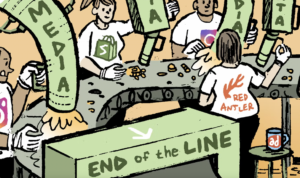

Is the marketing funnel as we know it officially dead?
Variations of that eternal question were posed over and over again to panelists at Paramount Advertising’s Performance Now summit in New York City on Tuesday.
But despite some speakers joking that “funnel” has become “the new F-word,” no one really took the bait. In fact, more than a few were quick to point out the funnel’s continued usefulness as shorthand for the marketer’s ultimate goal.

“We love the funnel,” said Aaron Sobol, Unilever’s head of media investment during one panel discussion aptly titled “The Flattened Funnel.”
“It’s easy to grasp, directionally,” Sobol said. “But there’s marketing language – and then there’s what consumers see.”
In other words, the funnel itself isn’t necessarily a problem, but rather that customers are converting through it more rapidly than ever. Marketers need to keep up without getting bogged down in their own metrics, jargon and pointless debates.
Direct connections
Pointless debates like the one about which is better, brand marketing or performance marketing.
“All media is performance media,” Sobol said, and can lead to some kind of measurable outcome – including, of course, CTV ads.
Unlike linear TV advertising, which is usually considered a brand awareness play, CTV can show up at different spots throughout the marketing funnel.
Amazon, for example, as both a publisher and a retail media network, is in a unique position to prove this phenomenon, said Krishan Bhatia, Amazon’s VP of global video advertising, speaking at the event.
Eight in 10 viewers of streaming ads across Amazon’s portfolio are also browsing the Amazon website, noted Bhatia, and 70% of those who were exposed to the ads eventually make a purchase.
“There’s a very direct connection between upper funnel and lower funnel,” Bhatia said, “and we believe closing that loop is really a huge advantage and opportunity for us and the industry at large.”
Of course, the connection between brand awareness and purchase intent is (marketing) scientific fact. Why else would the marketing funnel exist in the first place?
The difference today is that it’s becoming more measurable, said Lydia Daly, Paramount Advertising’s EVP of audience and marketplace intelligence.
“You can now get outcome-level data sales lift across all of these ad formats,” she said, “even the ones that we traditionally considered as awareness only.”
Into the funnel
But how do you measure across the full funnel in television advertising – and, more importantly, how do you decide what to measure?
Tracking events at the bottom of the funnel, like sales, is a no-brainer. But EDO, an outcomes-based measurement provider, prefers to focus on behavioral outcomes in the middle of the funnel, said Laura Grover, SVP and head of client solutions.
Not only are mid-funnel metrics usually available in a “very timely” manner compared to other measurable values, Grover said, but share of search can often be a “leading indicator” of market share.
But the top of the funnel can’t be ignored either, especially now that sales volume is down among many brands, said MikMak CEO Rachel Tipograph.
Publishers with CTV inventory should lean into the fact that they can help drive sales and attract new customers, she said.
Because “to bring new consumers into the funnel,” said Tipograph, “you need to be top of mind.”