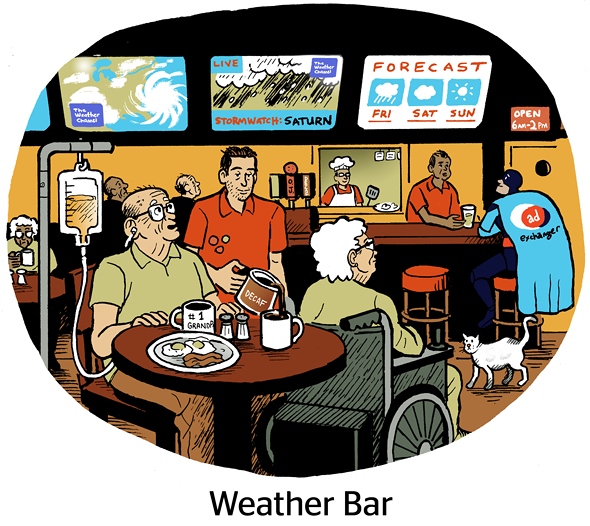
The Weather Company wants to know not just how weather forecasts make people feel, but also how they make people react to ads.
TWC is building a monetization model that treats weather as both a contextual and an emotional signal, its director of measurement, Shannon Ferguson, told AdExchanger.
After about a year of testing with neuroanalytics marketing research firm Neuro-Insight, her team is betting that the dread of a washed-out holiday or the relief of a sunny stretch ahead can shape how people receive ads on TWC’s The Weather Channel app – and how those ads perform through the funnel.
The goal is to “understand how weather triggers the subconscious mind – basically, which neural pathways in your brain light up when you process particular advertising alongside certain forecasted data,” Ferguson said.
More specifically, neuroanalytics testing is shaping how TWC thinks about when the ad experience should lean into awareness or nudge users toward a purchase.

Meanwhile, AI measurement and outcomes vendors are multiplying, putting more pressure on publishers to demonstrate their value using new agentic solutions. TWC is navigating that shifting marketplace by combining neuroscience intelligence and internal AI tools with a measurement approach that’s agnostic on third-party vendors.
The strategy is still a work in progress. But TWC’s approach offers a concrete look at how one publisher experiments with emerging tech like neuro data and agentic AI.
Weather and “emotional targeting”
TWC has always seen weather as a strong contextual signal for ads. But through its neuro research, TWC has come to see weather as an emotional signal, too.
The company ran a thought-leadership project with Neuro-Insight last year to examine which parts of the brain activate when people view different combinations of forecast data and ads and how this activity affects attention and memory.
To build on the findings from the Neuro-Insight study, Ferguson’s team is now trying to align ad exposure with those emotional states.
“It’s about ensuring the brand message lands when the user is in the right frame of mind to actually care,” she said.
For example, Ferguson said the company has to keep in mind that weather is relative market by market, even when it runs national campaigns. A recent activation with S.C. Johnson applied this logic. While some regions experienced rainfall, other areas enjoyed ideal weather, which changed where certain creative executions made sense, she said.
TWC has used its neuroscience framework to build what it calls emotional targeting. This approach identifies the emotional state a user is in when they check TWC’s app, then matches the ad strategy to that mindset across awareness, consideration and purchase.
TWC is now evangelizing this strategy in all of its public appearances, Ferguson added, including at the Cannes Lions earlier this summer.
Third-party-first measurement
In addition to experimenting with tying emotional targeting to outcomes, The Weather Company runs a mix of measurement strategies across the full funnel that should be familiar to most publishers.
“We’re still doing traditional brand studies, but we’re also diving into attribution studies to see how weather – as a real-time signal – drives actual behavior,” she said. “It’s less about chasing identity and more about understanding context, which is proving to be a much more reliable indicator of intent.”
TWC also maintains an in-house attribution solution that ties its impressions to actions on advertiser sites and assembles a consumer journey view. Ferguson sees that capability as a way to give sales and clients a more complete picture of what worked and what did not.
Even with those in-house attribution tools in hand, Ferguson said she does not want measurement to become a closed system.
“We don’t do a lot of first-party measurement or build much in-house, because we shouldn’t be grading our own homework,” she said. “It’s easy for us to say how wonderful we are, but it’s better when a third party shows you actually drove the lift.”
Because advertisers and agencies already have their preferred measurement providers, Ferguson’s team works inside those existing stacks rather than forcing clients onto a proprietary framework.
However, The Weather Company runs a vendor certification process that checks for privacy and compliance before it signs on with a measurement provider. The team pays close attention to compliance with privacy regulations like California’s CCPA and the EU’s GDPR, Ferguson said.
That posture has become more important as AI-driven outcomes vendors crowd into the space. Ferguson said she’s seeing more pitches from companies that claim access to detailed sales and credit card data, often at aggressive price points.
“The AI space has rapidly increased the outcome piece of measurement,” she said. “There are so many new companies that are competing with each other right now, so it’s really coming down to what you can actually offer, what data you actually have and then cost.”
AI agents in the sales flow
Alongside carefully weighing external AI partners, Ferguson’s group has begun building its AI sales tools. These tools sit on top of internal data and campaign reporting, and they help the measurement team synthesize information faster and tell clearer stories about customer journeys.
Those AI tools are part of TWC’s broader agentic workflow, which has a measurement research agent at its core, Ferguson said. All of these agents pull in performance data, campaign metadata and takeaways from prior campaigns to produce drafts of stories and recommendations, which the team then reviews.
Still, added Ferguson, as more AI vendors enter the market and more publishers test internal agents, the line between reporting and strategy in measurement will likely continue to blur.
As AI reporting becomes more ingrained in strategic decision-making, Ferguson’s team has had to take the good effects of AI with the bad. She is candid about hallucinations and other issues that come with generative systems. The agents sometimes surface incorrect patterns that the team has to catch, yet they also reveal useful insights that might have taken much longer to find manually.
Ultimately, the payoff Ferguson wants to see from these AI investments is faster insights and deeper involvement by her team in monetization decisions. And in those aspects, AI is already paying off.
“We’ve moved past just reporting numbers,” she said. “We’re now part of the strategic decision-making process, helping clients leverage weather signals to reach users in specific mindsets – from the initial RFP all the way through to the final campaign execution.”