

AI is a double-edged sword for publishers.
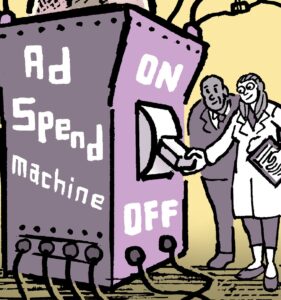
On the one hand, agentic AI tools are helping publishers streamline ad sales and operations, with the efficiency gains producing incremental revenue. But, on the other hand, publishers are losing monetizable traffic to generative AI-powered search. And internal optimizations may not be enough to offset those traffic losses.
Stephanie Layser, global head of publisher ad tech solutions at Amazon Web Services (AWS), has spent her career in ad tech on the sell side focusing on how publishers can get the most out of digital advertising. And publishers are getting some encouraging early results from deploying new AI tools, she said during the AWS Monetization Symposium in New York City on Wednesday.

Take Amazon-owned Twitch. Before it worked with AWS to automate parts of its sales process, the video platform suffered from data fragmentation that left 20% of advertisers’ campaign questions unanswered.
But Twitch worked with AWS to centralize its marketing data and created retrieval augmented generation (RAG) connections to give AI assistants access to that centralized data. As a result, Twitch has seen 25% higher revenue so far this year from advertisers that use AI solutions, Layser said. And these AI-enabled accounts are generating 120% more revenue compared to self-service accounts.
Layser spoke to AdExchanger about how AI is transforming how advertisers value media and the implications for publishers large and small.
AdExchanger: Do you think AI-powered outcomes-based measurement will democratize ad spend by pushing budgets to the best-performing publishers? Or will Big Tech platforms be best positioned to prove their value, resulting in the bulk of ad budgets remaining locked inside big platforms?
STEPHANIE LAYSER: Lack of scale has driven agencies to concentrate on a few big players versus being able to take advantage of smaller, more niche publishers. If negotiations are powered by AI agents, then it’s not as heavy of a lift to be able to do more ad buys with smaller publishers.
Now, smaller publishers need to be centered on what service they provide and the relationship they have with consumers. When you get a deep understanding of customer insights, that gives you the data to help provide outcomes that are equal to or better than the bigger platforms.
How do publishers prepare their data to take advantage of RAG integrations?
If you don’t have your customer data and your advertising transaction data in a place where it’s usable and organized, it’s very difficult to build an application. Oftentimes, media companies will have a marketing team focused on subscriptions. Maybe they have a sign-up flow where they understand different bits and pieces about a user. Then, their advertising team has a different data set in a different place.
In order for them to manually move that data together, they have to hand-select the right data points that are going to provide outcomes. But you’re not entirely sure exactly which data points are driving outcomes. Therefore, you can’t manually decide. It’s better to have it all together so you can let the technology optimize.
Increased AI activity online is reportedly ballooning publisher server costs. How can pubs keep server costs manageable?
I’ve also been reading the same reports, and it looks like the general trend is more bots are looking at content. So content licensing will continue to be a big area for publishers.
Just like the advertising ecosystem introduced measurement to be able to value each individual advertising slot through a DSP, I believe that eventually there will be a marketplace where we will be valuing individual pieces of content for use inside LLMs. We need to be really cognizant of making sure that revenue stream opens up for publishers and that it’s built in a way that’s beneficial.
What was your reaction to Cloudflare’s move to an opt-in model for AI scraping?
It’s fair. High-quality content takes money to be produced. So anything that can help our customers make more money is good for us.
More automation and algorithmic decisioning means more black boxes. How do AI tech providers balance automation with transparency?
I’ve always been a massive proponent of open-source standards. It’s part of the reason why I’m on the Prebid board. What helps increase transparency in ad decisioning is interoperability with a single open-source framework.
At AWS, we’re helping our customers to accelerate direct connectivity with Prebid and other platforms. That can help provide data on not only the outcome of a particular auction and whether it was fair, but also how publishers can use the outcome for their product innovation.
How will Amazon building its own Prebid adapter contribute to that transparency?
I can only speak on behalf of AWS, but we’re very excited about Amazon Ads and Amazon Publisher Services participating in Prebid. Now we’re in an ecosystem where almost everybody interoperates with a single industry framework. That really helps with the data story that we were talking about.
Just one more hard-hitting question: As a huge New York Mets fan, how are you feeling about this season so far? Which do you want to see them add before the trade deadline, another pitcher or another bat?
We need pitching. June was stressful for me, and it’s crazy because, last year, June was so magical. I think I have post-traumatic stress from the 2022 season, where we came out so hot and then tanked. But the last week or two has been giving me hope, being able to take the series from the Yanks. So yeah, I ride the wave, man.
This interview has been edited and condensed.
For more articles featuring Stephanie Layser, click here.