Navigating New Brand Safety Complexities: A Digital Marketer’s Perspective
Media governance measures advertisers can put in place to navigate the complexity of brand safety and gain better control of the quality of their media spend.
How big of a deal is The Trade Desk’s top 100 list? AdExchanger spoke to industry experts for their reactions and bounced some of their hot takes off The Trade Desk.
Future believes its new monetization offering can succeed where other publishers have struggled with selling ad tech and consulting to third-parties.
The open web is getting smaller, with the squeeze happening in two directions: Curated deals are skimming the cream off the open web, and exposed made-for-advertising websites are shuttering.
Pivoting to a “premium internet” is like avoiding the parts of town that have been blighted by illicit activity. The only real solution to MFA is for the dollars to dry up.
The phaseout of third-party cookies kicked off the sell-side curation trend. But it’s also being driven by advertiser concerns about open web media quality and the need to enhance publisher contextual signals with audience data.
Made-for-advertising (MFA) sites are roosting in reputable publishers’ subdomains. IDs are declared inconsistently. And the established third-party measurement companies are sitting on the sidelines.
Advertisers worried about MFA could take a cue from the mobile app ecosystem and focus on performance instead of viewability.
The practice involves monetizing resold subdomains jammed with recycled MFA articles produced by notorious content farms.
Buyers could solve many of the issues they have with the open web by focusing less on viewability and clicks and more on driving performance outcomes, says Goodway Group director of strategic partnerships Andrea Kwiatek.
MFA sites simply don’t belong on ad exchanges. And the industry already has the tools it needs to eliminate MFA from the supply chain.
Integral Ad Science had a decent Q1 – especially in comparison to its direct competitor, DoubleVerify. Even so, frustration with the opacity of third-party brand safety and ad verification providers is increasingly bubbling to the surface.
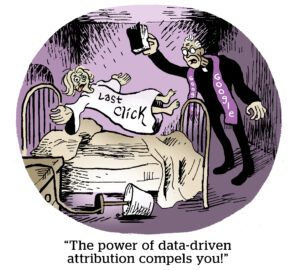
Enjoy this weekly comic strip from AdExchanger.com that highlights the digital advertising ecosystem …
Why does MFA continue to thrive? MFA monetization benefits everyone in the ad tech ecosystem that collects a revenue share. That includes both SSPs and DSPs.
Here’s today’s AdExchanger.com news round-up… Want it by email? Sign up here. Not-So-Sweet Deal A campaign without reporting is like an undressed salad. But Sweetgreen has to eat it anyway. “I’ve been pushing my Google reps,” the brand’s director of media and growth Jeff Lin declared during a panel at the Possible conference in Miami, Adweek […]
Rising levels of invalid traffic and MFA sites – together with the number of intermediaries taking their cut – are raising the cost of inventory. How can mobile demand platforms avoid waste and the costs associated?
YouTube is expanding its affiliate and shopping monetization products. Plus: Publishers are revamping their site and content quality to bear as little resemblance as possible to made-for-advertising sites.
Industry experts weigh in on Forbes’s MFA subdomain and why ad verification tools still regularly fail to flag some instances of alleged SIVT.
Garcia made waves last year when she publicly resigned her role as UM Worldwide’s chief privacy and responsibility officer.
URLs and domains – even those of big-name publisher brands – cannot be trusted in isolation. Buyers need to look at page-level data, too.
In today’s newsletter: Adalytics reveals Forbes was running a separate MFA sub-domain; The New York Times seeks to use attention benchmarking to validate its premium publisher status; and Google is reportedly looking to buy HubSpot.
Enjoy this weekly comic strip from AdExchanger.com that highlights the digital advertising ecosystem …
In today’s newsletter: Criteo gets MRC accredited for display impressions and click metrics; Google Analytics and Google Ads now use the same definition for “conversions”; and how marketing mutated the beverage aisle.
Retail media is built on its attribution quality, but real purchases can be gamed by programmatic metrics and create perverse incentives for RMNs to serve ads across low-quality inventory.
Enjoy this weekly comic strip from AdExchanger.com that highlights the digital advertising ecosystem …
In today’s newsletter: The CMO role is disappearing, but it may not be a bad thing; MFA sites use gen-AI images to game Facebook’s algorithm; Apple’s policies should end fingerprinting, but enforcement falls to app developers.
Why the 4A’s is hosting secret meetings to redefine MFA from “made for advertising” to “made for arbitrage.” Plus, a new report from Adalytics reveals that MFA-blocking solutions aren’t as effective as tech vendors claim.
Despite the backlash against MFA websites, there is still no industry standard to define MFA. So the 4A’s is hosting monthly meetings between buyers and sellers to nail down more explicit criteria for what constitutes MFA.
Practically every ad tech vendor has put out a press release in recent months full of bluster about cutting out made for advertising sites – and yet supply sources remain oversaturated with garbage inventory.
IAS is expanding its anti-MFA solution to identify what it calls “Ad Clutter” sites, which mimic MFA ad loads but don’t operate with an ad arbitrage model.