

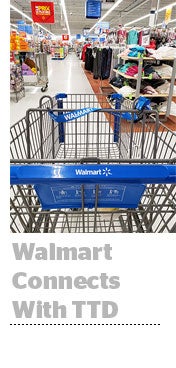
Walmart is building infrastructure to support its fast-growing retail media business. After more than a year of testing, it settled on a custom-built version of the Trade Desk DSP.
AdExchanger first reported last January that Walmart was testing two rival DSPs, the Trade Desk and Xandr.
Walmart’s DSP is a separate, walled-off version of the Trade Desk, filled with exclusive Walmart data and inventory (and connected to a different cloud, given that using Amazon Web Services is verboten for Walmart). The DSP uses a self-service model to give buyers more transparency, completing its evolution from the ad network-style Walmart Exchange that felt like a black box to buyers. Walmart first unveiled its self-serve approach last year.
The custom-built Walmart DSP is filled with goodies to entice buyers. On the data side, buyers can add exclusive first-party segments from Walmart that account for a shopper’s buying preferences. And buyers can also see online and offline conversion data – a rare form of closed-loop measurement that makes attribution and optimization much easier. Plus, the Walmart DSP will incorporate weather signals and store-level precision in geotargeting. Imagine being able to show hot chocolate ads before a big snowstorm.
The Walmart DSP will also be the only way to access Walmart’s advertising inventory,– like Walmart.com and in-store ad placements. Streaming platform Vudu was going to be part of the inventory mix – until Walmart sold it to Fandango last spring.

Plus, Walmart offers enough scale to reel in buyers, claiming it has 150 million weekly customers. Its new loyalty program, Walmart+, will give buyers additional data points to serve relevant ads.
Moving to the Trade Desk DSP means Walmart’s media group operation is saying goodbye to Xandr on the media group side of its business. Since it was known as AppNexus, Xandr had a deep relationship with Walmart. It powered the bulk of Walmart’s retail media operation across the DSP part of its business, and Walmart the marketer continues to use Xandr. Triad Retail Media, which sold Walmart inventory, also used AppNexus tech.
The finishing touches are still being put on the DSP. Buyers will be able to activate on the platform in advance of the winter holidays this year.
The retail media opportunity
Walmart’s push into retail media is part of a growing trend that includes Amazon, CVS, Target and Walgreens. “Retail media is the new black,” Profitero CEO Bryan Weiner said in a recent AdExchanger column.
Many of these retailers want to replicate Amazon’s runaway success in the advertising market. But there’s also a technical reason why retail media is poised for success.
When third-party cookies go away next year, marketers who previously relied on third-party data companies to reach potential consumers will be left in the lurch. Instead of working with companies that amalgamate data signals from multiple companies, they’ll have to go to a single source.
This conundrum creates need for solutions like Walmart Connect – which can sell its shopper data on 150 million weekly shoppers to allow buyers to activate. While the scale will still be smaller and likely more expensive than what third-party data companies offer, retail media data will be the only horse in town.
“We’ve built a substantial business that can serve clients in a way no one else can – as a closed-loop omnichannel media company,” said Walmart chief customer officer Janey Whiteside in a statement – which will hold even more truth come 2022.







