

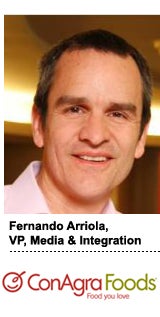
 For CPG companies like ConAgra, buying media using sales data from retailers like Walmart offers a way to finally close the loop between media spend and sales. But some are concerned about the lack of transparency that comes with using the Walmart Exchange.
“Walmart has more data than we do,” said Fernando Arriola, VP of media and integration at ConAgra. “Advertisers don’t have clarity into the type of data they are using, and we have varying levels of visibility into what they’re doing.”
Walmart buys media for retailers like ConAgra through its exchange (WMX), announced last July, and other retailers are likely to follow. But ConAgra doesn’t know what data points Walmart is collecting and using to purchase the media.
Or what it might gain from having access to such data. “If the retailers have data that we don’t have exposure to, what kind of business advantage do they have in how they work with us?” Arriola said.
Given the upper hand Walmart and its peers have in the data department, Arriola has concerns that these media-buying retailers will be less willing to tackle other big issues like viewability and fraud.
“When we’re doing something with Rocket Fuel, where we do guaranteed in-view or non-human preventions, Walmart Exchange may choose not to do it, or not be centralized or focused enough to want to do it,” Arriola said.
Walmart also doesn’t allow conquesting, or targeting a competitors’ consumers, using its data, because it doesn’t serve its interests. “We both have the objective of selling more stuff, but the retailers’ objective is increasing overall basket ring size,” Arriola said. “They don’t want you to target SpaghettiOs and have consumers replace that with [ConAgra’s] Chef Boyardee.

Walmart, and other retailers, are free to treat different CPG companies in the space differently. Arriola doesn’t know if ConAgra receives the same access to sales data as its competitors, or what other type of data its competitors might have that it doesn’t. “We don’t know if Kraft, P&G, Kellogg are doing the closed sales loop,” he said, through privileged relationships with retailers.
But he’s also excited about the complex capabilities Walmart Exchange could bring to its media buying. “Walmart thinks that there is a competitive advantage for them in using weather-triggered data down to the store level,” Arriola said. A rainstorm in Florida could change buying behavior. And, in turn, partners could run ads targeted to the time they know shoppers change their behavior.
“It’s looking at the different digital triggers,” he added. “We haven’t done weather in a digital programmatic way with Walmart yet, but they’d definitely be game.”
Within the past two years, ConAgra has started working with smaller grocers to share data when it’s mutually beneficial. That may mean a retailer will go to ConAgra to figure out why a certain category isn’t performing. In turn, ConAgra has access to sales data that it can use to evaluate the efficacy of its media. But this kind of relationship is still in its “early days,” Arriola said.
Besides working with programs like the Walmart Exchange, ConAgra has other options, such as using third-party vendors like Nielsen Catalina or Nielsen Homescan.
When working with a retailer that will share data, it can use data-onboarding capabilities around store loyalty cards to enable purchase-based targeting.
ConAgra could search among a grocery store’s loyalty card members who have bought all-beef hot dogs, match up the email attached to the card using a provider like Epsilon, and then target those people online.
Overall, Arriola describes ConAgra as a conservative player that likes to watch other players’ approaches first before devising its own.
“We didn’t jump in heavy with the programmatic space, and one of the drivers for that was the lack of transparency with agency partners and not having a media confidence in the algorithms,” Arriola said. “We figured we might have more upside with digital using existing tools like purchase-based targeting with partners like Yahoo Genome [now retired and part of “Yahoo Advertising”].
Programmatic buying will be a growing part of its business, as it expands off tests it has done with partners like Rocket Fuel.
This year, it’s finalizing its technology stack, including its DSP and DMP. To combat fraud, it plans to take a blocking approach rather than a monitoring approach, to make the fraud-reduction process less labor-intensive for its agency.
And despite its ability to do purchase-based targeting and buy media through partners like the Walmart Exchange, it continues to face attribution challenges. “The dynamic with programmatic for us it that we still haven’t been able to figure out who acts on the advertising,” Arriola said, “and that’s true for the entire CPG space.”








