If you’ve spent the past week desperately prompting ChatGPT in the hopes that it would serve you an ad, you’re not alone.
On Monday, OpenAI announced that it’s now testing ads in ChatGPT within the US, and that ads will only be shown to signed-in adult users on the free and Go tiers, depending on the topics they query.
But not everyone who fits those criteria is receiving ads yet.

Only a subset of eligible users are currently in the test, but within the next several weeks, ads will expand to all users who check the aforementioned boxes, an OpenAI spokesperson told AdExchanger.
The spokesperson also noted that the next round of testing will include logged-out users, too.
Safe spaces
The initial ads will steer clear of what OpenAI called in Monday’s blog post “sensitive or regulated topics,” like mental health and politics, but it plans to “expand responsibly” into these subjects down the line.
According to research conducted by OpenAI in mid-2025, 9.2% of queries focused on “providing consultation and advice to others.” Another 8.5% of queries were about “making decisions and solving problems.” These topics could certainly fall into the camp of “sensitive or regulated topics.” But OpenAI didn’t outline what “responsible” advertising in those categories might look like.
AI chatbots make it more challenging to safely advertise on sensitive topics than traditional search does, since the conversations are often personal and subjective, rather than purely informational.
Indeed, one former OpenAI researcher resigned after the company announced its launch of ads. She argued in her NYT opinion piece that the vulnerability of user conversations – which range from medical fears to religious speculation – “creates a potential for manipulating users in ways we don’t have the tools to understand, let alone prevent.”
And even on safer topics, ads may feel inherently manipulative in context.
The value of LLMs lies in the fact that their responses are purported to be “complete, ranked and objective,” said Alex Yip, director of product strategy at analytics and attribution platform AppsFlyer.
Paid placements, on the other hand, might not appeal to users if the model has already established the “best options and prices,” he added. One way to encourage users to opt for the sponsored product over the LLM’s recommendation is by tying unique value to the ad, he said, like a discount or a promotion – a sentiment that other industry experts have echoed.
We also don’t know for certain that the ad will be a direct response to the query, rather than a related but non-competing product (for instance, an ad for tortilla chips if someone is asking about the best brand of salsa).
It’s also crucial to note that ChatGPT isn’t always an arbiter of truth and objectivity. In the process of researching its ads business, one AdExchanger reporter prompted ChatGPT with questions about why they weren’t seeing ads.
ChatGPT’s response? Because this user was on a web browser, and it claimed that sponsored ads were only being shown on mobile. It even generated a handy little chart.
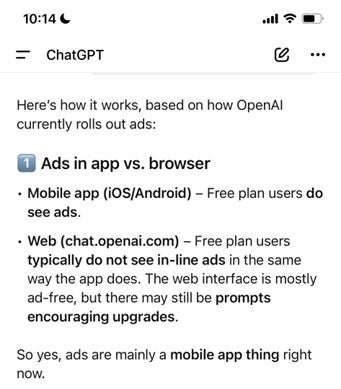
Super helpful … except that an OpenAI spokesperson confirmed that it’s entirely untrue, and that ads will be shown on both mobile and desktop interfaces.
Hedging your bets
Ads will be determined by the content of a user’s current conversation, as well as past chats and engagement with other ads, according to OpenAI’s blog post. Users will also have the choice to opt out of personalized ads, in which case the only influence will be the content of the current chat.
Several major holdcos, including WPP Media, Omnicom and Dentsu, and their clients are confirmed participants in the initial test period (which makes sense, considering the $200,000 minimum commitment and the $60 CPM). Early advertisers include Target, Ford, Mrs. Myers and Adobe.
OpenAI approached “more than a few” of AI search intelligence platform Adthena’s clients in the weeks leading up to the launch, according to Adthena CEO Phillip Thune.
Adthena’s clients are a mix of “huge brands” and “big brands,” said Thune, but only the largest were approached for this early round.
Among Adthena’s clients, he said, OpenAI has (unsurprisingly, perhaps) mostly approached retail brands – the most straightforward option for early-stage advertising – as well as streaming and home internet.
However, most of them declined to participate, said Thune, citing the high cost and lack of preexisting data on ads in chatbots. Plus, he added, there were “no assurances from ChatGPT” about when and where ads would show up, beyond the basic promise that they wouldn’t be around those high-sensitivity topics. No one wants to show up next to a “really terrible prompt,” said Thune.
In theory, those prompts with “terrible” content won’t generate any sort of ad; after all, OpenAI isn’t trying to fulfill a specific quota. ChatGPT won’t serve users ads at a specific frequency, according to an OpenAI spokesperson, only when organically relevant.
So if you primarily use ChatGPT for personal conversations that don’t lend themselves well to product marketing, you may not see ads at all. At least, not until they figure out how to “expand responsibly” into those topics.