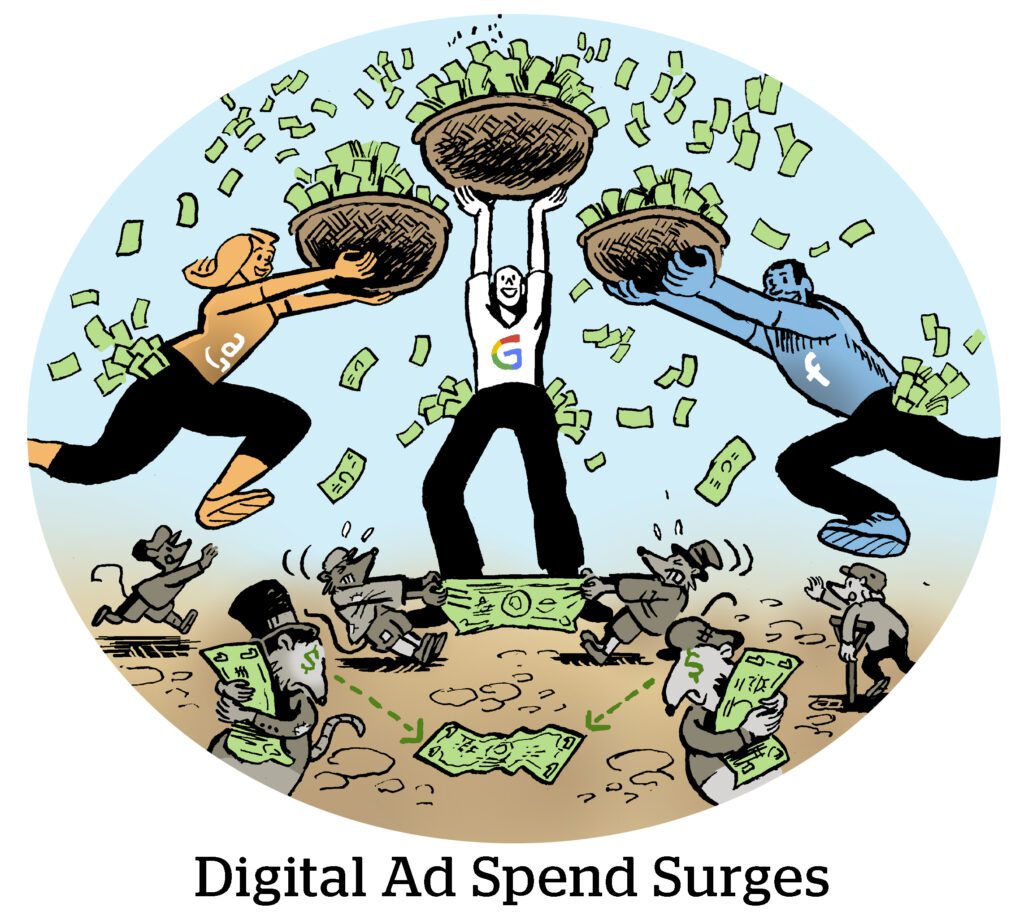
Describing Google’s revenue growth has become a problem, as it so vastly outpaces the human capacity to understand large numbers and percentage growth rates.
Since the company reported total revenue for Q4 of $113.8 billion on Thursday, perhaps a walk down memory lane of Alphabet Q4 earnings calls could provide some useful context.
Nine years ago, Alphabet’s Q4 2016 revenue was reported at $26 billion. That was back when CEO Sundar Pichai might use the word “programmatic” multiple times on an investor call, even citing the company’s third-party programmatic revenue as a “strong contributor” to growth.
Jump to Q4 2021, and Google made $75 billion. During Q4 2024, Google made $96 billion at a time when other ad-supported tech companies were crumpling.

In addition to its eye-popping total revenue for Q4 2025, Alphabet also cleared $400 billion for the full-year 2025, of which $132 billion was profit.
Alphabet’s market cap has almost doubled in the past year, as it is now a $4 trillion company.
Beyond ads
Google is the ads behemoth. But as the company’s investor call showed, ads are the skeleton for something that is growing in entirely new directions.
For instance, Mark Mahaney of the investment bank Evercore asked about YouTube’s 9% growth rate in Q4 2025, which lagged the growth of other ad channels.
There were some systemic effects, said Chief Business Officer Philipp Schindler, such as the drop-off from the election cycle. “But taking a step back, I think it’s important to think about YouTube ads and subs holistically,” he said.
YouTube Music and other subscription services had particularly strong quarters. And the net result is that “when a user shifts from being an ad-supported user to a YouTube Music and Premium customer, it has a slightly negative impact on YouTube ads revenues, but a positive impact on our business,” he said.
Ads also come up only sparingly among investors anymore. Ads remain the mechanism of monetization; that hasn’t changed at all. But the interest and metrics championed by Google’s leadership and investors are more to do with the daily token processing.
When Google boasted of its major new client “wins,” citing Wendy’s, Woolworths, Kroger and the Schwarz Gruppe, which operates Lidl among other grocery chains, it meant as enterprise cloud customers.
“Gemini is becoming the AI engine for the world’s most successful software companies,” Pichai said.
And the growth of Google’s own ad tech software is one of the main beneficiaries of its advancements in AI and with new Gemini models. For instance, he said some 70 million creative assets were AI-generated in Q4 for Google’s AI Max and Performance, which are its AI-based ad-serving products. And Gemini models reduce the number of wasted ads as they improve in query matching and ranking. Google also now serves ads more effectively on longer, more complicated search queries (in traditional search), which previously would have gone unmonetized.
To the degree that Google’s ad business goes up, it is tied more and more to the agentic AI and cloud-based business development.
Which, fair enough, Alphabet’s capital expenditures to support its AI growth reached $91.4 billion in 2025, split approximately 60% in servers and 40% in data centers and networking equipment, said CFO Anat Ashkenazi.
For 2026, Ashkenzai told investors the capex investment total is likely to fall between $175 billion and $185 billion.
That’s a lot of ads.