

 “Marketer’s Note” is a weekly column informing marketers about the rapidly evolving, digital marketing technology ecosystem. It is written by Joanna O’Connell, Director of Research, AdExchanger Research.
The news last week that the New York Times is opening restrictions on programmatic access to its inventory made a big splash – understandably, given the Times’ fits and starts in this area over the last couple years.
Though it’s easy to pick on the Times for being slow to move in programmatic* (which isn’t necessarily right, by the way – it seems more accurate to say that they moved too early relative to the market, a couple years back, felt they got burned and pulled back as a result), the reality is that this is great news: if the Gray Lady recognizes that this thing called “programmatic” is much more than just real time bidding in an open exchange, but rather a new mode of conducting business transactions and operationalizing some key facets of ad buying and selling, well, who’s left to doubt?
It reminds me of one of my findings from the “State of Programmatic Media” survey we fielded (the results of which we presented at Programmatic I/O, as many of you may recall, and which is currently being turned into a report, as I’ve mentioned before). Specifically, when I asked publisher respondents to rank the benefits of “programmatic selling” from most beneficial to least, they overwhelmingly favored “operational efficiency” and, I was happy to see, “better sell through.”

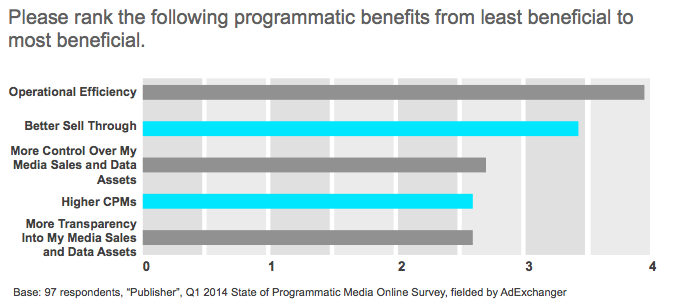
So publishers increasingly believe programmatic can streamline business and operational processes and help facilitate yield maximization (when it works like it’s supposed to, which is still, let’s face it, a big project necessitating participation from the whole ecosystem, to bring to full fruition).
To quote Michael Zimbalist, SVP of Ad Products and R&D for the New York Times, from his recent AdExchanger interview: “There’s no area of programmatic we’re philosophically opposed to going forward with. Programmatic is now part of an overall practice. We’ve recast our thinking around programmatic as part of a total yield-management practice…”
Progress!
Thoughts, comments, send them my way, as always.
Joanna
*Even our own cartoonist got in on the fun: https://adexchanger.com/comic-strip/comic-time-for-a-drink/
Follow Joanna O’Connell (@joannaoconnell ) and AdExchanger (@adexchanger) on Twitter.







