


TV ad measurement is in the midst of an overhaul from panel-based ratings to audience-based impressions.
And there has been positive progress. But that doesn’t mean the current state of measurement isn’t still … a big fat mess.
Luckily for advertisers, TV measurement is nowhere near as messy as it was just 12 months ago, said Kelly Metz, managing director of linear and advanced TV activation at Omnicom Media Group, speaking at AdExchanger’s Programmatic I/O conference in New York City on Monday.
The rise of programmatic TV advertising, for example, generates more data that TV advertisers can use to measure beyond age and demo.
One day, all TV ad spots on all screens will be bought programmatically – and TV buyers are learning to speak this new language, said Kelly Abcarian, EVP of measurement and impact at NBCUniversal.
But despite the growth of programmatic TV, buyers still lack the transparency they say they need to make informed media buys.

Full data transparency in media buying – which includes program-level insights and the ability to do more granular audience targeting – will be what bridges TV measurement into the future.
Panning the panel
Speaking of the future, ratings are out and impressions are in.
TV measurement should be about counting audiences and doing it accurately, said Andrea Zapata, EVP of ad sales, research and measurement insights at Warner Bros. Discovery.
And that’s why buyers want granularity, too. “I’m not using modeled data for digital [targeting] – I’m using pixel-based data to find cross-platform reach,” OMG’s Metz said.
More traditional metrics, like GRPs, are still relevant in legacy TV buys, but it doesn’t make sense to make TV buys based on “tiny, tiny panel data,” Metz said.
That doesn’t mean panels aren’t still valuable as a research tool, Metz said, they’re just not the path toward “always-on measurement.”
Be it linear or connected, TV buyers are now using television data sets that are modeled off of data from millions, not thousands, of households.
Netflix is too chill
Yet Netflix, which launches its ad-supported tier in early November, is sticking with panels for audience measurement, and both broadcasters and buyers are less than impressed.
Netflix made the right move in partnering with DoubleVerify and Integral Ad Science for ad verification – that’s just table stakes, Metz said. But Netflix’s choice of Nielsen’s Digital Ad Ratings (DAR) tool doesn’t blaze a trail.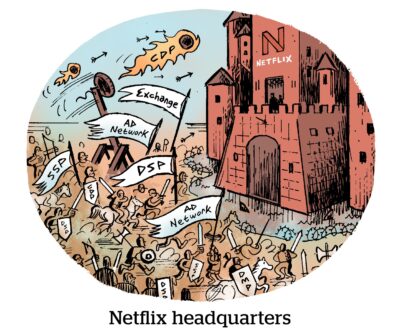
“I was hoping for bolder moves than we’ve seen so far [from Netflix],” Metz said. “Nielsen is not enough, and it is not appropriate for digital measurement.”
Only more advanced measurement capabilities beyond age and gender will bring value to advertisers and shareholders, she added, “and that is not DAR.”
Back to the future
But TV measurement is about more than just counting impressions.
The onus is on the content providers to prove the efficacy of an impression, Zapata said.
Even though TV marketers today do have a better understanding of their audiences, there’s a lot they still don’t see, including program-level viewership data and insights.
Buyers have been asking for this data to be made available in the media planning and buying process, but their pleas have largely gone unanswered.
“Today, I do not have transparency into what [shows] I can buy [against] and where I can run across … streaming properties,” Metz said (looking over pointedly at NBCU’s Abcarian). “And if I did, I’d be able to make smarter buying decisions.”
Sellers actually agree with this sentiment. Media owners want content quality to be a factor in measurement.
“You can’t detach content from reach metrics,” Abcarian said. “Brands need to understand the differences in their media environments,” she added, including how competitive advertisers are performing.
So, what’s the holdup?
Publishers have always preferred keeping their first-party data to themselves not just because they see it as a competitive advantage but because, well, it’s just easier that way.
The more data and programmatic inventory publishers share with third parties, the higher the risk of ad fraud and lower quality or less trustworthy ads.
Google claims that over half its YouTube ads are delivered through a connected TV – but YouTube doesn’t share data about its media that would help buyers contextualize the channel within the rest of their media buys, Metz said. “It’s a real frustration and challenge.”
And for all their talk about “democratizing media,” CTV publishers are still pretty reluctant to give buyers the data transparency they’re asking for.
“The holdup is concern around what measurement partners are doing to protect premium inventory,” Abcarian said.
The fact is, CTV publishers have “flooded the market with new supply and impressions,” Abcarian said, and TV ad quality (and consequently, the user experience) will suffer if TV measurement becomes a process of just “pushing and smushing impressions together.”
At the same time, Abcarian acknowledged that more transparency is necessary for responsible media buying.
Old habits die hard, but as an industry, “we need to usher in the change – not fear it,” Abcarian said.






