
 Using customer data to personalize or optimize individuals’ website experiences can increase conversion and customer satisfaction, yet a majority of digital marketing professionals do not prioritize it, according to two recent studies from Adobe and Econsultancy. As marketers leverage more digital tools, turning to real-time behavioral and existing customer data helps segment website visitors and personalize their experiences with product recommendations, search results and images or text.
The February 2013 “Realities of Online Personalization” study from Econsultancy, in association with optimization company Monetate, found that 94% of the 1,100 client-side and agency digital and ecommerce professionals consider the personalization of the web experience critical to current and future success. However, 56% of companies are not customizing the experience for consumers at all, and an additional 40% have only somewhat customized their sites.
Adobe meanwhile found that 65% of companies present less than 20% of their visitors with targeted content, while only 13% of respondents said that more than half of their onsite visitors see optimized content.


Additionally, marketers aren’t allocating enough budgets to see real success; 53% of digital marketers set aside less than 5% of their total marketing budget to the agency fees, professional services and technology needed for optimization activities, according to Adobe.
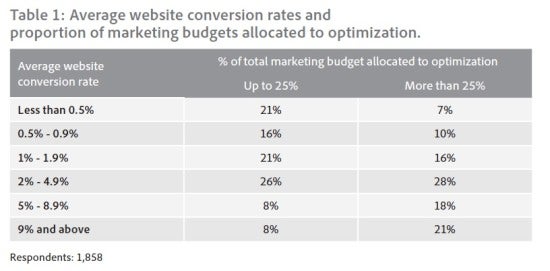
Yet for the 6% of marketers who are spending more than a quarter of their budget on optimization, those companies see a definite uptick in conversion rates; 21% see a conversion rate of 9% or higher, while only 8% of lower-spending marketers see the same conversion rate averages.
Of respondents in the Adobe survey, 15% said their customers had a very positive reaction, while 42% said they had a somewhat positive reaction. Only 3% said customers reacted negatively, while 39% said they had no opinion.
Additionally, two-thirds of client- and agency-side professionals told Econsultancy that what drove the introduction of more personalization was both improved customer experience and improved business performance.
With the clear benefits, what is holding these marketers back? Client-side respondents to the Econsultancy survey reported that IT roadblocks, legacy technology, lack of budget, lack of staff, and disparate data sources are the top five major barriers to adopting or improving website personalization.

When it comes to the data used, marketers turn to consumer profiles, stated preferences, behavior, social graph data and, in some cases, location, according to Adobe. In the Econsultancy report, 56% of client-side respondents and 61% of agency-side said they look at first-party historical customer data and segments. Real-time browsing data impacted 30% and 46% of client and agency respondents, while 20% of clients and 37% of agencies used third-party profiling data such as demographics.
Looking ahead, mobile targeting is a trend to watch. In the Econsultancy study, only 14% of client-side respondents said they were personalizing experiences on tablets and only 13% on mobile; however, 54% said they plan to personalize for both devices over the next year.
Adobe also focused on mobile, saying, “A theme throughout this year’s study is that mobile changes the personalization equation. A ‘nice to have’ on the desktop, personalization is essential for mobile where users’ attention and ability to navigate is limited. Mobile also introduces location as a powerful variable for what content to deliver.”








