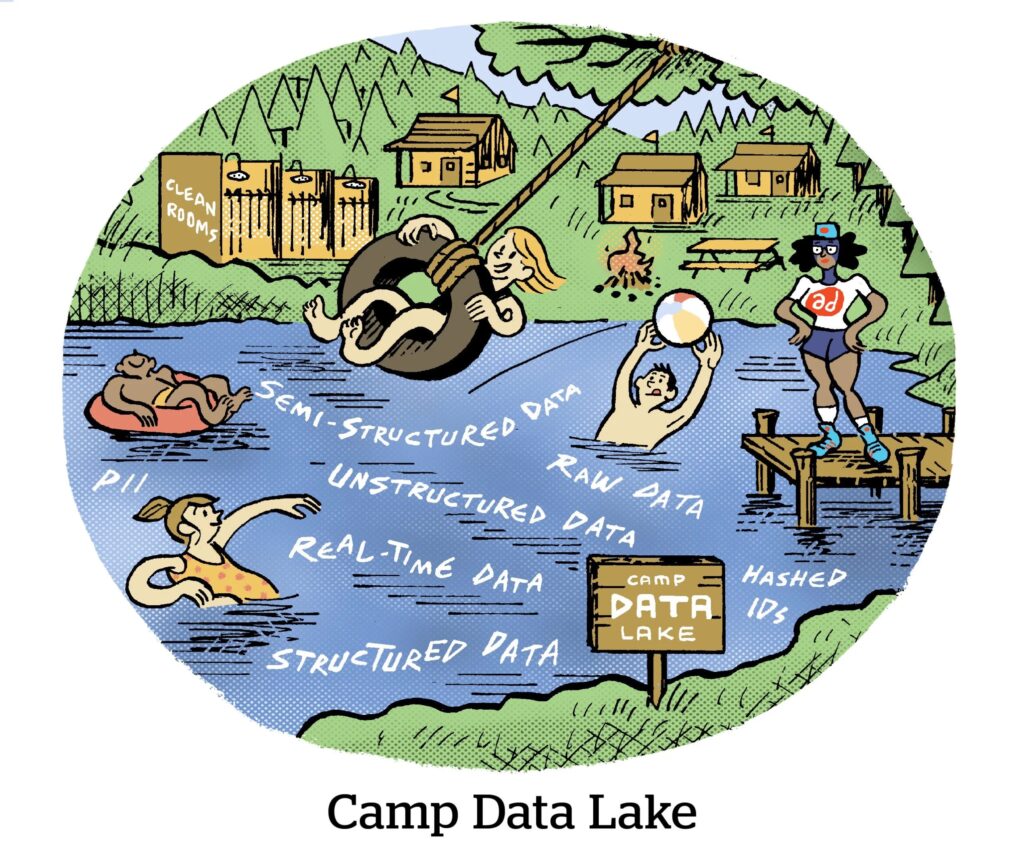
You’re probably sick of hearing about data silos, but that doesn’t mean they don’t still exist.
Data engineers toil away managing data infrastructure and building ETL pipelines into data warehouses, data clouds and data lakes.
Meanwhile, most marketers don’t know what the heck that means and just want to use customer data to create personalized campaigns and analyze performance. They don’t care where the data sits, whether that be in a customer data platform, a data warehouse, a lakehouse or a data vacation home. (Made that last one up.)
Part of the challenge is that there hasn’t been a smooth way to manage data centrally across these multiple platforms, said Timothy Hobson, VP of engineering at legal services platform LegalZoom.
To combat this problem, LegalZoom has been beta-testing new tools from communications API provider Twilio that allow marketers to access data from the cloud without needing to call in the engineers.

In the past, “our data team would have to build bespoke connections, one after another, to all the different destinations in order to serve the marketing team, including for audience building,” Hobson said. “We didn’t have reusability.”
And without reusability, there can’t be efficiency.
Data connections
Data lakes store all forms of raw data. Data warehouses store raw data that’s been cleaned and processed or refined, if you will. And CDPs serve as centralized databases to organize, analyze and activate customer data for campaigns.
LegalZoom’s data engineering team did a lot of background work to unify all the company’s data across sources within Snowflake to make it usable for business purposes, including clickstream data, online transactions and data from third-party partners.
Last year, LegalZoom started using the Twilio-owned Segment CDP.
And then, more recently, LegalZoom began testing a new tool from Twilio, in beta for the past six months, called Linked Audiences, that creates a layer of interoperability between Segment and cloud-based data platforms, such as Snowflake and Databricks. A new data graph within Segment, also still in beta, creates matches across the data sets.
With a bridge between its cloud data platform (Snowflake) and its CDP (Segment), LegalZoom’s marketing team can now enrich customer profiles with data from the cloud and activate without having to make a special request to the engineering folks each time.
“There’s a wealth of contextual data about a customer or prospect that’s locked away inside of a data warehouse, which is usually the domain of the IT and data engineering teams,” said Robin Grochol, VP of product and user experience at Twilio. “Think of this as unlocking that data for marketers.”
Marketers, you do you
In LegalZoom’s case, unlocking data for marketers means freeing up its data engineers to spend less time serving the marketing team because the marketing team can serve itself.
“Now that all of our data is cleaned up and consistent, we can do some pretty interesting stuff,” Hobson said. “And there isn’t any kind of tension or struggle between the two teams.”
LegalZoom’s marketing team can now directly query and segment data from Snowflake, and the data engineering team can use the same cleaned-up data set to support projects that benefit the wider organization.
For example, Hobson’s team recently built a propensity model to predict customer lifetime value or the likelihood of a specific behavior or action. The sales team can use it to score the most likely prospects, while the user experience team can use it to predict likely behavior on the website. And marketing can use it to identify and target specific audiences, such as likely cart abandoners.
Previously, if marketing wanted to target likely cart abandoners, that would be a time-consuming and involved project for the data engineering team.
“I never had to engage with marketing people so much in my life,” Hobson (half) joked, referring to the pre-Twilio workflow.
“But now,” he said, “we’re in a position where the data team can work on what it’s good at – modeling and curating data – and the marketing team can focus on what they want to do, which is to engage our customers.”
Twilio’s Linked Audiences and the new data graph within Segment are still in beta, but both will be generally available starting in August.