

 The value that Salesforce.com’s solutions bring to marketers, customer experience managers, and sales staff is well-established. But what can Salesforce.com offer for online advertisers?
Within the various acquired companies that constitute Salesforce.com’s ExactTarget Marketing Cloud — recently integrated with the Salesforce1 platform — is Social.com. Social.com was made possible when social media commerce company Buddy Media acquired social ad-buying tool Brighter Option in February 2012. Buddy Media itself was snapped up by Salesforce.com in June 2012, and is now one of the key components of the ExactTarget Marketing Cloud.
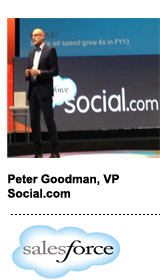
Social.com VP Peter Goodman, Brighter Option’s founder and CEO, discussed Salesforce.com’s paid media play and amplification opportunities.
AdExchanger: How are Salesforce.com and Social.com leveraging Facebook Custom Audiences?
PETER GOODMAN: The Custom Audiences product has really showed brands that you can activate first-party data for ad buying. Everything used to be based on anonymous cookies and now you can actually identify where people are in the funnel even at the top level – even if you just have an email list. It’s super exciting to me because of all of the other data you can layer on from Facebook. Then, as a technology player, we obviously have to look at, “How can we solve this problem for scale again?” because it’s great to have a couple hundred thousand people on an email list and to send the same message to them, but how do you really take that data and activate it in a scalable, yet effective way?

How has the ExactTarget acquisition affected your ability to do this?
When ExactTarget was acquired, I had a meeting with leadership there and I was like, “This is fantastic.” Having access to their products and marketing automation side of the world – where they were already segmenting their audiences using email or based on where they were in the pipeline using mobile, POS (point of sale) or Web data – was a no-brainer for us to build out this Active Audiences product and allow brands and agencies to leverage that first-party data for scalable ad targeting.
Active Audiences helped Salesforce.com win a Facebook Preferred Marketing Developer (PMD) Innovation Award. What is Active Audiences?
The product was used in a select beta and is not going to be rolled out [for general release] just yet. But what it does is bring together the power of ExactTarget email marketing and allows you to create targeted Facebook campaigns based on customer engagement campaigns, depending where they are in the funnel using their email on mobile, POS information, ecommerce or just the Web and taking the data we have and creating segments within Active Audiences that will appear within Social.com for the media buyer to buy against.
Can you give a use case?
We have a (retail) customer called The Clymb that wanted to know how they could acquire new customers based on their current customers (members that had high transactional value) and Facebook obviously has the lookalike audiences, where you can not only target your customers and potential customers, but you can also leverage that to get more from lookalike audiences from a selection of IPs that will be really profitable for you.
They wanted to look at members that had opened an email or clicked on an email in the last 45 days. They also wanted to reactivate members who had not clicked on an email or opened an email … that allowed them to create different buckets of users based on where they were in the customer cycle. They created Custom Audiences around them to buy against in Social.com. The great thing is the data is all anonymized in Social.com, so you just see the audiences that have been created in Active Audiences.
As both a Twitter Ads API and Facebook PMD partner, which platform is most exciting to you from an advertising perspective?
From the standpoint that it’s all based on cookies, we’re really focused on using identity and email addresses to just not focus on that. Facebook is ultimately focused on identity, whether you’re retargeting consumers based on age or things they like. I think Twitter is very much in that category as well. They recently bought MoPub, and with Facebook getting in to their mobile ad network, I think the future will be based on identity, not cookies, and Twitter’s a fantastic platform where the opportunity (for advertisers really) exists and I think there’s a lot of room to move in there for everyone as well. It comes down to real-time listening and buying against that rather than reacting to an event after the fact.
Let’s talk more about Salesforce Identity. Is Salesforce.com viewing this as a classification or targeting opportunity?
From a classification standpoint, it would make sense because we have to rely on others to allow us to target, naturally. Whether it’s email log-ins or cell phone numbers, for us, it becomes, “How do we take the millions of rows of data we have and allow customers to activate that for greater paid purposes?” and I think that comes down to segmentation and delivery of the right message.
If you’ve got a million email addresses, they can be segmented whether they’re partly through a customer journey or whether they’re demographically segmented. You can use that sort of as a way to activate that database. It’s not about just activating data around individuals, but also activating data about a brand. We can activate ads at the right time around the brand journey if there’s an event or sponsorship activations or conversations online (we monitor through Radian6) that maybe wouldn’t be identified at an individual level, but that you want to target at a brand level.
Speaking of targeting, what is Salesforce.com’s stance on broadening access to third-party data through partner access to Catalina, Acxiom, etc.? Is this even an end goal?
I think it becomes valuable when it needs to be. I think there’s lots of data that has never been activated. We’re starting the activation piece right now, which Social.com allows for. We listen to our customer’s wants as we progress and this activation of identity is something people are eying.
Also, I think there’s a distinction, too, where agencies have their own trading desks and they’re not necessarily activating first-party data – where they’re using a lot of third-party data. We, because of the tie-ins with our technologies, can allow agencies to still run the campaigns but the data is shared dynamically between our platforms so the right people at the right time can activate the information. I think the world has been based on cookies for so long, it’s quite hard to break that cycle sometimes.
But, I think as Facebook and other (platforms open up access to) APIs, I think that’s where the future will go. It won’t distinctly have to do with social networks. Activation (will be tied to) anywhere you log in. I think, eventually, the word “social” will drop out of “social ads,” and it’ll just be ads that are socially fueled.
What is the future of advertising?
When you look at traditional advertising based on the cookie, it’s very much focused on the future of the device rather than the person. I think what we’ve seen change over the last year with Custom Audiences and various other things, is that when you look at the amount of data in email and cell phones that we sit on as a business, there was no real way before now to actually activate that data. Cookies are one thing, but they’re anonymous.
I always use this analogy: I use my family laptop at home and get adverts for women’s shoes because earlier in the day, my wife was searching for shoes. However, if I log into Facebook, I don’t get ads directed at my wife.
What role will Salesforce.com have in this?
Salesforce.com sits on so much customer data that we’re starting to introduce ways for [clients] to actually activate it from a paid media standpoint. If you know who your good customers are, naturally you’re going to want to find more of those customers instead of hoping they’ll be like the people you wanted.
With the identity play cross-platform, that will be really huge. You’ll be on your laptop or your desktop on Facebook and you’ll run out of your house with your mobile, and it’s almost like that stream of your customer journey follows you out the door.









