The Golden Ticket
Spotify wants to sell you concert tickets.
It’s a pretty obvious next step for a streaming audio business. Spotify knows people’s music preferences and could easily extrapolate their likelihood to pay to attend a nearby show.
Monetizing music “super fans” is Spotify’s big opportunity. But actually doing it is pretty complicated, writes Lucas Shaw at Bloomberg.

For one, Spotify must negotiate with record labels and venues to secure an allotment of tickets upfront. These would then be made available to listeners who sign up for a new roughly $6 per month subscription tier, which Spotify hasn’t launched yet but plans to this year.
Why is that challenging? Well, big stars that sell out their shows aren’t inclined to simply give Spotify a chunk of seats upfront.
And there’s also an advertising connection here.
Whereas Spotify has been playing catch-up with its ad platform, Google, Amazon and Apple can easily monetize “super-fans” by targeting ads for ticket sellers and getting a substantial cut of the overall revenue through attribution. And they can do it without having to secure the exclusive rights to physical seats in a venue.
A Million Bites Of The Apple
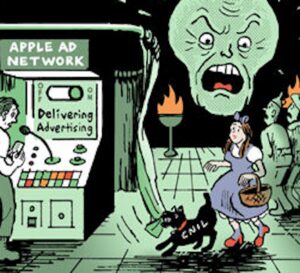
Apple recently notified search ad customers of an upcoming change to its attribution system. Beginning in April, view-through conversions may be the default conversion type. [H/t Thomas Petit for sharing.]
Sounds pretty innocuous, but it’s a major shift happening in the background that many advertisers (and even agencies) won’t necessarily be attuned to.
“View-through attribution” refers to impressions being credited for simply having existed in a theoretically viewable placement. “Viewable,” meanwhile, is defined by Apple as at least half of an ad being on screen for one second. That’s in contrast to click-based conversions, which are the default for Google and had been for Apple – until now.
Apple’s quiet transition to view-through attribution will dramatically increase its potential to self-attribute conversions to its own platform.
For instance, say an Instacart ad got served to someone a couple weeks ago – and the ad never even fully appeared on the page. But it was served by Apple. Now imagine that yesterday another of Instacart’s partners served an ad that got clicked on, leading to a browsing session of Instacart’s App Store reviews followed by an app download shortly thereafter.
Who deserves credit?
If you think it’s Apple, stand pat. Otherwise, consider resetting your Apple Search Ad conversion defaults.
Freedumb Of Speech
Advertisers apparently need to watch what they say about Elon Musk.
The Washington Post and Meta recently blocked campaigns with ad creative that was critical of Musk and his influence in the Trump administration.
Last week, WaPo reneged on a negotiated direct deal with advocacy group Common Cause and the Southern Poverty Law Center Action Fund, The Hill reports.
The groups had agreed to a $115,000 ad buy in WaPo’s Tuesday edition exhorting people to “Fire Elon Musk.” The ad would have appeared inside the paper and as a wrap covering the front and back pages of some editions.
But WaPo informed Common Cause on Friday that it would not run the wrap ad as planned. WaPo – which is rather cash-strapped at the moment – did not offer a reason for rejecting the six-figure buy.
Meanwhile, earlier this month, Meta removed a Facebook ad purchased by corporate watchdog group Ekō, according to Popular Information’s Musk-focused Substack, Musk Watch. The ad called out Musk’s Department of Government Efficiency gaining access to sensitive data on American taxpayers.
Meta claimed the ad violated its rules on “Unacceptable Business Practices.” After Musk Watch contacted Meta, the platform reinstated the campaign and claimed it had been removed in error.
But Wait! There’s More
Amazon has shut down Inspire, the TikTok-style shopping feed it launched inside its app in 2022. [The Information]
Microsoft is delaying a policy change originally scheduled for this month that would keep users signed into their Microsoft accounts unless they manually sign out or switch to private browsing. [The Verge]
Facebook will no longer store live videos indefinitely and will instead delete them after 30 days. [TechCrunch]
As more creators expand to episodic content, studios want to repurpose and syndicate their shows. [Digiday]
French consent management platform Axeptio has acquired Brazilian CMP AdOpt. [release]
You’re Hired
OAAA appoints former IAB President Patrick Dolan as COO. [release]
Retail media ad tech startup Swiftly hires Anthony Viglietti as COO. [release]
Thanks for reading AdExchanger’s daily news round-up… Want it by email? Sign up here.