Here’s today’s AdExchanger.com news round-up… Want it by email? Sign up here.
Whose Funeral?
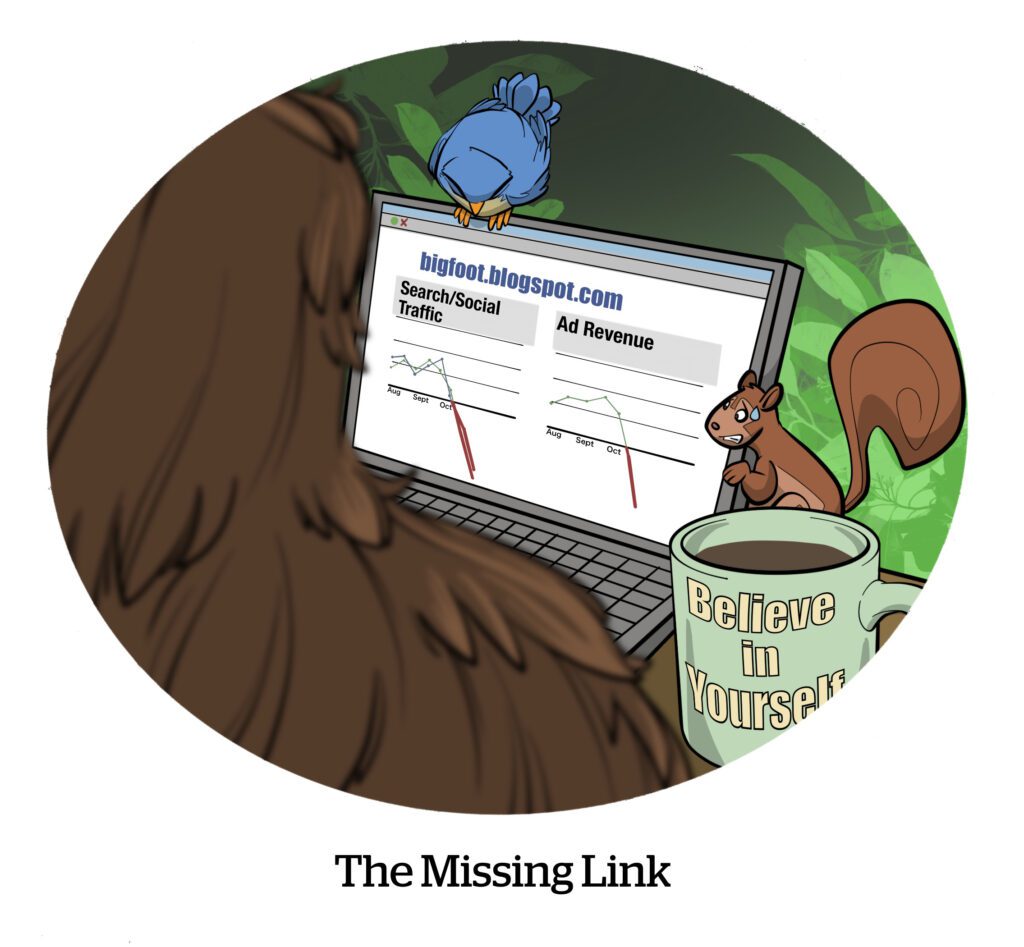
Google Search upended online traffic earlier this year with a core update as a follow-up to its “helpful content update” last September.
The long and short of it is this: Many niche and independent publishers saw a 70% to 90% decline in search traffic after Google’s core update.
Google apparently invited some of the “most vocal independent site owners who’ve been shadowbanned by their brutal updates” to its Mountain View campus earlier this week – and 20 showed up, writes Joshua Tyler of Giant Freakin Robot, a pop culture site.
“It turned into a funeral,” he writes.

Tyler takes a few potshots at the palatial emptiness of Google’s HQ, but his main takeaway is that publishers should understand how little Google thinks of them.
He does have a kind word for Danny Sullivan, however, Google Search’s industry liaison. Google’s official liaisons – Ginny Marvin, product liaison for Google Ads, is another – somehow manage to preserve the general goodwill and trust of industry execs, including many who don’t trust Google.
The event wrapped with an unnamed Google Search scientist giving “a self-congratulatory speech about what a great job we were doing at helping Google improve so he can deliver better search results to his users,” Tyler writes, going on to quote: “Search results without any of us in them.”
Recommendation Fixation
The rise of affiliate marketing in the 2010s – driven by Google’s search changes – prompted an explosion in online recommendations by actual humans, rather than algorithms.
But while the surge in ostensibly organic recommendations may have been part of a backlash against algorithms, all it really accomplished was to further transform the internet into a recommendation engine, writes Kyle Chayka at The New Yorker.
Recommendations for everything from what products to buy, what media to consume and what hobbies to adopt have taken over social media and the open web. Today, the digital media landscape feels like “a list of recommendations on where to get your recommendations,” according to Delia Cai, founder of the Deez Links newsletter.
Generative AI will trigger a new flood of machine-driven recommendations. In such a crowded environment, an influencer’s taste becomes the new digital media currency, Chayka writes.
But yet another backlash is brewing in the form of gatekeeping. Take, for instance, Redditors trying to steer Google’s AI search away from recommending popular restaurants to tourists.
But here’s the irony: The things that people love enough to try and gate keep them from the digital masses could become the next big marketing signal.
“Mundane things are easy fodder for recommendations,” Chayka writes. “What is truly closest to your heart might warrant a bit of withholding.”
Please, No More Politics
Speaking of algorithmic grievances, does it feel almost impossible to avoid US election news lately?
It almost certainly does to anyone still on X. Because according to the Wall Street Journal, X’s algorithm is feeding users political content whether they want to see it or not.
To prove this, WSJ set up a bunch of brand-new X accounts, selecting nonpartisan interests like “crafts” and “parenting” upon sign-up. Each one was still served political tweets and overwhelmingly more conservative ones at that.
This would seem to contradict statements made by Elon Musk, who claimed the platform would remain “neutral” despite his own obsession with Donald Trump.
But there isn’t necessarily any back-end manipulation going on here. The answer could be as simple as demographics. As the Pew Research Center notes, Republican users are now twice as likely to believe X is good for democracy since Musk first took it over in 2022. It’s not surprising that there’s more of these folks hanging around the platform now.
Regardless, brand-safety-conscious advertisers will likely continue to keep their distance. Placing ads against political content is one thing. Placing them against tweets by infamously conservative shitposter “catturd2” is quite another.
But Wait! There’s More!
Amazon Prime Day may not be the holiday shopping bellwether it used to be. [Digiday]
How online retailers are fighting back against the biggest new trend in fraud: fake returns. [The Information]
David Ellison will hold full control of the newly combined Paramount-Skydance after the deal closes. [Variety]
Viant announces plans to license Comscore’s data to train its ViantAI model. [release]
Roku posts its first $1 billion quarter, but gets dinged on weak Q4 guidance and its decision to stop reporting streaming household numbers. [Yahoo Finance]
You’re Hired
PilotDesk names Geir Magnusson as its CTO. [release]
Netflix hires Nicolle Pangis as VP of advertising. [MarketingDive]
Audacy names Ray Borelli SVP of research and insights. [release]
Gregg Galletta will be Truthset’s new executive VP. [Adweek]