Organic Diet
Everyone has probably seen viral app ads in their social feeds, even if they don’t know the term.
These so-called “viral apps” rely on organic social engagement, rather than paid media, to rake in new customers. They use thumb-stopping videos to pause doomscrollers and get a click. And the app is typically unrelated to the video.
The category has an unseemly reputation. But can (or should) paid media pros learn from viral apps?
Marcus Burke, a Meta advertising consultant at ctrl shift, writes in a blog post that mobile buyers should be borrowing from specialists in organic virality.
To a degree, this involves embracing shamelessness.
Paid media clicks generally come with intent and some knowledge of the company; viral apps generate deluges of users, none of whom know or care about the product when they arrive. So the onboarding process looks like web quiz flows and makes “big promises” regarding the app, Burke writes.
“Paid advertisers take note: If your onboarding assumes the user already knows why they’re here, you’re leaving conversion on the table.”
Viral apps also use “spinning wheels, gift reveals, countdowns” to get a quick credit card at a low cost. They also ask for five-star reviews almost immediately, not after multiple days or sessions to prove the user enjoys the service.
TTD’s Tribulations
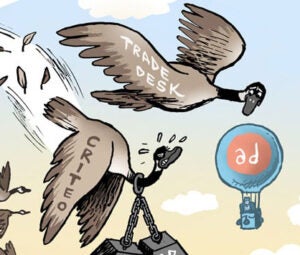
Dentsu and WPP are shifting budgets from The Trade Desk’s OpenPath, Adweek reports.
Trade Desk’s direct-to-publisher channel is particularly strong as a path to premium video supply. But agency buyers cited concerns around insufficient transparency and potential hidden fees as reasons they’re pulling back.
One source says OpenPath includes unclear costs that make the product hard to compare with SSPs or other supply channels. TTD denies any hidden costs, noting that OpenPath fees hover around 4% of media spend.
Agencies are also concerned that OpenPath might compete with their own services for inventory and audience curation.
But another subcurrent for the TTD drama is the consolidation of holdco agencies behind certain ad tech vendors.
Publicis and TTD are longtime strategic partners. WPP is associated with Google, having repped the brand and front-run many Google and YouTube ad products. A new coupling is Omnicom and Amazon. Omnicom won the Amazon brand RFP and is a huge Amazon DSP customer, if not a default user of Amazon ad tech.
Former Dentsu Americas CEO Michael Komasinski left last year to lead Criteo, which promptly signed a strategic deal to make Criteo a “default data supplier” for all Dentsu retail media buys.
Breaking the Internet
Doesn’t it feel like major web outages have gotten more frequent lately?
Part of the problem, which Mashable described last year, has to do with infrastructure consolidation. When a massive host network like Cloudflare goes down, thousands of other sites go down, too.
But here’s another, less provable theory: Maybe these service disruptions are related to an increase in AI-generated code.
For example, Amazon Web Services recently experienced two AI-related outages, the most recent of which involved Kiro, its agentic AI coding assistant. Amazon was quick to blame the problem on “user error, not AI error,” but employees who spoke to the Financial Times expressed skepticism about the tool’s usefulness given the risk of error.
No internet means no internet ads, which poses an obvious problem. But it’s also worth noting that some of the biggest online advertising platforms – Google, Meta, Amazon, just to name a few – are also major proponents of AI technology.
And as anybody who’s dealt with Meta’s annual Glitchmas issues will tell you, AI-based product failures don’t need to break the entire internet to wreak havoc on ad budgets.
But Wait! There’s More!
The Trump tariffs – which caused several analysts to revise their 2025 advertising growth projections downward by at least 1% – have been struck down by the Supreme Court. [SCOTUSblog]
Anthropic is rolling out a new AI tool that it claims will be able to spot software bugs on its own. [Fortune]
NBCUniversal is planning to offer Peacock customers add-on subscriptions to other specialty streamers. [Business Insider]
Last week was proof that the FCC’s equal time rule is no match for YouTube. [Fast Company]
Video game publisher Finji claims that TikTok is using generative AI to modify its ads without permission, including one that features racist and sexist caricatures of its characters. [IGN]