
Most competitive intelligence is backward-looking. Earnings calls tell us what happened last quarter. Annual reports tell us where budgets went last year. Traditional competitive intelligence tools often focus on creative libraries, estimated spend or campaign archives.
Useful? Yes. Actionable? Not always.
By the time most marketers learn that a competitor has changed strategy, the market has already moved. That’s why one of the most valuable signals in advertising today isn’t total spend; it’s how that spend is being deployed in real time.

We analyzed Meta advertising activity across six of the largest insurance advertisers in the US: Progressive, GEICO, Allstate, Liberty Mutual and Nationwide.
The goal wasn’t to identify who spent the most; it was to understand what their spending patterns reveal about how they compete.
Looking beyond budget
Insurance is one of the most competitive categories in advertising.
Products are highly regulated, differentiation is limited and customer acquisition is expensive. Growth is often determined by the ability to acquire attention efficiently.
In April, Progressive wasn’t simply outspending competitors; it appeared to be acquiring attention significantly more efficiently than the rest of the market.
While most major insurers clustered within a relatively similar CPM range, Progressive’s CPM was dramatically lower despite being the category’s largest spender. That combination is unusual.
In most advertising auctions, scale alone does not create a substantial pricing advantage. Yet Progressive was simultaneously buying more inventory and paying less for it.
How is Progressive achieving this advantage, and what does it reveal about the company’s broader media strategy?
Signal 1: Efficiency
Two companies can spend exactly the same amount and generate vastly different outcomes. Yet most marketers monitor budget, while far fewer monitor efficiency.
In Progressive’s case, the efficiency gap appears large enough to represent a strategic advantage rather than a normal market variation. The significance isn’t the CPM itself; it’s what the CPM implies.
Somewhere inside Progressive’s acquisition system, there are advantages that competitors may not possess.
Signal 2: Allocation
The second signal appears in channel allocation. The data suggests Progressive allocates a larger portion of its Meta budget toward placements such as Messenger and Threads than many of its peers.
These environments often face less auction pressure than core Feed inventory, creating opportunities for advertisers willing to diversify placement strategy.
Whether intentional or algorithmic, the outcome is the same: lower acquisition costs and broader reach. This is the type of insight that rarely appears in public reporting.
Allocation decisions often reveal more about future strategy than budget size ever could.
Signal 3: Strategic intent
But the most interesting finding wasn’t about Progressive; it was about the category itself.
Our research revealed two distinct philosophies of growth emerging within insurance.
One group treats social as a primary acquisition engine. The other treats it as a supporting channel within a broader brand strategy.
GEICO stands out in this analysis. While spending less overall than Progressive, GEICO appears to allocate a larger proportion of its media investment toward Meta platforms than many competitors.
That suggests a company rebuilding growth through concentrated digital investment rather than relying primarily on traditional channels.
This is the kind of strategic shift that often becomes visible in media allocation months before it appears in analyst reports or earnings commentary. By the time public reporting catches up, the strategy is already underway.
The same pattern appears beyond social
A reasonable question is whether these signals are unique to Meta.
Looking at open web programmatic activity, similar patterns begin to emerge. Progressive maintains a dominant share of voice across display advertising while continuing to demonstrate strong media efficiency. That consistency matters because it suggests the advantage may not be tied to a specific platform.
Instead, it points toward a broader media buying system operating across channels.
When the same signals appear across social and programmatic environments simultaneously, marketers should pay attention.
What Polaris AI sees that traditional intelligence misses
The most valuable signals in modern advertising are hidden in media allocation decisions, efficiency trends, placement strategies and channel shifts. They rarely appear in earnings calls, press releases or traditional reporting. They appear first in the auction.
A competitor’s CPM falls. Another shifts its budget into new placements. A third begins concentrating in a specific geography. Individually, these are observations. The strategic question is what they mean.
The challenge isn’t about access to information; it’s interpretation. This is where AI changes the equation.
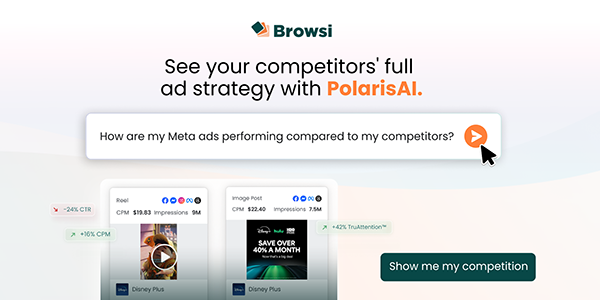
Polaris AI is a competitive intelligence AI platform that tracks competitor ad activity across social channels and the open web. The platform delivers creative performance metrics – including CTR, CPM, share of voice and spend efficiency – in real time, alongside a full breakdown of competitor strategy based on the breadth of signals it captures and contextualizes. Its AI layer surfaces daily signals and proactive alerts when competitor activity shifts and can be queried directly in natural language for on-demand answers to any competitive question a marketer needs to ask.
In the insurance category, the data points to a clear efficiency gap. Progressive isn’t just outspending rivals; it’s outbuying them. Polaris AI translates that signal into a hypothesis: Lower acquisition costs likely reflect a media strategy built on audience precision and diversified placement, not budget size.
For marketers, the value isn’t simply knowing who spends the most; it’s understanding why they’re winning before the rest of the market notices.