Merkle’s retail and consumer goods group has become a testbed for multiple other verticals.
That isn’t surprising.
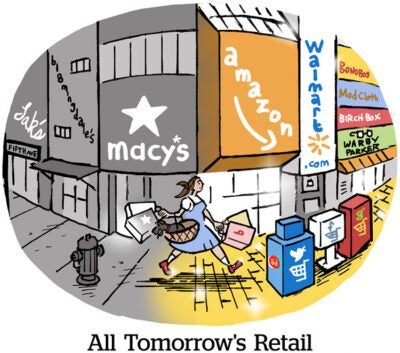
Although people tend to think of retail advertising from the perspective of grocery store chains and major CPG brands (Walmart, Target, Kroger and the brands they carry), these days the “retail media” category includes a host of new entrant: Best Buy, Marriott, Lyft, Uber, craft goods store Michael’s. Take your pick.
Anne-Marie Schaffer, an EVP and growth officer for Merkle’s retail and CPG group, is experiencing a similar evolution in her role. Merkle recently folded “automobility” into its retail and consumer goods group – Uber, Lyft and T-Mobile have all launched media networks – and has lately been incorporating quick-serve restaurants and other kinds of retail chains.
AdExchanger spoke with Schaffer about her role and how Merkle stays on top of the fast-moving retail media opportunity.

AdExchanger: What does the retail and CPG “growth officer” role entail?
ANNE-MARIE SCHAFFER: I work with our capability leaders to develop solutions for Merkle as we start to see needs in the marketplace.
An example of that: A couple of years ago was the start of retail media network acceleration. We had worked with one grocer’s media network for three years, with our ambition to have them take it in house. We then took that solution and process and replicated it across other big-box retailers. Now it’s even going across other type of retailers.
We look for those types of fast currents and create solutions around them.
Any solutions that are in the early stage now?
More recently, we’ve been trying to create solutions around new digital messaging strategies, as well as social commerce. As we observe client needs, we start to build these things and test the waters from a data perspective with some of our clients and then get it in market to see if it gets traction within our business.
Retailers, even those with large in-house ad groups, have added many new ad tech and agency partners this year. Will that trend continue?
We’re going to see it continue to expand over the course of the next 18 to 24 months. After that, though, we might see consolidation.
But we’re still seeing a lot of second-tier retailers looking at what the big-box companies are doing and at the opportunity to monetize their websites with various partners. We’ll see those capabilities expand as marketplaces start to gain traction on the tech side.
The trend will continue to morph and evolve but, at some point, it’ll hit a point of scale where dollars can only go so far. Right now, Amazon represents around $40 billion of a $45 billion marketplace for retail media networks – and there’s only so many ad dollars that can go to shopper marketing.
The statistic I’ve seen is that retail media should double over the course of the next 18 months to about $90 billion. Once we get there the question becomes, how many dollars can still flow through these media networks?
That’s when we’ll start to see some consolidation.
What has to happen right now from a growth perspective in order for retailer networks to double within 18 months?
Let’s say you’re a company like Party City, for example, and you know there’s an opportunity to sell other types of services and products. They can sell experiences through marketplaces. They can partner with party planners, local stores or find other types of experiences that cater to parties.
We’re going to start to see more and more of those types of retailers moving into the monetization side of retail media networks. If you’re a shoe store that sells soccer cleats, that’s an opportunity to sell other aspects of soccer that are non-endemic to the site. That is a way into local businesses.
Right now, retail media is primarily for big-box retailers and big CPG brands. But there’s the opportunity to have local dollars flow through some of these retail networks as well, which is a big part of the opportunity captured by Google and Facebook. We’ll see that expand.
Aside from Amazon, are there examples of retailers with interesting non-endemic business?
Conversations are starting to happen, but often in the opposite way.
Before we see a retailer like Walmart develop a non-endemic financial services category, for example, I’d expect to see financial services to enter retail media.
Like, what about a financial services company that can monetize its site? They have a lot of products and services they sell. American Express or Chase, say, aren’t just selling credit cards and financial services. They’re also sharing experiences, they may have physical banks and they have a lot of content hubs. They can start to monetize their media and data, too.
I’ve yet to see one come to market, but that’s where we’ll see future iterations of retail media networks in a non-endemic space.
Earlier you mentioned social commerce as an exciting early-stage opportunity for Merkle. What’s the state of social commerce right now?
It’s very nascent. We’re still in testing mode to see what’s working and what’s not. It’s a very Gen-Z targeted environment right now.
The big question as it relates to social commerce is: Is it a consideration play or a purchasing play?
We’ve done some surveys, including a Dentsu consumer report that we put out every couple of months.
The most recent wave showed that younger and higher-income consumers pay attention to and are highly influenced by social platforms and cultural trends related to products and services.
What we’re testing is whether they’ll actually make purchases.
This interview has been edited and condensed.