

Wall Street has had a tumultuous relationship with the online advertising industry.
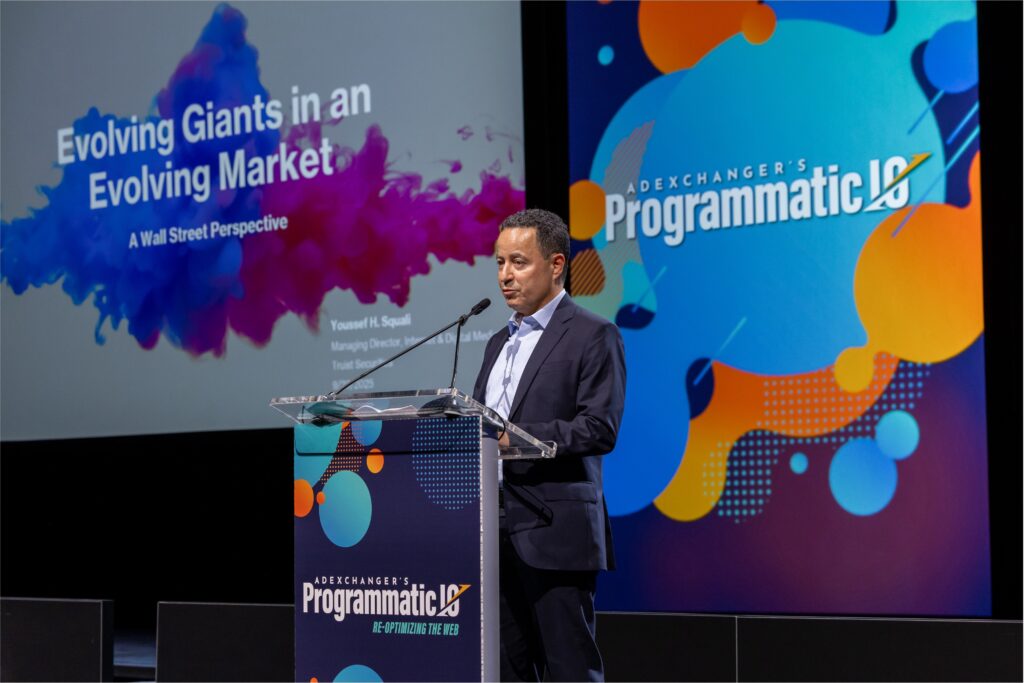
Internet and advertising stocks have steadily outperformed the S&P 500, climbing by nearly 50% over the past 12 months alone, said Youssef Squali, managing director and head of the Internet & Digital Media Research Group at Truist Securities, speaking earlier this week at AdExchanger’s Programmatic IO conference in New York City.
However, Squali noted, that growth has accrued almost entirely to a handful of big names – Google, Meta, Reddit and AppLovin – while smaller pureplay ad tech companies struggle.

Investors are enamored of Google and Meta for obvious reasons, and they’ve also got love for newer ad platforms like Roku, Reddit and AppLovin. But ad tech, not so much, Squali said. It’s a fool-me-twice-shame-on-me sort of thing.
“Many of these investors lost their shirt and got completely creamed on smaller-cap names that held a lot of promise when they first went public,” he said.
Squali then went on to list a tragic series of ad tech has-beens, including Rocket Fuel, YuMe, Marin Software, Tremor Media and Rubicon Project, which he said “fizzled out” and no longer exist as standalone businesses because they couldn’t deliver on their financial promises.
Wall Street’s programmatic perspective
For public ad tech companies, there is a real concern about major institutional investors backing away from the category. This trend exposes ad tech to the vicissitudes of both individual retail investors, Squali said, and large-volume hedge fund traders.
So what can pureplay ad tech companies do to clean up their rep on the street?
First, companies need to sharpen their particular value prop in a way that investment bankers can intuitively understand. Squali pointed to The Trade Desk as an example, noting how it successfully convinced investors of its core value propositions, namely offering transparent programmatic bids while solely representing the buy side.
Education is necessary.
“Maybe not so for this group,” Squali said of the programmatic-focused audience at Prog IO, “but certainly from the outside looking in, it is often difficult to grasp the nuances of the various players: their value proposition, their competitive group – if they have one – and the true unit economics of their models.”
However, there is reason for hope.
Since the largest equity investors have soured on the category, and because there isn’t a clear understanding of which companies are the real standouts that’ll last, there is what Squali called a “material dislocation” in the valuations of some ad tech companies. “Which is great for an investor,” he said.
Trading on The Trade Desk
Take TTD, which is up 17x since its IPO nine years ago, according to Squali. Sounds pretty good.
Yet the stock is down by about 60% year to date, having shed some $40 billion in market cap during this calendar year. The Trade Desk is now “pretty much hated by investors across the board,” Squali said, despite remaining one of the best-performing internet stocks of the past couple of decades.
Ouch.
But for those ready to dispute Squali’s rough handling of TTD, hold your fire.
The Trade Desk has been burdened by tough comps this year, he said, since there was a better macroeconomic situation in 2024, not to mention the US election. With the Olympics next year and US midterm elections, TTD should be back to favorable year-over-year metrics.
Also, Squali said, Truist Securities has spoken with brand marketers who continue to maintain that TTD’s platform is superior to the Amazon DSP, which still has a reputation for clunky UIs and fewer features than the programmatic natives.
“I’m sure there are folks in this audience who know a ton more on this subject,” he added. “In fact, I’d love to talk to you afterwards about this.”
Because, despite his harsh words early on, Squali remain bullish on TTD.
Squali predicted that TTD shares would double in value by the end of 2026 and suggested that the DSP could maybe even make a splashy acquisition of LiveRamp to bolster its identity data, a move that investors would likely reward.
Yes, The Trade Desk already has its Unified ID 2.0 program, but owning a strong proprietary identity graph is “just too strategic” an asset for TTD to be cool settling as a “midsize No. 2” player, he said.
But most investors won’t be joining Truist in backing TTD during its spiral this year, Squali acknowledged. “Driving a recovery in the stock is clearly not for the faint of heart,” he said.









