
Here’s today’s AdExchanger.com news round-up… Want it by email? Sign up here.
Playing The Game
Amazon took its first real step into linear TV broadcast territory in September when it streamed its first live NFL game only carried on Amazon Prime, not a TV network.
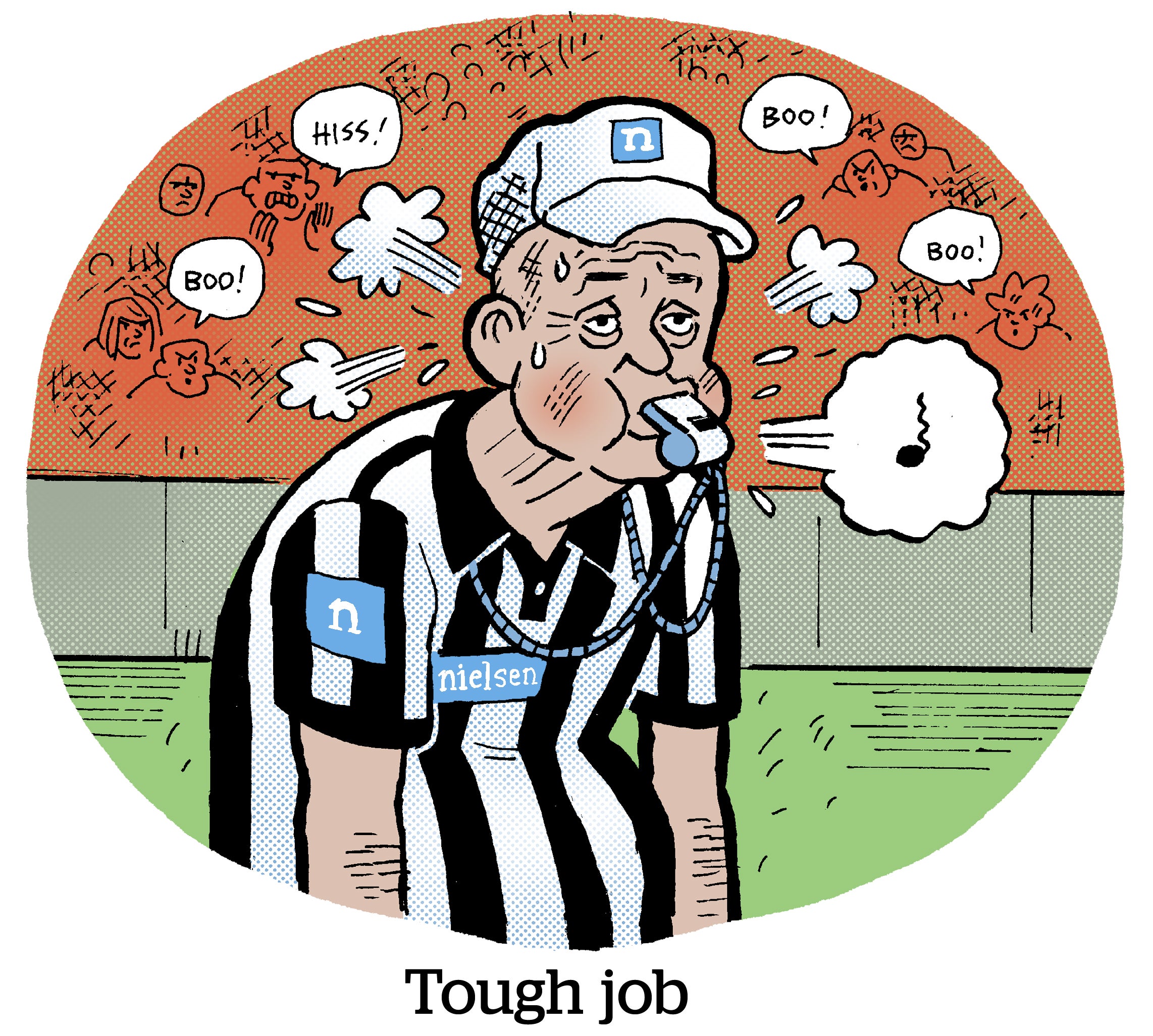
And, of course, Amazon is already feuding with Nielsen.
There’s no open discord, like some broadcasters have created with Nielsen. But an awkward question hangs in the air.
Every week, Nielsen gives its ratings for the Amazon Prime Thursday Night Football program. And every week, Amazon gives its own, considerably higher ratings. Through six weeks of NFL games, Nielsen’s average rating is 10.3 million viewers, and Amazon’s self-rated average is 12.1 million.
“I don’t at all believe that Amazon’s numbers are not right,” a Nielsen spokeswoman told CBS. “And I don’t believe that our numbers are not right.”
That’s not not true. After all, Nielsen’s ratings are based on modeled panel data, so there’s a statistical range. Amazon, like Netflix, knows what subscribers have their devices tuning in to the stream.
“We wouldn’t put out our number if we weren’t comfortable that it was accurate,” said Jay Marine, Prime Video VP and head of sports programming.
Nielsen being Nielsen, though, Marine can’t help but throw some shade. “You have to remember that this is new — new for Nielsen.”

The Devil In The Details
The digital advertising and ad tech industry is trying to make lemonade out of the sour lemons it’s been given in the form of state-based privacy laws.
The opportunity – which is to say, the problem – with state privacy laws is that none have actually specified definitions yet for what qualifies as protected, personal or enforceable forms of data. The legal definitions will “remain nebulous” until cases are taken to court by regulators and resolved by judges, Politico reports. (The writer excerpted part of the paywalled newsletter in a tweet.)
For instance, the IAB’s new contractual language for privacy-based data collection in the US is based on uncertainty in the legal text, says Cobun Zweifel-Keegan, managing director in Washington, DC, for the International Association of Privacy Professionals. “In such an environment, there can be multiple defensible positions and it can be impossible to predict whose predictions will carry force of law as things develop.”
Don’t hold your breath in the meantime.
It’ll be years before cases are taken up and find their way to court. And it could be years later still before judges begin settling the law.
The “Based” In Subscription-Based
Can small and indie news make subscriptions work?
This year, Defector Media, an employee-owned site of former Deadspin writers, made $3.8 million, according to its annual report. That covered $3.7 million in operating costs.
Subscriptions accounted for 95% of revenue. The remainder came from merchandise, site sponsorships, streaming deals and podcast ads.
Defector reached 41,000 subscribers last month. About 80% are on annual plans. Renewal rates for those that signed up in 2020 and have renewed every year since was 90%. Churn rate for this year was 3% per month.
Defector discontinued paid digital advertising after “unpleasant” results on Twitter and “promising” results on Google, because it said it didn’t have time to optimize subscriber campaigns properly. It refuses to spend on Facebook.
Flexible subscription pricing is one reason for Defector’s success. It offers multiple subscription tiers, from “Readers” (who pay $79 per year and comprise 62% of subscribers) to “Accomplices” (who pay $1,000 and number about 70).
This year, it rolled out a promotional tier of 99 cents for the first month, after which more than 60% of new subscribers upgraded to the Reader tier. Defector also introduced a $12-per-month podcast subscription with a promo contest to appear on an episode.
But Wait, There’s More!
Insider video ad revenue grows from onsite, direct-sold deals. [Insider]
Google acquires Alter, an AI avatar startup that helps creators and brands, for about $100 million. [TechCrunch]
How Twitter will change as a private company. [NYT]
Walmart and Netflix premiere a new in-store expansion. [Adweek]
The TikTok Creator Marketplace is experiencing some growing pains. [Marketing Brew]
You’re Hired!
Omnicom Group names Alex Hesz as EVP, Chief Strategy Officer. [MediaPost]






