
The Trade Desk’s Kokai launch in 2023 was the DSP’s most dramatic overhaul of its buying interface to date. Now, Kokai is getting its biggest update in three years, TTD announced on Thursday.
The update centers on agentic AI workflow improvements and automated audience building, which are quickly becoming table stakes for programmatic platforms. Top TTD competitors Google DV360, Amazon DSP and Yahoo DSP have introduced similar tools, and SSPs are also getting in on the action. Meanwhile, some ad agencies are building their own in-house solutions.
TTD is also adding new features that simplify Kokai’s reporting interface so advertisers have to click into fewer measurement widgets to keep track of campaign goals and model how changes will impact performance. And TTD is making it easier to launch conversion lift studies in real time, without having to contact third-party measurement partners to set them up.
The update, called Kokai Zuma, is now available to all advertisers using TTD’s DSP. While some of the new agentic capabilities will remain in closed beta for the time being, most of the new features are live for all users.

The AI features are all opt-in, TTD told reporters during a briefing on the new feature set last Thursday, but the user interface improvements will be applied for everyone.
Agentic improvements
The most visible overhaul to Kokai’s user interface is the addition of the Koa Assistant, a conversational AI tool that will appear on the DSP’s dashboard. The tool is now in open beta, and TTD plans for it to be widely available by the end of the year.
Koa Assistant gives advertisers a single touch point for prompting AI agents powered by TTD’s Koa AI technology. For example, a new Audience Creation agent, also introduced in the Zuma update, suggests audiences to target or exclude based on a campaign prompt.
According to TTD, Audience Creation will be especially useful for advertisers who pay for access to TTD’s Audience Unlimited service, in which buyers pay a 4.4% impression fee for unrestricted access to a host of participating data providers, currently including more than 70% of TTD’s data partners. Otherwise, advertisers have to pay for each individual data set they apply to their campaign targeting through TTD’s data marketplace.
The Audience Creation agent is also able to pull in performance data from TTD’s retail media and ecommerce partners. “This is not only making purchase-level data more accessible and discoverable for advertisers,” said Jaime Nash, senior director of product marketing at The Trade Desk. “It’s also helping our commerce partners showcase the value and usability of their data.”
In addition, TTD is introducing a new AI agent for ad frequency optimization, and it also added new agents for customer support, troubleshooting, building campaign templates from a media plan and pulling performance insights from campaigns mid-flight.
Buyers can prompt these agents using the Koa Assistant, which they can link to third-party AI agents using TTD’s Open Agentic Kit. They can also control all of these different agents in their interface of choice. Although, “our preferred use case is using the in-platform AI assistant,” said Samantha Ross, senior director of product marketing at The Trade Desk.
UI overhaul
Kokai’s Zuma update also overhauls Kokai’s distinct (and divisive) user interface, which is based on the periodic table of elements.
TTD had previously made the periodic table UI optional in response to a steady drumbeat of criticism about the interface being less intuitive than the DSP’s legacy interface, which was named Solimar. With the new update, the periodic table will no longer be Kokai’s default view.
Also in response to feedback, TTD is making campaign insights visible in Kokai’s dashboard without users having to click into different campaign view windows or so-called ad groups.
As soon as users open up a Kokai campaign landing page, they’ll be able to see key metrics and data visualizations, said Ross. “They’re featured big and bold at the top of every page, so users can easily see how their campaign is performing.”
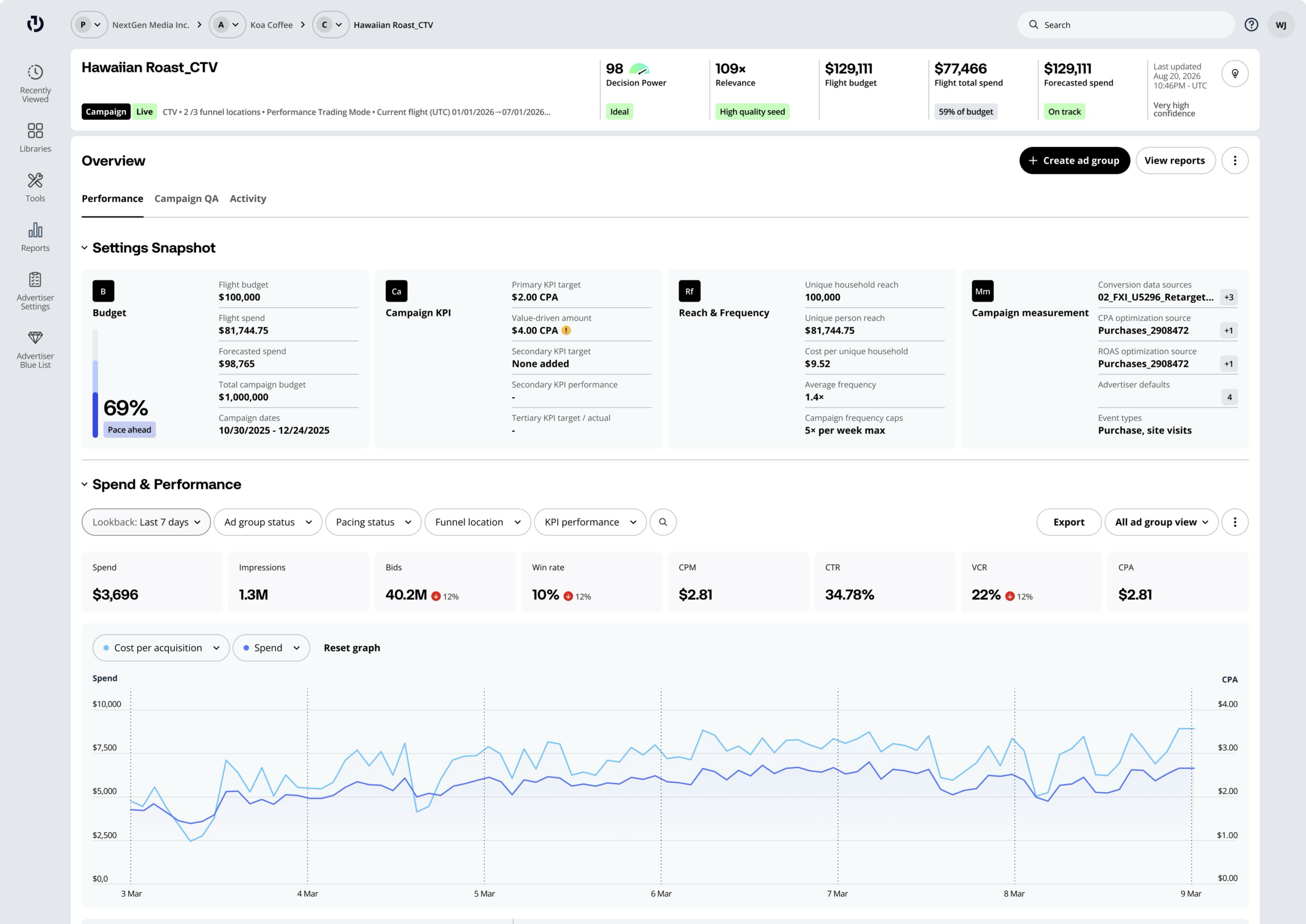
The Kokai UI also now enables advertisers to make bulk changes across dozens or even hundreds of ad groups simultaneously. And a new modeling feature lets users see the projected impact of these changes before they apply them.
Then, when users click into a specific ad group, a new Applied Settings feature will let them see all of the campaign parameters and targeting settings they’ve applied for that ad group in a single view. Settings that might be blocking ad delivery will be labeled in red, and agentic recommendations for new settings will appear in yellow.
Measurement moves
Kokai’s Zuma update also makes some notable improvements when it comes to campaign measurement and reporting. These upgrades mostly center on streamlining the process of launching measurement studies.
Previously, Ross said, launching a Lucid brand lift study required the advertiser to contact the measurement company to coordinate feasibility and setup checks to ensure that the campaign’s impact on brand awareness could be adequately measured using Lucid’s methodology. This process would typically take about a week.
Now, advertisers can launch a Lucid study in Kokai with one click, Ross said, because TTD has automated those setup checks on its backend.
Plus, due to a recent integration between TTD and Nielsen, advertisers can automate Nielsen IQ lift studies within Kokai in a similar fashion to Lucid’s.
TTD also introduced new features for measuring incremental increases in brand awareness or conversions in specific geographic regions. And a new reporting feature takes the same ecommerce sales data used for Audience Creation and packages it into a buyer report that breaks down a brand’s household penetration and how often households shopped at different retailers over the past year.
According to Ross, these features align with The Trade Desk’s new focus on measurement, which has been touted by TTD CEO Jeff Green in recent earnings calls.
“For too long, the industry has relied on proxy metrics like CTR, CPA and video completion rate” to prove that campaigns are performing, Ross said. But now, marketers have to demonstrate how programmatic spend drives “business growth, sales and incrementality.”
“We want to bring deeper, richer insights,” Ross added, “so advertisers can optimize toward things that truly matter, like platforms and channels that are driving growth.”