
For CTV advertisers, figuring out exactly which shows their ads ran in – and how that impacted performance – is still the Holy Grail.
But streaming platforms typically share either self-declared content categories or incomplete show-level reporting after ad campaigns have run. In many cases, the best a buyer can expect is for the platform to provide a show name for 10% to 15% of impressions purchased, said David Nyurenberg, SVP of digital at InterMedia Advertising.
Ad tech providers, however, are working to reverse-engineer show-level reporting using publisher-provided anonymized content IDs. They’re matching that reporting to conversion logs so advertisers can break down the cost per acquisition (CPA) when they advertise in specific shows. And they’re passing those signals into DSPs to optimize their budget allocations for performance.
InterMedia has been testing such an integration with contextual advertising platform Peer39 and Pontiac Intelligence’s DSP. The solution gave InterMedia show-level reporting for 94% of the impressions it bought for a recent CTV campaign.

Nyurenberg joked that, when he saw the first reporting spreadsheet, complete with CPA breakdowns for individual shows, he teared up. But, he said, the biggest breakthrough was turning those insights into actionable signals that could aid live campaign optimization.
And, he added, given the progress different programmatic players have made with similar solutions, the Holy Grail might finally be within CTV buyers’ reach.
Tracking performance
The solution is based on Peer39’s content ID integrations with streaming publishers.
Peer39 ingests a unique content ID for each streaming program that aired an ad. It can then use that ID to create the equivalent of an impression-tracking URL for a display ad impression, said the company’s CEO, Mario Diez. Peer39 then determines exactly which shows those content IDs correspond to through its publisher connections.
Because the ID is only tied to the content, the advertiser never gets any data about an individual user’s or household’s viewing habits. This helps ensure compliance with the Video Privacy Protection Act, Diez said.
The SSP that auctions the CTV inventory passes the content ID in the bid requests it sends to Pontiac DSP. Pontiac uses that signal to match the advertiser’s ad spend to the inventory in which their ads appeared.
Pontiac also measures ad performance by embedding a tracking pixel on the brand’s website to track outcomes like site visits or purchases. The DSP’s optimization engine can then use this data to prioritize buying inventory that drives outcomes.
Because Peer39’s ID works on a universal data ingestion model, Diez said, it can authenticate the content an ad appeared in no matter what content-level signal the publisher provides – whether a proprietary publisher ID or a third-party contextual ID.
Which is important, because the content-level signals provided by streaming platforms can be “all over the place” and are “not consistently transparent in any way,” said Erik Thorson, CTO and co-founder of Pontiac Intelligence.
“Some publishers will pass us everything, and some will pass us almost nothing,” Thorson said. Plus, the data provided by publishers doesn’t always match the DSP’s data during campaign reconciliation, he said. “But if it’s standardized and anonymized, then it can be safe for the publisher, and we can target it and optimize to it.”
Publishers also benefit by demonstrating the true value of their inventory when it comes to driving performance, Diez said.
And advertisers get much more transparency into what they’re buying than when the show-level data is self-declared by a publisher, he said. He added that, in Q4, Peer39 noticed a large amount of ad spend going to inventory that was self-declared as documentary programming. After digging into it, the company found out that the inventory in question was actually a streaming network’s Yule log.
“Without these types of signals,” Diez joked, “the Yule log is valued the same as a Yankees game.”
Live optimization
In practice, the content-level signals are proving to be a valuable mid-flight optimization signal.
InterMedia beta tested the solution on a recent CTV campaign for the detergent brand Laundry Sauce. It was able to get show-level performance reporting for 94% of the impressions it purchased, Nyurenberg said.
He emphasized that these impressions were purchased via a true open auction, not a curated deal or private marketplace, in which it would be easier to get the data directly from a publisher.
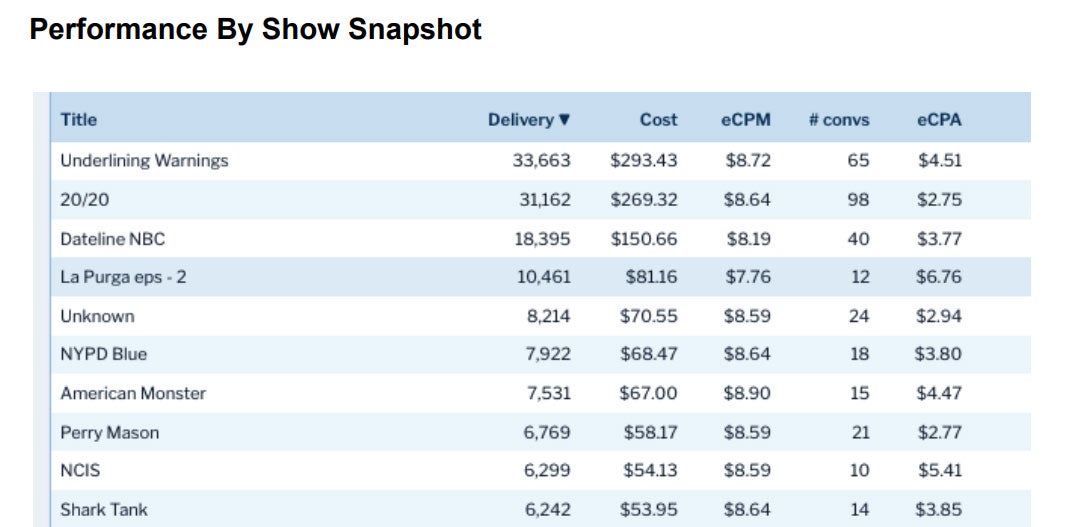
Pontiac used Peer39’s show-level tracking to determine exactly how much of the client’s budget InterMedia spent across different streaming networks, specific individual shows and content categories. The DSP then broke down the effective CPM, number of conversions and the effective CPA across these publisher properties and content types.
The measurement breakdown exposed that ad performance varied across CTV programming categories by as much as 4x, proving that it pays for brands to be discerning about where their ads are running.
And after Pontiac fed the CPA data into the live Laundry Sauce campaign, it boosted performance significantly. Add-to-cart conversions went up by 64%. And the optimized impressions generated a 2.5x higher page-view-to-add-to-cart conversion rate.
The Laundry Sauce campaign was a closed beta test, but both Peer39 and Pontiac told AdExchanger that the solution is available to anyone who wants to test it out.
And, notably, Nyurenberg said he’s seen other programmatic tech providers, including Viant, IRIS.tv and Beeswax, embedding content data into buy-side decisioning through similar frameworks. So these capabilities are poised to become more widely available to CTV buyers across different partners.
“We’ll soon see show-level data evolve from something that’s reported after a campaign into something that actively shapes every bidding decision before it happens,” Nyurenberg said. “We’re witnessing something that has the potential to become a new operating model for CTV buying.”