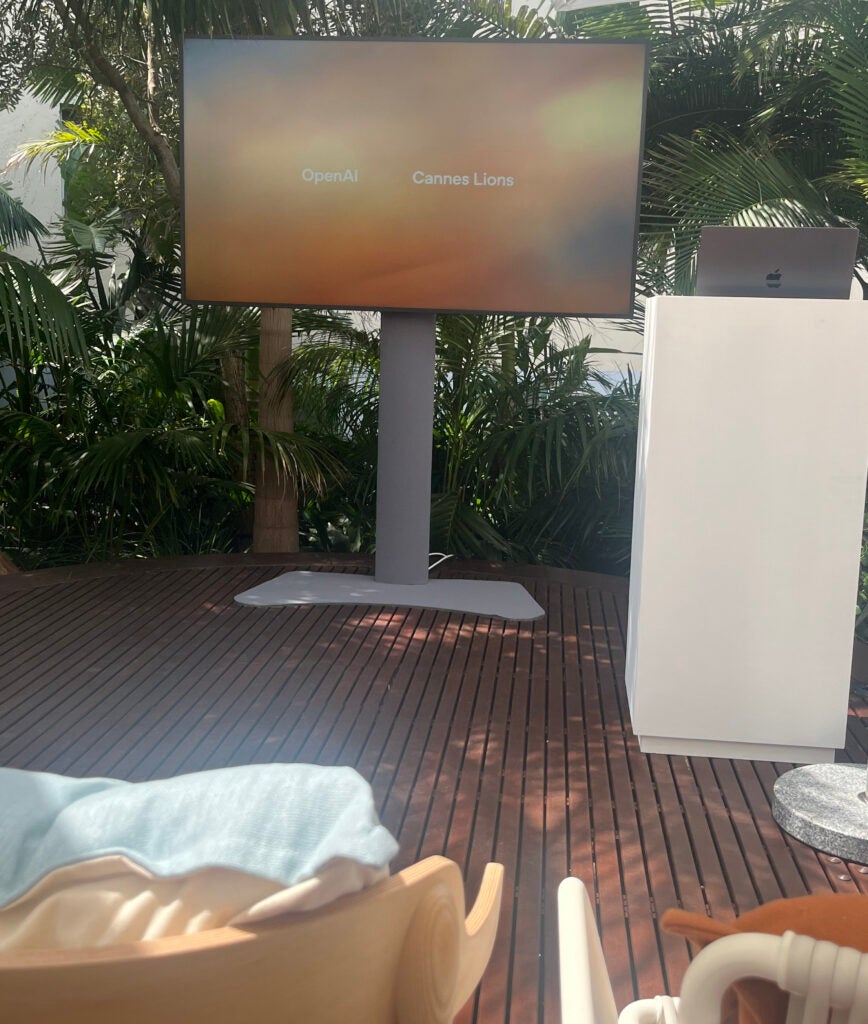
OpenAI didn’t make its Cannes Lions debut from a Croisette rooftop or in a branded beach club.
Instead, the company summoned a small group of reporters late Monday morning to a semi-secluded outdoor patio located a roughly 15-minute walk from the festival’s main center of gravity.
It was a rather sedate way to unveil what Dave Dugan, OpenAI’s head of global ads solutions, called “an entirely new ads product [and] an entirely new experience.”
“Why does someone open the ChatGPT app?” Dugan asked the (very sweaty) reporters taking notes in the 90-degree heat. “They want to do research, they want to solve a problem, they want to get information on a particular topic. They’re not coming to ChatGPT to scroll.”

It’s an interesting line coming from a longtime Meta executive, a company that helped define the art of stopping thumbs mid-scroll. Before joining OpenAI in April, Dugan spent more than 12 years at Meta, most recently as VP of global clients and agencies.
Speaking of Meta, it took them until 2021 – as in, 17 years – to break $100 billion in ad revenue. OpenAI, meanwhile, has reportedly told investors it expects to hit $100 billion in revenue within the next four years.
Whether that’s a realistic target is debatable. But here’s the pitch OpenAI is making to try and get there.
From attention to ‘intelligence’
Forget impressions and time spent. CRO Denise Dresser said OpenAI wants its advertising business to be measured by whether the ads help people get things done.
“We’re moving from the attention economy to the intelligence economy, and what consumers really want is usefulness,” she said. “And so that’s what we’re all about.”
Ads as an entrée
OpenAI also sees advertising not just as a revenue line but as a way to underwrite access to its product, especially for free users and those in lower-priced tiers.
“Our goal is to increase access for more people to better AI tools,” Dugan said. “As we build our ads platforms, it’s a way to subsidize those experiences and bring more information to more people. There’s a direct tie between ads and the mission of our business.”
For all intents and purchases
OpenAI now has more than 900 million weekly active users and around 20% of the questions people are asking have direct commercial intent, according to Dugan. But an even broader set of queries are upper funnel with commercial potential.
“Say, for instance, I’m planning a trip to the Alps with my family, and I ask ‘What’s a good time of the year to go?’” he said. “I’m not yet showing commercial intent yet, but that could be predictive of possibilities.”
Gotta have guardrails
Meanwhile, to make ads inside a chat feel acceptable to users, OpenAI is drawing bright lines, including clear ones around where sponsored messages appear and what stays off-limits to advertisers.
“We have to be very clear that we’re never sharing conversational information with advertisers,” Dugan said. “It’s an important topic for our users that we maintain that trust.”
Creative workflows
But what about the creative itself? We are in Cannes, after all, where it’s all about the work.
Well, the work is changing, said Chad Nelson, a creative specialist at OpenAI, because the scale of production is changing.
“I’ve gone around the world and talked to brands and they’re not producing assets in the thousands – they’re producing assets in the tens of thousands,” Nelson said. “Think about the languages, the different audiences, the different formats and the different platforms they have to publish on. It’s just a massive amount of work to create, and I think that’s where OpenAI and our models can play a huge role.”
No coding experience required
The interesting part isn’t just having more tools, though, Nelson added; it’s about being able to build your own, even if you don’t know how to write code.
Using Codex, which is OpenAI’s coding agent, a creative director can sketch out a workflow in natural language and pretty easily turn it into a working app, he said.
“I don’t code – I actually don’t code at all – but I know how to talk to these systems,” Nelson said. “Some of the best creative directors in your company can now become R&D leaders; they can actually start to design and think about production workflows, tools and systems.”
Live to Palais another day
But do creatives want to become R&D leaders? Someone should walk over the Palais where they’re getting their Lions Awards and ask them.
Nelson pushed back, however, on the notion that AI will squeeze agencies out of the picture.
“This is where it gets very complementary,” he said. “I’ve talked to brands and I’ve talked to their agencies as well, and ultimately it goes back to the sheer quantity of assets that need to be produced. If I can [do that] in a way that becomes more effective and talk to people on a more personal level – I think that’s what both brands and agencies want.”
Big baby steps
Yet, for all its ambition, OpenAI is also at pains to stress that its ads business is still in its infancy.
“We’re still very early in this – today is 19 weeks since we launched this ads product,” Dugan said. “It’s like a baby; for a while, you talk about how old your baby is in weeks.”
But things are moving fast.
Since February, OpenAI has launched its ads pilot in the US; rolled out an ad manager in beta; added international markets, including the UK and Australia; released conversion tracking; struck partnerships with ad tech companies, agencies and brands; and gone from selling ads only on a CPM basis to also offering a cost-per-click option, which now accounts for the majority of spend on the platform.
“We are clearly in the advertising business now,” Dresser said.