
Everywhere you look, a new agentic measurement tool seems to have sprung up.
Agentic execution layers, on the other hand, are harder to come by, according to Nathan Venezia, founder of Concord. (As you may have guessed, Concord, which is based in France, is a platform for agentic media executions.)
“I’m not going to say we’re the first,” Venezia mercifully conceded to AdExchanger.
But agentic execution is a more compelling product than a reporting platform, he said, since advertisers and agencies typically have their own business intelligence tools, and getting those tools connected to an LLM “is the easiest part.” The harder task, he added, is under Concord’s purview: streamlining campaign activation across multiple walled gardens.
Venezia’s pitch seems to have landed with investors. On Tuesday, Concord announced $3 million in seed funding, backed by a16z Scout, Drysdale, Motier Ventures, Better Angle and a group of industry angels.
Know your limits
Although it serves as an execution layer, Concord is not a DSP, Venezia was quick to clarify.
The platform doesn’t handle bids or media buys, and Concord’s AI agents are only in charge of the actual campaign execution. They don’t come up with optimizations or handle reporting – although Concord does also offer proprietary tools that aid these tasks.
In fact, Venezia believes that “the less AI there is in an AI platform, the better the outcome.”
For instance, if Concord’s optimization algorithm determines that a campaign’s mobile ads are performing better than its desktop ads, the algorithm can push that result to the agents, flagging that they should put more money toward mobile. The agent could then execute the task, even though it wasn’t a part of determining what change needed to be made.
Once advertisers have allocated their budgets and weighed how best to optimize their spend, Concord executes their campaigns across platforms including Google, Meta and Amazon within a single user interface.
Concord connects to these various third-party platforms through API integrations – not via Model Context Protocol (MCP), the universal standard for allowing AI agents to communicate with other AI models and external data sources.
Not relying on MCP is something of a hot take these days, since everyone and their mother seems to be coming out with new MCP-compatible agentic tools.
But Venezia doesn’t believe that MCP offers a sufficiently in-depth connection to tech platforms. MCP is just an API wrapper, he said, so, at best, it can only do as much as an API. “Most of the time,” he added, “it does less.”
The problem with an MCP, according to Venezia, is that the agent needs to “guess” which tool to call to develop a campaign, but it can’t accurately guess every detail from the targeting to the tags to the exclusion lists.
Concord’s solution to all this guesswork was to have its execution layer directly integrate with each platform’s full API, including “hundreds and thousands of endpoints,” Venezia said.
But although Concord’s tech stack doesn’t use MCP to integrate with third-party platforms, the same can’t be said for integrations with its brand and agency clients. Concord can integrate with a customer’s own AI agents via either MCP or API.
Makin’ money moves
Making the integration process simpler for clients is one of Concord’s priorities for putting its new funding to use.
Right now, the company is small, at only six people. Over the next few months, Venezia said, it plans to hire across sales, engineering and operations and aims to double its headcount. It’s also planning to hire more customer development support in the US and UK.
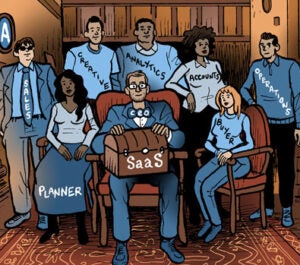
The operations side will be focused on client solutions, he said, making it easier to integrate Concord into their workflow. Concord currently operates as a SaaS platform, but will eventually function almost exclusively as headless architecture (that is, infrastructure that can be bought separately and integrated via API) that clients can embed directly into their own agentic stack.
That won’t be an immediate transition, but SaaS is nearing the end of its era, Venezia said.
Concord is already seeing an increase in headless architecture sales, he said. But he expects demand for headless solutions to really pick up in the coming years once companies have built their own agentic stacks and Concord has white-labeled more of its own tools.
SaaS businesses might need to reckon with their business models as the industry trends toward new expectations. Clients want to build out their own AI tools and infrastructure, said Venezia, which will require a different monetization model and the ability to buy infrastructure directly.