
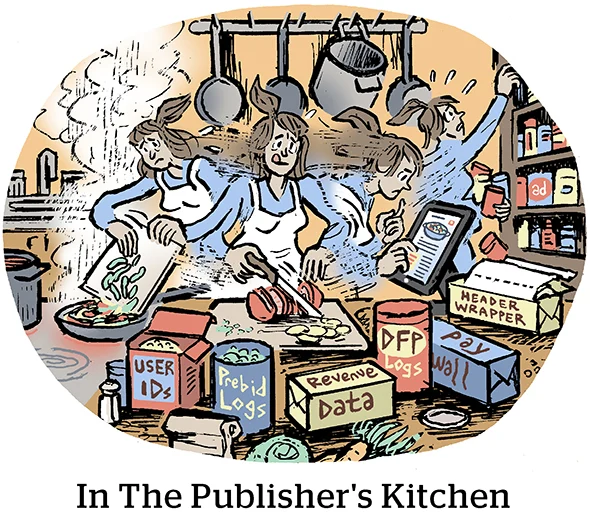
For all the advancements in programmatic ad tech, buyers’ expectations haven’t changed much: They still want a single, coherent view of reach and performance.
But for publishers, the operational reality is messy, with inventory spanning print, web, social, streaming and newsletters, each with their own currency and blind spots. Stitching these audiences together requires organizing a patchwork of first-party data signals into something a buyer can actually plan against. And more publishers are relying on AI to make these connections.
At Trusted Media Brands (TMB), sales teams have to find audiences across a portfolio that ranges from its century-old flagship, Reader’s Digest, to brands that span print and digital, like Taste of Home, to social and streaming properties, like FailArmy and The Pet Collective. Magazine subscribers, site visitors, social scrollers, FAST-channel viewers and newsletter loyalists all surface in different dashboards that lack a shared measurement language.
“The magazine subscriber doesn’t look anything like the TikTok viewer, at least on paper,” said Michael Boccacino, VP of marketing at TMB. “But advertisers still expect you to tell one clear story about who you reach and why it matters.”

At TMB, that work sits with research, insights and revenue teams. Their job is to reconcile the different verticals into a narrative that emphasizes where the audience is genuinely engaged, not just where the biggest number appears. And these teams are increasingly relying on AI tools to tell that story.
Making sense of the mess
TMB is using AI in parts of the business where there are clear bottlenecks: synthesizing performance data, accelerating creative development and experimenting with more automated planning.
On the ad sales side, TMB is using a generative AI tool provided by Jasper.ai to help its team parse large performance data sets – including spreadsheets of URLs, engagement stats and traffic sources – and turn them into narratives for advertisers.
“If you give Jasper a thousand lines of content and performance data, it can help you spot patterns a lot faster,” Boccacino said. “It’s not deciding strategy, but it’s surfacing what’s working so a marketer can tell a smarter story.”
That means non-analysts can quickly answer questions like which kinds of stories drive performance for certain audiences or which creators and formats tend to correlate with longer view times, he said. The result is faster, more data-driven RFP responses without requiring every marketer to become a full-time data scientist.
Internally, TMB is also testing AI for media planning, inventory checks and reporting. The publisher expects more buying to be automated or mediated by agency-side tools going forward, Boccacino said, and it wants to have its own complementary sell-side tools.
Meanwhile, building those capabilities in-house on the publisher side gives TMB more leverage with AI tech vendors, according to Boccacino. If a tool doesn’t offer something TMB can’t reasonably build itself, or isn’t clearly differentiated, it’s a tough sell.
“In a world where AI makes it cheaper to build more on your own, the bar for signing new partners is only going up,” he said. “The value has to be obvious, or we’re better off investing in our own stack.”
First-party data threads
First-party data is the starting point for how TMB weaves its audience narratives. Instead of focusing on the largest cross-platform audience, TMB is building around signals that demonstrate high-intent, repeat or action-oriented behavior.
TMB uses Permutive as a data partner on the web side to better understand who is visiting its sites, then layers in internal analytics and platform-level performance, including social and streaming data. From there, TMB’s audience teams identify which environments consistently drive repeat usage, longer sessions or actions like newsletter sign-ups.
Speaking of newsletters, those audiences don’t deliver the largest raw reach in TMB’s portfolio, Boccacino said, but they punch above their weight in terms of intent. “Open rates and click-throughs are meaningfully higher than what you’d see on the site, and that’s compelling when you talk about outcomes instead of just impressions.”
Newsletter audiences are also a hedge against SEO and AI-driven changes in search, Boccacino said, where evergreen recipe or service content can be replicated by search engines and generative answer boxes. Direct, opt-in relationships matter more when content discovery is in flux, he added.
Meanwhile, social media and CTV can generate massive reach in lean-back environments, Boccacino said, albeit often with lower engagement than TMB sees from its newsletters.
And web audiences still work within a familiar set of KPIs that includes unique site visits, with ad performance measured using viewability and maybe an attention metric or two, he said. However, print, social video, CTV and newsletter data is typically not directly comparable to web data.
All that media fragmentation forces publishers to make trade-offs in how they present themselves to the market. Do they lead with the biggest number, even if it represents shallow attention? Or do they foreground smaller, higher-intent surfaces and risk looking “small” in an RFP stack?
“You can’t just point at Comscore or a single platform dashboard and call it a day,” Boccacino said. “Performance lives in different systems, under different definitions of attention, and you have to do the stitching yourself.”
The need to make sense of these discrete data signals when crafting a sales story creates new demands on the organization. Teams need to mine their data faster, turn disparate performance logs into usable insights and respond to RFPs with more than generic reach slides.
“It’s not about abandoning scale,” Boccacino said. “It’s about being honest about where the relationship with the audience is strongest, and pricing and packaging around that instead of around the loudest number.”