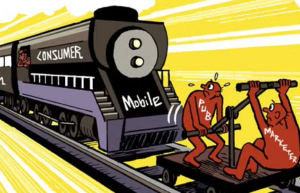
Even as mobile real-time bidding gets more attention, the obstacles currently in its path will continue to prove challenging, says Brian Monahan, managing partner of IPG’s Magna Global.
The media shop’s research unit just unveiled its twice-annual Media Economy Report, which details the promise and the problems of mobile advertising. As Monahan pointed out in an interview with AdExchanger, the wide-ranging fragmentation of mobile usage — all the various devices, carriers, apps, browsers — make a seamless, programmatic platform solution eminently desirable. The problem is that when it comes to Apple’s iOS system — which makes up up a large chunk of the mobile usage out there — iOS doesn’t allow for cookies.
“You’d think that machines were set up to sort out these issues,” Monahan said. “Programmatic would be perfect to help mobile achieve even faster spending growth. But the keystone for the ability to do anything programmatically is identity and the ability to track how your ad performed. Outside of contextual and location targeting, you need cookies. And there’s no universal mobile alternative to the cookie — yet.”

Looking at the horizon, Monahan does see Facebook as naturally positioned to help solve the identification issue. After all, aside from having to authentically sign in to use Facebook, many users rely on Facebook Connect to allow them ready access to many of their apps. But privacy concerns have held back any real effort to pursue that.
In the meantime, location is a poor substitute that is unlikely to unlock substantive marketing dollars any time soon says Monahan.
“Location is a signal that could trigger programmatic, eventually and in part,” Monahan said. “But we haven’t figured out how to use that in a smart way, apart being able to say to a user, ‘You’re 100 yards from a Starbucks, here’s a promotion.’ We don’t see that as a big driver of mobile ad spend. I suspect that that will come as retailers do a better job of point of sales. When you figure out the ROI proposition, that’s when the marketing spending will come.”
Aside from Facebook, current hopes for boosting mobile ad revenues are being placed on Apple’s recently introduced “identifier for advertising” (IFA), which acts like a persistent cookie. But again, as Monahan notes, advertisers want something more universal, since the costs of duplicating a campaign for Apple and Google Android’s systems cause a natural aversion to budget-conscious advertisers.
Like Facebook, Amazon recently launched third- party mobile ad network that enables targeting based on the tech giants’ respective user databases. While this is likely to help Amazon gain a greater share of the mobile ad pie, it’s not likely to inspire marketers much either, at this point at least.
Perhaps the best chance for making mobile ad spending more attractive will come from traditional DSPs and mobile DSPs, such as Telenav’s ThinkNear and EveryScreen Media, which Magna’s report mentions are now validating data accuracy and privacy compliance.
There is at least one particular upside to the current state of mobile advertising. As consumers are way ahead of marketers in terms of usage, those marketers who do spend their budgets on mobile are getting more bang for their buck, Monahan says.
When factoring for ad unit attentiveness, Magna’s report estimates that the “cost per attentive second of a mobile ad unit is tied with national TV as the most efficient way to purchase attention.” In other words, a person’s eyeballs are more equal when captured by TV or mobile as opposed to digital in general or print, which because of the mass of spending splashed everywhere, is diminished in value.
Specifically, Monahan says, a second of advertising attention goes for 1/100 penny, whereas a second of mobile ad attention is 1.7x less expensive at 6/1000 of a penny.
“And if you factor in the imbalance between supply and demand, mobile CPMs right now remain one of the biggest bargains an advertisers can get these days,” Monahan says.