After almost 20 years serving as CEO of The Walt Disney Company, Bob Iger will likely step down before his contract expires at the end of this year, The Wall Street Journal reported over the weekend.
But during an earnings call with investors on Monday, Iger chose not to get nostalgic about his entire tenure, or to confirm the rumors at all. Instead, he focused on the last three years, when he returned to the CEO role in 2022 after leaving it in 2020.
When he first came back, the streaming business had lost $4 billion that year, Iger said, and required massive organizational restructuring to “create more accountability.”
All that effort seems to have paid off, financially speaking. Last quarter, Disney’s SVOD services grew 11% year over year to more than $5 billion, driven by growth in both subscription and advertising revenue.
For the first quarter of Disney’s fiscal year (which begins in October, not January) total revenue increased 5% to $26 billion.
Ad-venture in the great wide somewhere
Overall, SVOD advertising revenue saw a year-over-year increase of 4% to $922 million.
But not all advertising revenue was generated alike.
Although overall entertainment revenue increased 7% to $11.6 billion for the quarter, entertainment advertising revenue (which includes both streaming and linear networks) decreased 6%. Disney’s executive team chalked this decline up to adverse impacts from 2024’s Star India transaction, 2025’s Fubo transaction and a downturn in political advertising across both years.
Meanwhile, sports had the opposite concerns. The category only grew 1% to $4.9 billion, offset by higher production and programming costs (plus a $110 million loss in operating income from Disney’s spat with YouTube TV). However, sports advertising revenue grew a sizable 10%, which aligns with recent advertising industry trends, as well as Disney’s recent focus on ESPN.
And it’s worth noting that, despite a 13% increase in subscription revenue for entertainment SVOD last quarter to $4.4 billion, Disney will no longer be reporting on subscriber numbers for Disney+ and Hulu moving forward. (Maybe the news that Disney lost subscribers over Kimmel’s suspension had some kind of a chilling effect?)
A whole new world (left to conquer)
Looking ahead to the full year, Disney’s outlook predicts double-digit operating income growth for its entertainment segment, as well as an SVOD operating margin cost of 10%. (As of last quarter, it’s now at 8.4%.)
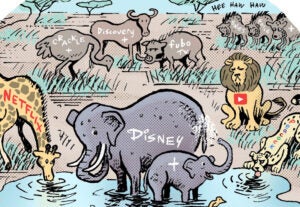
However, expect Disney to continue taking a back seat to the ongoing acquisition battle between Netflix and Paramount over Warner Bros. Discovery.
“I don’t really feel that we have a need to buy more IP,” Iger said on the investor call – ironically, given that he was CEO when Disney acquired Pixar in 2006, Marvel in 2009, Lucasfilm in 20212 and 20th Century Fox in 2019. “We’re just going to continue to create our own and we’ve got an unbelievable bedrock of stories, already told to grow from.”
Instead, Iger’s focus is on continuing to unify the Disney+ and Hulu apps, which will likely happen by the end of the year. Already, adding all of Hulu’s content to Disney+ has reduced churn, and so has bundling Disney with ESPN, Iger said.
And speaking of apps, Iger is still very gung ho on Disney’s three-year licensing deal with OpenAI’s Sora, as well as the idea of bringing short-form, user-generated content to the Disney mobile app – something that’s already worked on the new ESPN app, apparently.
“It’s all, I think, a positive step in terms of adding a feature that we believe will greatly enhance engagement,” said Iger.
Of course, ESPN’s short-form content consists of highlight reels and live reactions – things that naturally appeal to sports viewers on other social media platforms. If the Sora app’s dwindling user base is any indication, even Disney-curated AI content might not be enough to increase users.