

 Publishers looking to maximize their yield need to think more like buyers.
With that goal in mind, Rubicon Project unveiled Ad Engine on Thursday, a beta feature running in its Seller Cloud with NewsCorp as a launch partner. Although Rubicon hasn’t released an official date for when the product will made made generally available, Josh Turner, director of product management for Seller Cloud, said he’s looking at Q1 2015 or “perhaps earlier if we feel like it’s ready.”
Ad Engine aims to go beyond mediation to help publishers optimize revenue across the breadth of their inventory by allowing them to do their own trading and set up their own direct advertising deals in addition to programmatic buys, which they could do already.
The impetus for this feature came from a trend Kaylie Smith, head of Rubicon Project’s Seller Cloud, started seeing several years ago – mostly in Europe – in which publishers attempted to optimize performance by slapping together two or three different demand-side platforms (DSPs) that weren’t necessarily purpose-built to support the publisher community.
“A lot of what they picked off the shelf they had to cobble together with sticky tape and rubber bands to make it work,” Smith said. “It’s something that we’ve seen accelerate in the US this year. We built a platform to meet that market need.”

This may sound somewhat familiar. PubMatic’s CEO Rajeev Goal has been vocal about the importance of “holistic” sales management in both guaranteed and non-guaranteed programmatic. Rubicon has also been talking about this for awhile. Last August, Jordan Mitchell, Rubicon’s VP of product, wrote about the concept of holistic yield management in a column on AdExchanger.
In that piece, Mitchell noted that the “highest bid wins” mentality – aggregating all demand into a single auction with each impressions going to the highest bid – isn’t the best way to go about yield management because it doesn’t take into account the value of rare, what he called “scarce,” impressions.
“Awarding each impression to the highest bidder, without considering scarcity, optimizes your revenue only for that impression,” he wrote. “It does not maximize your revenue overall.”
Although Ad Engine works by creating a real-time unified auction, where buyers compete to purchase inventory, it’s also aware of the supply and demand scarcity, pricing, campaign commitments and the priority of buys.
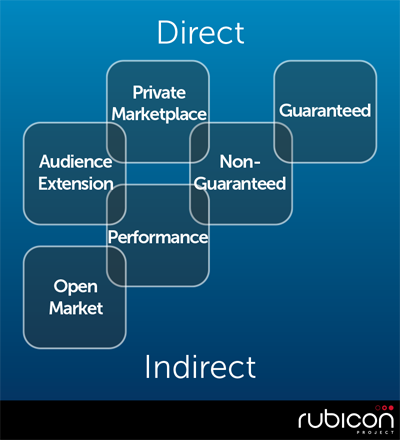 This “intelligent” auction – and the fact that publishers can now optimize their inventory through direct sales, programmatic, guaranteed and everything in-between – is what sets Ad Engine apart, said Turner, as does the fact that it’s all occurring in a unified decisioning platform.
“A lot of the industry thinks of things in terms of direct sales or programmatic, but what we’re doing is direct sales and programmatic,” Turner said. “‘Yield optimization’ as a term is very much still alive, but I would append the word ‘holistic’ to that because it’s no longer just a question of optimizing inventory that publishers can’t sell themselves, but optimizing across everything, including direct sales.”
The platform will also support programmatic direct sales through deal ID.
“Traditionally, Seller Cloud enabled publishers to build out their auction strategy and their deal-based strategy,” Smith said. “But now publishers can package their audience and sell direct to advertisers over RTB pipes. What’s new here is the ability to optimize their own indirect campaigns against all their activity and then manage their yield to get the most out of more impressions in one place. It also opens up new revenue streams.”
The revenue aspect in particular is front-of-mind for NewsCorp, according to its VP of ad marketplaces Charlie Weiss, who said he’s looking to Rubicon for help with growing programmatic revenue through “improved operations.”
“Being able to serve impressions based on what is valuable in a direct versus programmatic marketplace will better position us for growth going into the 2015 calendar year,” Weiss told AdExchanger.
NewsCorp announced in August of last year that it was launching its own global programmatic advertising exchange. Since that time, Weiss said NewsCorp has been “a lot more aggressive with programmatic advertising as a result.”
“In turn, it’s really changed how we look at digital as a whole,” Weiss said. “Improving yield across all channels feeds into this.”






