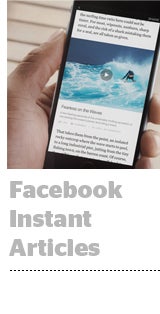
 Facebook has confirmed it will begin displaying publishers’ articles natively in the Facebook mobile app, naming nine initial media partners for the program. (Read the blog post.) Participating publishers are The New York Times, National Geographic, BuzzFeed, NBC, The Atlantic, The Guardian, BBC News, Spiegel and Bild.
“We’ve been comfortable with experimenting with a variety of storytelling platforms over the past few years,” National Geographic Society Chief Media Officer Declan Moore told AdExchanger.
Moore sees opportunities both for monetization and brand-building by participating in the program, which is called Instant Articles. Articles that are part of a user’s daily content consumption increase the likelihood a user will become a member of National Geographic, attend a live event or seek out its content elsewhere, including on TV, Moore said.
The Times likewise sees opportunities to convert readers of Instant Articles, according to a New York Times spokesperson. Facebook accounted for 14 to 16% of traffic referrals in the first quarter. Being on Instant Articles give the Times an opportunity to meet readers where they already are consuming content.
The Atlantic is looking at two metrics to evaluate success with Instant Articles. “What we care about is increasing the audience reach in every way we can, amplifying the brand without cannibalizing the audience on TheAtlantic.com,” Bob Cohn, President and COO of The Atlantic, told AdExchanger. “The other measure of success will be increasing revenue.”
Publishers keep 100% of the revenue from the ads they sell directly on the platform, and 70% of the ad revenue if Facebook sells the ads through its Facebook Audience Network.

Publishers have one distinct disadvantage: They won’t have access to the same level of audience targeting data as Facebook in order to sell ads, according to Re/code. But they can use analytics data, from Google and Adobe, to understand their audience.
The native stories load 10 times faster than linked-out stories. They also have a look and feel that borrows some ideas from Facebook Paper, the social network’s dedicated news reader.
Publishers will be able to use some of these features – like image scrolling and panning – in order to develop a branded look for their articles, even though they’re displayed natively. It’s similar to how Snapchat Discover encouraged publishers to translate their branded look to a Snapchat-friendly format.
“The mobile web is great, but there’s still clunkiness to it,” Moore said. “This offers a smooth navigation, fast rendition of the content, and a real opportunity for us to reach more people with the storytelling,”
The publishers working with Facebook can measure performance of articles using Google Analytics and Adobe Analytics. And comScore will count articles read on the platform toward a publisher’s traffic stats.
National Geographic plans to measure success through audience engagement and monetization. The Instant Articles won’t roll out globally, allowing National Geographic to do A/B comparisons of article performance with and without Instant Articles.
“The data feedback loop that is so important to our company will be equally seamless for content on and off our own website,” BuzzFeed publisher Dao Nguyen and chief of staff Ashley McCollum said in a blog post about the site’s participation in the program.
Banner ad-free BuzzFeed can push sponsored posts out via Instant Articles, tracked through ad server DFP. However, McCollum told AdExchanger the site is being tested and that BuzzFeed has not yet offered such placements to the market.
The Atlantic featured data storage company Seagate as its launch sponsor. The advertiser was already running ads on The Atlantic. Cohn envisions that The Atlantic will sell the ads as part of a separate offering, or perhaps combine it with a mobile campaign for advertisers who opt in.
The standard ad offering for Instant Articles is surprisingly mundane: a 300×250 banner. Facebook itself doesn’t run such ads, and Snapchat Discover required publishers and advertisers come up with native-style ad formats. It’s expected that Facebook will up the ante for ad formats in future iterations of Instant Articles.
Cohn is going into the deal optimistically, but with “eyes wide open.” The favorable revenue sharing, as well as the ability to put analytics tags and ad tags on the Instant Articles pages clinched the deal. Instant Articles is a good opportunity for right now, but one that will be continuously evaluated.