Founded during the dot-com boom as a trade group to support publishers, the IAB turned 30 this year. And the organization, which now welcomes brands, agencies, tech platforms and creators, weathered online critiques leading up to their Annual Leadership Meeting that it had drifted too far from its publisher-focused roots.
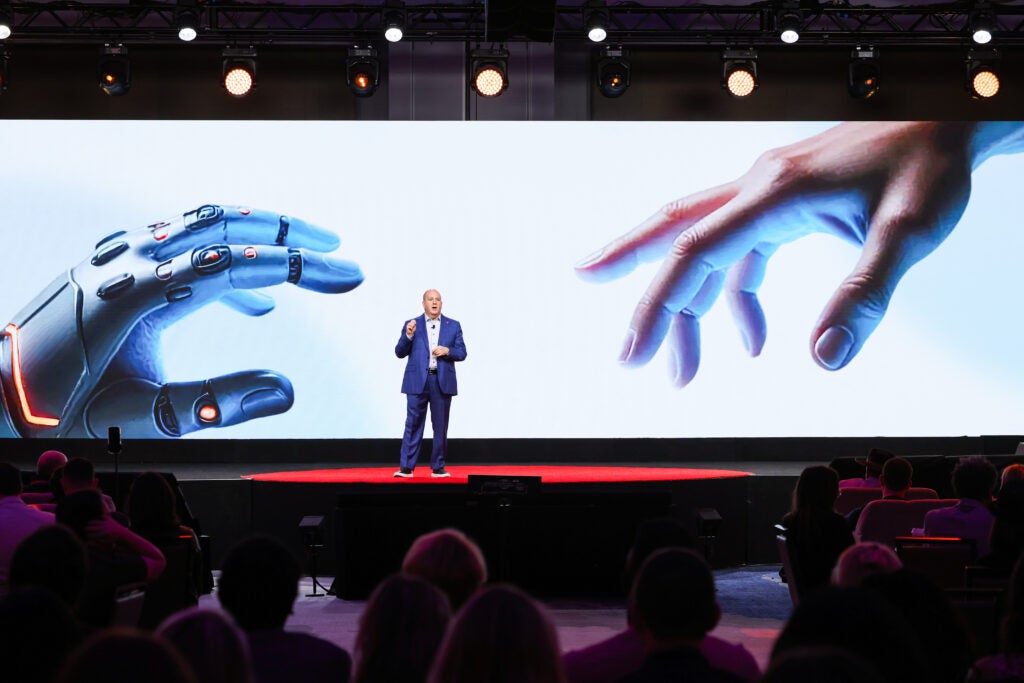
But IAB CEO David Cohen refutes that narrative. “There’s a lot of companies that are hurting in the current environment,” he said in an interview with AdExchanger after his opening speech Monday addressing attendees at the Palm Desert, California, event. “The health of the publisher community is critical to the health of our overall business.”
“If we don’t have publishers, we don’t have content,” he added. “What are we optimizing What are we reading? What are we engaging with? It’s a problem.”
On stage, he railed against AI companies who train their models on publishers’ content without compensating them. “Every single company that is training and building these AI tools without compensating publishers is free riding on their investments,” he said. “Free riding isn’t just unfair. It’s stealing.”
To that end, he introduced Accountability for Publishers Act. The proposed legislation would mandate that companies that use the publisher content to train models –presumably including IAB members like Google – would need to pay for that content.
Cohen spoke to AdExchanger about the IAB’s current priorities, from ensuring that AI companies compensate publishers to the need for standardization in measurement and CTV.

AdExchanger: Coming into this conference, there were LinkedIn debates criticizing the conference agenda for not speaking to publisher needs.
DAVID COHEN: To be in this role, you need super thick skin. I try not to engage, but every so often…I lose control. Going into ALM we wanted two things to come up: Number one, AI is changing the business. Number two, the health of the publisher community is critical to the health of our overall business. If we don’t have publishers, we don’t have content. What are we optimizing What are we reading? What are we engaging with? It’s a problem.
Let’s talk about the AI legislation you announced onstage Monday. You’re looking for a sponsor. What’s the next step?
We announced it to the industry today [Monday], and we announced it to the Hill today, and we have already gotten two Senators’ offices who are interested in talking. We’re talking in a language that they understand, and they’re interested in and they’re looking to lean in.
When you’re announcing something like this AI legislation, it’s going to have implications for your member base on both sides. How did you navigate that?
We did not go to our membership base to tell them exactly what was happening. But I would be really shocked if this was surprising based on the conversations that we had. We talked to the chair and the vice chair and got their blessing. And we’ve been talking to some of our big members about the changes that AI is bringing to publishers in earnest for like two years. I do think that they are listening more than they were before.
A year ago, we were still talking about the Privacy Sandbox and cookies. What difference does it make to have this pending change off the table?
It’s given everyone a sigh of relief. Just looking back a year, people were concerned about what the Privacy Sandbox was, and how it was going to change the business materially. We have been so utterly consumed with AI since that time, we have a whole new set of opportunities and challenges.
We’ve been losing signal on cookies for years before Privacy Sandbox, I’d say AI has the opportunity to change far more than that. The stakes are higher now.
In your opening speech, you talked about pay TV falling below 50% of US households, which will affect local TV stations. What are your biggest CTV priorities over the coming year?
Trying to get CTV to actually deliver on the promise of better personalized, better measurable television. The conversion API (CAPI) work, is a step in that direction. And standardizing ad sides, so you don’t have 15 different ways you can buy CTV, you have six, it’s another big thing. If buyers say that they are creating the same four or six sizes, and if you don’t have them, we’re not going to buy them, I think folks will start capitulating.
The IAB unveiled Project Eidos, to bring more standardization to the industry. What’s next?
We wanted to focus on the question “What’s the future of measurement.” So what does attribution look like? What does MMM look like in an age of AI? What do outcomes look like?
The challenge now is that when we’re not targeting humans, we’re targeting agents. Connecting agents to humans: How does that work? What is the connective tissue between David’s agent and David the person? No one would have talked about David’s agent a year ago. But now we are talking about David’s agent.
Standardization is really hard. The fundamental challenge around standardization is that there are winners and losers when you standardize things. Is a six-second YouTube ad is the same as a classic 30-second TV commercial? Can you talk about what you see as the way through when you have that kind of challenge?
You’re just scratching the surface on the confusion. There’s not good nomenclature for how things are defined in the video space. Forget about the time about six seconds versus 15 versus 30, when we say social video, when we say CTV, are we saying the same thing? I don’t know that we are. So we’re trying to standardize.
There is standardization and innovation, right? So we can have lots of innovation, but now that we have arrived at six standard CTV ad sizes, this business can scale in a much more meaningful way, as opposed to every Tom, Dick and Harry having their own size.
What’s the biggest distraction in the industry right now that people should not be distracted by?
There is a lot of chatter about, “Are you on the adCP train?” “Are you on the IAB Tech Lab train?” “Are you in the Brian O’Kelley camp?” “Or you’re the Tony Katsur camp?”
That whole narrative is boring and time-consuming, and it’s not helpful. We should not glorify that with continuing to talk about that. We’re going to do good work with our members and boards, and we’ll deliver what we believe is the agentic solution that’s going to get the greatest number of the industry in the agentic world quicker. So all this kind of bullshit, to answer your question, is definitely not useful and not helpful.
This interview has been edited and condensed.